

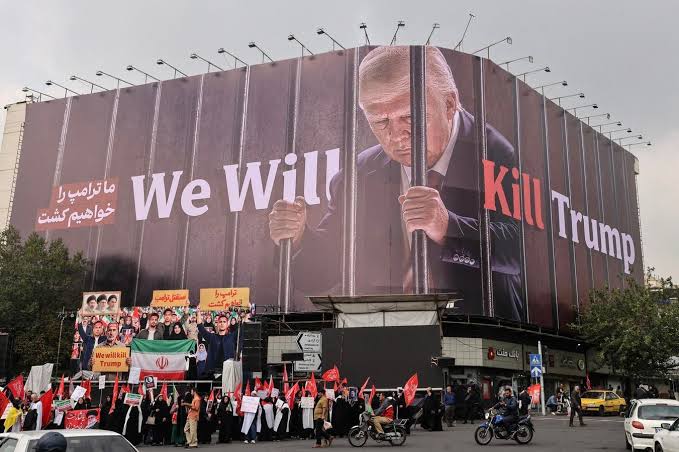
Iran has escalated its anti-American rhetoric with the unveiling of a massive billboard in Tehran carrying an ominous message for US President Donald Trump: “We will kill Trump.”
The provocative display, installed at the busy Enghelab Square in the Iranian capital on Tuesday, depicts Trump sitting behind prison bars with his head bowed. The billboard comes amid the continuing conflict involving Iran, the United States and Israel, with tensions across the Middle East remaining high.
Another display nearby featured Trump alongside US Vice President JD Vance, special envoy Steve Witkoff and Israeli Prime Minister Benjamin Netanyahu. All four leaders were portrayed with bloodied faces and torn suits, against a backdrop of battered American and Israeli flags.
The imagery reflects Tehran’s increasingly aggressive public messaging against Washington and Tel Aviv as the war continues to shape the region’s political and security landscape.
Dozens of people gathered at Enghelab Square following the unveiling of the displays. Some waved red flags and carried banners bearing the words “There will be blood”, while others raised slogans demanding revenge for the killing of Iran’s Supreme Leader Ayatollah Ali Khamenei.
Khamenei was killed in US-Israeli strikes on February 28, an attack that triggered the wider conflict in the Middle East. The Iranian leadership and its supporters have repeatedly vowed retaliation for his killing.
Anti-Trump propaganda spreads across Tehran
The latest billboard is part of a broader campaign of anti-American displays across Tehran, where public spaces have increasingly become platforms for political messaging against Trump and the United States.
At Tajrish Square in northern Tehran, an open-air exhibition featured several paintings targeting the US President. One depicted Trump lying bloodied on the ground with a foot pressing down on his head, while another showed a bomb obscuring his face.
A life-sized replica of a prison cell was also installed at the location, with an actor impersonating Trump spending the day inside it. A screen positioned beside the installation displayed images of destruction attributed to American strikes on Iran.
Tehran has accused Trump of deliberately targeting civilian infrastructure during the conflict, including a school and a wedding ceremony, allegedly killing dozens of people, including women and children.
The displays serve as a reminder of how Iran has sought to turn its public spaces into instruments of political messaging during the conflict.
Threats against Trump emerge amid renewed diplomatic efforts
The aggressive messaging comes at a time when diplomatic efforts to bring Washington and Tehran back to the negotiating table have gathered momentum.
Despite the escalating rhetoric, Trump has indicated that an agreement with Iran remains possible, recently saying that a deal “could happen”. The prospect of renewed negotiations has raised hopes of preventing another round of fighting, although tensions remain unresolved.
The conflict has also had consequences well beyond the Middle East, disrupting regional stability and contributing to rising global prices.
Trump is also facing crucial US midterm elections on Tuesday, with voter discontent over the Iran war emerging as one of the issues weighing on the political landscape.
Iran’s long history of anti-American displays
Anti-American and anti-Israeli murals, billboards and public installations have been a recurring feature of Iran’s political landscape since the 1979 Islamic Revolution.
The country’s public spaces have frequently been used to honour military figures, celebrate political allies and communicate hostile messages towards countries regarded as adversaries by Tehran.
The latest display targeting Trump follows this established pattern. However, its explicit threat against a sitting US President stands out for its unusually direct language.
As diplomatic manoeuvring continues behind the scenes, Tehran’s public messaging suggests that its leadership is in no hurry to soften its confrontational posture towards Washington.
