

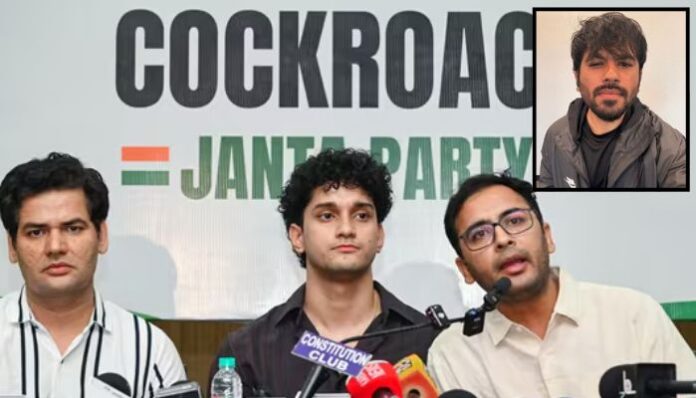
Just days before his planned arrival in India, Cockroach Janta Party (CJP) founder Abhijeet Dipke admitted on camera that he has not yet obtained police permission for the protest he intends to organise in Delhi, despite prior approval being a standard requirement for public demonstrations.
On Wednesday, 3rd June, during an interview with journalist Ajit Anjum, Dipke was asked whether he had taken the necessary police permission for the proposed protest. In response, Dipke replied, “No.”
CJP only wants to do Drama, not Protest
— Ankur Singh (@AnkurSingh) June 3, 2026
Anjum- Have you taken Police Permission required to organise Protest?
Dipke- No
Anjum- it's procedure to obtain prior permission and give undertaking of how many people will be there, timing of protest, etc.
Dipke- I will go to Police… pic.twitter.com/Zh2EiAMxQn
Anjum then pointed out that organisers are generally required to seek permission in advance and provide details such as the expected number of participants, the timing of the protest and other logistical information. Dipke responded that he would go to the police station on the same day and ask for permission.
Anjum countered that same-day permissions are generally not granted and questioned why the application had not been submitted earlier. Dipke replied, “I will wait in the police station till they give permission.” When asked the same question again, he replied, “we want to do things our way, we will stick to that.”
Anjum- CJP has many members in Delhi, why don't they take police permission for protest on 6th?
— Ankur Singh (@AnkurSingh) June 3, 2026
Dipke: we want to do things our way, we will stick to that.
It's very clear that Abhijeet Dipke doesn't want to do peaceful protest. He wants to do chaos and get Detained to show… pic.twitter.com/fD0U83pyDV
Adding to the controversy, CJP held a press conference on Wednesday, 3rd June where the party spopkesperson openly questioned the very idea of seeking prior permission for protests. During the interaction, Dipke argued that the existing system makes little sense. He said: “You are asking us to take permission. Tell me, how many months in advance should we apply? Then the permission gets rejected, and then we go to court. Why should we ask for permission in the first place? Does it make sense that you go to Jantar Mantar at 10 in the morning, leave at 5 in the evening, raise slogans and then everything ends there? Is that how protest works in a democracy? That is the culture we are fighting against. That has to change.”
CJP Gen-Z nahi Gen-C hai
— Ankur Singh (@AnkurSingh) June 3, 2026
Gen- Chutiya
CJP says why to take police permission before?
Next they will say why file nomination for elections before?
We will go to Election Commission office on morning of Voting. In a Democracy they'll have to allow us to contest elections.
Can… pic.twitter.com/w9U218xPu2
The remarks have further raised questions about whether the group intends to follow established procedures or deliberately challenge them as part of its political strategy.
The motive is to play the victim card
Dipke’s remarks have sparked criticism online as to why permission was not sought in advance if the proposed protest is intended to be peaceful and constitutional.
The motive is so clear that he doesn’t want a peaceful protest; instead, want to create drama and play the victim card that if permission is denied due to procedural issues, he could later claim that authorities blocked the protest. It most likely gives the impression that Dipke is preparing for a confrontation with authorities rather than ensuring all procedural requirements are completed beforehand.
There’s also another question: why members or spokespersons associated with the Cockroach Janta Party could not have completed the permission process before he arrived in India.
Dipke announces protest at Jantar Mantar on 6th June
The controversy comes shortly after Dipke announced on 1st June, through social media, that he would return to India from the United States on 6th June and lead a protest in New Delhi.
In a video posted on X, Dipke urged supporters to assemble at Delhi airport upon his arrival before proceeding to Parliament Street Police Station to seek permission for a protest. While he repeatedly described the event as “peaceful” and “constitutional”, critics argue that the call appears to be an attempt to sustain momentum through street mobilisation after online campaigns failed to generate the desired political impact.
Important announcement:
— Cockroach is Back (@Cockroachisback) June 1, 2026
CJP Founder @abhijeet_dipke will return to India on June 6 for a peaceful protest at Jantar Mantar, Delhi, demanding the resignation of the Education Minister. pic.twitter.com/x9M1v38Pwu
The proposed demonstration aims to demand the resignation of Union Education Minister Dharmendra Pradhan over alleged irregularities in examinations such as NEET, CBSE, CUET, and SSC GD.
Nevertheless, by calling on students and supporters from across the country to gather in the national capital, Dipke appears to be testing whether the outrage cultivated online can translate into visible pressure on the streets.
The 6th June mobilisation is being closely watched because it marks an attempt to take a movement that gained attention largely through social media and convert it into a ground-level demonstration in the national capital.
