

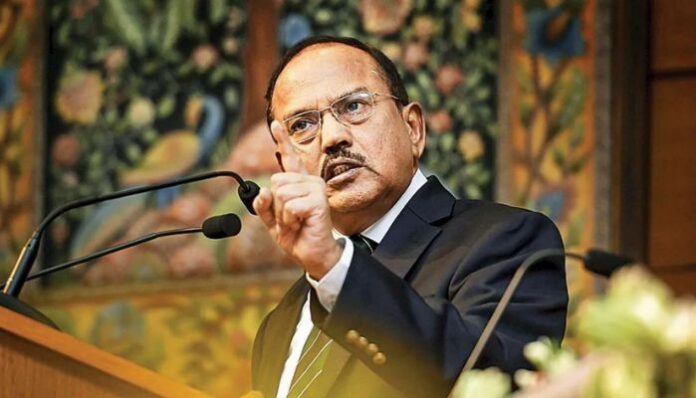
On Saturday, 10th January, National Security Advisor (NSA) Ajit Doval said that India’s freedom was not achieved easily and came after generations of suffering, humiliation and destruction. Speaking at the opening ceremony of the Viksit Bharat Young Leaders Dialogue, Doval urged young Indians to understand the painful lessons of history and use them as strength to rebuild the nation.
He said that today’s independent India often forgets the sacrifices made by earlier generations. “This country was not always as free as it looks today. Our ancestors paid a huge price for it,” Doval said. He spoke about the hardships people faced during centuries of foreign rule, including executions, destruction of villages and loss of cultural heritage.
‘History should ignite fire in today’s youth’
Doval said India’s past should not be remembered only with sadness, but should inspire action. “Many people were sent to the gallows. Villages were burned. Our civilisation was damaged. Temples were looted, and people could do nothing but watch,” he said. According to him, this painful history should ignite a fire within every young Indian.
While acknowledging that the word “revenge” may sound harsh, Doval said it carries a powerful meaning in this context. “Revenge is not an ideal word, but it is a powerful force. We must take revenge for our history,” he said. He explained that this did not mean violence, but rebuilding India into a strong and confident nation based on its own values, rights and beliefs.
Lessons from a peaceful but vulnerable civilisation
The NSA also spoke about India’s ancient civilisation, describing it as advanced and peaceful. He said India never invaded other lands, destroyed temples, or looted foreign nations, even at a time when much of the world was still developing.
India’s NSA Ajit Doval’s powerful statement: “We were a very advanced civilization. We never broke anyone's temples. We did not attack any foreigners even when the rest of the world was weak we did not understand the threats to our security. And so history taught us a lesson.” pic.twitter.com/6ngW2VDx5W
— Aditya Raj Kaul (@AdityaRajKaul) January 10, 2026
However, he warned that India’s biggest mistake in the past was ignoring threats to its own security. “We failed to recognise dangers to ourselves. History punished us for that neglect,” he said. Doval stressed that forgetting these lessons would be the greatest tragedy for future generations.
“Did we truly learn from history? Will we remember these lessons? If future generations forget them, it will cost the country dearly,” he warned.
Talking about the India’s economy, he said, “A Cambridge University professor was asked to do a study on this, and he later wrote a book, World History of Economy, covering the 1st to the 19th century. He stated that for 1,700 years, most of the time India, and sometimes China, led the world economy, together accounting for 55–60 percent of it.”
VIDEO | Delhi: NSA Ajit Doval at the Viksit Bharat Young Leaders Dialogue says, “You will all witness the India we are imagining. But this will not be the first time this has happened with India. When Japan was rising, the West began discussing whether an Asian country could move… pic.twitter.com/XoKcF1neRJ
— Press Trust of India (@PTI_News) January 10, 2026
“India has seen many successes. We were once at the peak of science, economy, and technology, but we declined because nothing is permanent. That is a perpetual struggle. Nationhood and the nation itself require continuous effort to remain strong, and that struggle never ends,” he added.
Viksit Bharat Young Leaders Dialogue
“The Viksit Bharat Young Leaders Dialogue 2.0 started on Saturday, 10th January, at Bharat Mandapam in New Delhi and continues until the 12th January. The first edition of the same was organised at the same venue in January 2025. This event encourages young leaders to participate in the conceptualisation of a strong and self-dependent future for the country of India.”
