

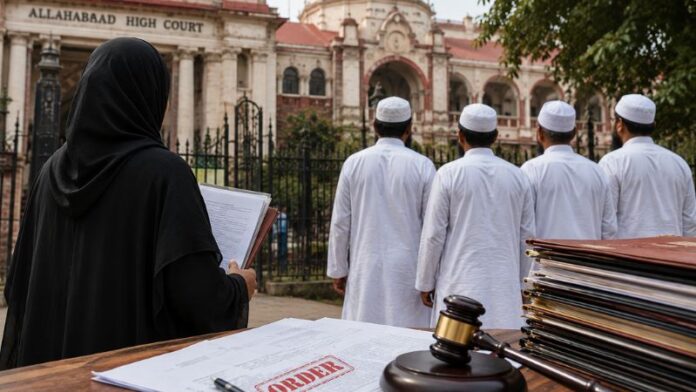
The Allahabad High Court has ruled that personal or religious law cannot be invoked to shield criminal offences committed under the guise of Nikah Halala. The Court held that if the allegations disclose offences under the Bharatiya Nyaya Sanhita (BNS) or the Protection of Children from Sexual Offences (POCSO) Act, criminal law will prevail over personal law, and neither investigation nor prosecution can be halted on religious grounds.
A Division Bench of Justice J.J. Munir and Justice Tarun Saxena dismissed all four petitions seeking the quashing of the FIR, observing that the allegations are serious and warrant a full investigation. The Court clarified that at the FIR stage, it is not required to determine whether the allegations are true, but only whether they disclose a cognisable offence requiring investigation.
What did the High Court say?
The High Court held that if a crime is committed in the name of Nikah Halala or any other religious practice, it will be governed by criminal law. Personal law cannot be used to seek immunity from prosecution.
The Bench further observed that if sexual intercourse is forced upon a minor girl under the pretext of Nikah Halala, the provisions of the POCSO Act would apply. Referring to the Supreme Court’s 2017 judgment in Independent Thought v. Union of India, the Court reiterated that sexual intercourse with a girl below 18 years of age cannot be justified under any personal law.
Background of the case
According to the FIR, the complainant was married to Azhar Nawaz in April 2015 when she was around 15 years old. In January 2016, Azhar divorced her through triple talaq. The woman alleged that she was then compelled to undergo Nikah Halala by marrying Maulana Qayyum so that she could remarry Azhar. She was subsequently remarried to Azhar in 2017. The High Court noted that the complainant was a minor during the first Halala, indicating that the case may involve statutory rape.
According to the FIR, after Azhar divorced her again in 2021, he wished to resume cohabitation with her. The complainant alleged that Azhar’s brother, Shahnawaz Chaudhary, and a relative, Hakim Nishat, told her that since she had been divorced twice, she would have to undergo Halala twice. She alleged that in February 2025, the two men raped her after threatening to kill her and her daughter.
The complainant also alleged that Maulana Nadeem, with the assistance of Aqeel, Shahnawaz Chaudhary, Hakim Nishat and Azhar Nawaz, conducted a sham marriage to falsely convince her that she had been validly remarried to Azhar, after which she was asked to resume marital relations with him.
On December 9, 2025, an FIR was registered at Saidangali Police Station in Uttar Pradesh’s Amroha district against nine accused, including Tayyab, Shahnawaz Chaudhary, Hakim Nishat, Asim, and Murtaza alias Qari Murtaza. The FIR invokes multiple provisions of the BNS, the Muslim Women (Protection of Rights on Marriage) Act, 2019, and the POCSO Act, alleging repeated rape spanning nearly a decade.
The accused sought quashing of the FIR, contending that Nikah Halala is recognised under Muslim personal law and that triple talaq was legally valid in 2016. They also claimed the FIR was motivated by disputes over child custody and property, while some argued that their role was minimal.
Why did the High Court refuse to quash the FIR?
The High Court held that it cannot assess the truthfulness of the allegations at this preliminary stage. It found that the FIR and the complainant’s statements disclose a prima facie case involving grave offences.
The Bench observed that the record indicates the complainant was a minor during the first Halala, raising the issue of statutory rape, while the allegations relating to the second alleged Halala include gang rape.
The Court emphasised that the veracity of these allegations can only be determined through a proper police investigation and trial. Therefore, it refused to interfere by quashing the FIR.
Constitutional values highlighted
The High Court also reflected on the constitutional implications of the allegations, observing that the facts disclosed in the record portray a section of society far removed from the constitutional ideals of equality, privacy, and individual dignity enshrined under Articles 14 and 21 of the Constitution.
The Bench remarked that the prima facie facts emerging from the record are “shocking to the conscience” and depict circumstances inconsistent with the constitutional vision of equal dignity and personal liberty.
