

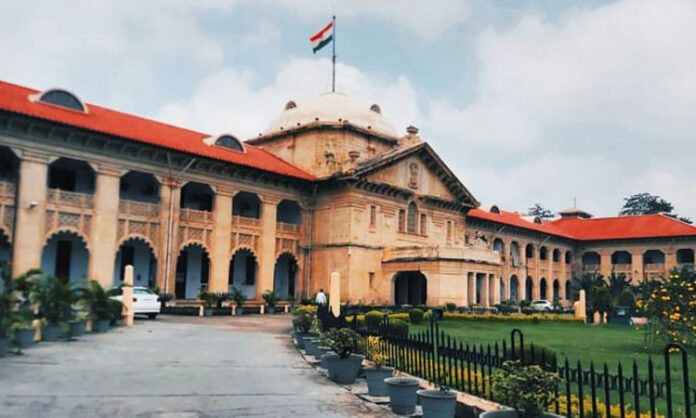
The Allahabad High Court has dismissed a public interest litigation (PIL) challenging the National Board of Examination in Medical Sciences’ (NBEMS) decision to sharply reduce the qualifying percentiles for NEET-PG 2025, holding that the plea lacked factual substance and raised issues already settled by judicial precedent.
The petition, filed by advocate Abhinav Gaur, questioned NBEMS’ notification dated January 13, 2026, which revised the qualifying cut-offs for postgraduate medical admissions across all categories. Under the revised norms, the qualifying percentile for the general category was reduced from the 50th to the 7th percentile, for persons with disabilities from the 45th to the 5th percentile, and for candidates belonging to SC, ST and OBC categories, including those with benchmark disabilities, to zero percentile.
Gaur contended that the decision was arbitrary, discriminatory and violative of Article 16 of the Constitution. He sought a declaration that the revised cut-offs were unconstitutional and prayed that all admissions made on the basis of the lowered criteria be declared null and void. The petition argued that such drastic dilution compromised merit in postgraduate medical education and could have serious implications for public health.
A key allegation was that the relaxation was designed to benefit private medical colleges, as seats in government institutions had largely been filled. The petitioner also challenged the rationale for prescribing different qualifying percentiles for different categories, arguing that if a zero percentile was permissible, it should be uniformly applied across all categories rather than selectively.
Opposing the plea, counsel for the Union of India and NBEMS submitted that the issue was no longer open for debate. They pointed out that an identical challenge had already been rejected by the Delhi High Court in Sanchit Seth vs National Board of Examination in Medical Sciences, where the court upheld the revised cut-offs as a policy decision taken after due deliberation to ensure optimal utilisation of vacant postgraduate seats.
A division bench comprising Chief Justice Arun Bhansali and Justice Kshitij Shailendra noted that the petitioner had failed to place any material on record beyond the impugned notification to substantiate allegations of arbitrariness, mala fides or constitutional violation. The court observed that no empirical data or factual foundation had been provided to support the sweeping claims made in the PIL.
The bench also remarked that the litigation appeared “only academic in nature”, noting that the petitioner, being an advocate, had no direct stake in medical education. It further highlighted an inherent contradiction in the submissions, as the petitioner opposed the grant of zero percentile to reserved categories while simultaneously seeking its extension to all categories.
Relying extensively on the Delhi High Court’s reasoning, the Allahabad High Court held that expanding the pool of candidates for counselling did not undermine merit, since admissions would still be governed by inter se merit and candidates would have to complete rigorous postgraduate training.
Emphasising the limited scope of judicial review over policy decisions, the court found no infirmity in NBEMS’ decision-making process and dismissed the PIL. There was no order as to costs. The judgment was pronounced on January 27, 2026.
