

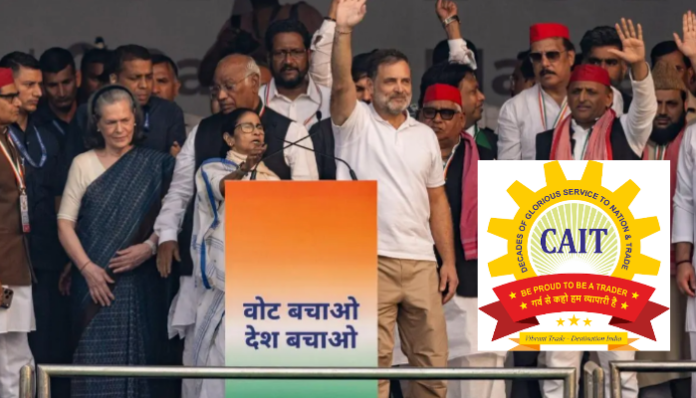
The Confederation of All India Traders (CAIT) has sent a strongly worded letter to Rahul Gandhi on 5th November (Thursday), highlighting its “deep anguish and resentment” over the repeated disruptions to businesses across the country over the past month. It pointed to the Congress-led I.N.D.I. Alliance’s program on 1st November and the continued support for agitations in different parts of the country, which have taken a heavy toll on the business community, especially during the festive season.
The communication read, “We are writing to express the deep anguish and resentment of the trading community, not merely in Delhi but across the country, over the repeated disruption of commercial activities caused by political rallies, protests and demonstrations, including your rally held in Delhi on November 1, 2026, and the continued support extended by you, the Congress party and other allied political parties to demonstrations organised by various groups over the past month.”
The Confederation of All India Traders (CAIT) has written a letter to Rahul Gandhi, Leader of the Opposition in the Lok Sabha, expressing the deep anguish and resentment of the trading community across the country alleging the repeated disruption of commercial activities in Delhi due to political rallies, protests and demonstrations over the past month. In the letter, CAIT has questioned the Congress rally held on November 1, 2026, and the continued support extended by the Congress Party and other political parties to demonstrations organised by various groups during this period.
— ANI (@ANI) November 5, 2026
According to CAIT, the freedom to protest is secured by the Constitution, but it cannot be used as a permit to consistently interfere with the right of millions of people to make a living. “Let us make it absolutely clear that we fully respect every citizen’s constitutional right to freedom of speech, expression and peaceful protest. These are fundamental pillars of democracy. However, the right to protest cannot become an unrestricted licence to disrupt commercial activity, obstruct public movement or deprive millions of citizens of their right to earn a livelihood,” the letter emphasised.
It cited the Constitution’s Article 19(1)(g), which protects every citizen’s right to engage in trade or business and to exercise a profession, charging that this important part has been “conveniently overlooked” by Gandhi, his party and the opposition who have been backing these agitations “in the name of championing the right to protest.”
The letter outlined, “The repeated protests, rallies, demonstrations and road blockades over the past month, particularly during the crucial festive season, have caused considerable losses to Delhi’s trading community. Thousands of traders, shopkeepers, street vendors, transporters, daily wage earners and their families have suffered. Customers and business visitors coming from across the country have also faced enormous inconvenience.”
CAIT then posed a series of enquiries to the Leader of the Opposition in the Lok Sabha, asking, “Is the right to protest more important than the right to trade and earn a livelihood? Why should traders and working families pay the price for political disagreements in which they have no involvement? Do you consider it politically and morally justified to disrupt the commercial life of the national capital? Who will compensate the traders and small businesses for the considerable losses suffered due to these repeated demonstrations?”
It also called out the Gandhi scion’s alleged appeal to the protesters to purchase from local stores, questioning, “How do you reconcile your appeal to rally participants to shop from local markets with your rally and support for demonstrations that prevent customers from reaching those very markets? Is this not a contradiction in your own position?”
The letter raised the issue of whether the grand old party and its former chief were willing to take responsibility for the heavy losses suffered by businesses. It conveyed, “Do you and the Congress party take responsibility for the economic hardship caused by protests supported by your party and its political allies? Or are the livelihoods of ordinary citizens merely collateral damage in political battles? Would you support the same kind of prolonged disruption if your own business, livelihood or daily earnings were affected? Why should a small trader be expected to silently bear what others would never accept for themselves?”
CAIT mentioned Gandhi and reiterated that while political parties have the democratic right to protest the government, hold demonstrations, and raise public issues, their political leadership also involves responsibility and consideration for the average citizen, and a city’s economic life shouldn’t be held captive by any political party, organisation, or pressure group.
It appealed, “We therefore urge you and the leadership of other political parties to ensure that demonstrations are held at designated locations, without obstructing commercial areas, public movement and the livelihood of ordinary citizens. Equally, political parties must refrain from encouraging activities that impose an avoidable economic burden on traders and working families.”
The letter further noted that Indian traders cannot be treated as collateral damage in political disputes and should be treated with the same constitutional consideration as those using their right to protest, as they contribute to the country’s economic development, employment and prosperity, adding, “We expect you to introspect and respond to these concerns with the seriousness they deserve.”
“Political opposition may be your democratic right, but protecting the livelihood of citizens is equally your political and moral responsibility. The right to protest cannot be exercised by taking away someone else’s right to earn. Democracy must protect both the voice of the protester and the livelihood of the trader. We look forward to your response and, more importantly, responsible action,” it concluded.
The letter was signed by BC Bhartia, National President of CAIT, which is an “apex body of trade federations, associations and small-scale sector of India.” Additionally, CAIT announced plans to hold a nationwide Dhikkar Diwas (Day of Condemnation) in response to the issue. Its date will be decided upon at an upcoming national meeting in New Delhi.
Traders had voiced concerns even before the political gathering in the national capital. In multiple letters to Gandhi, the Chamber of Trade and Industry (CTI) stated that the event might impede access to about 20 important marketplaces close to Ramlila Maidan, affecting 80% of their business. It calculated that daily transactions over the holiday season, valued at Rs 10,000-12,000 crore, could be at risk.
