

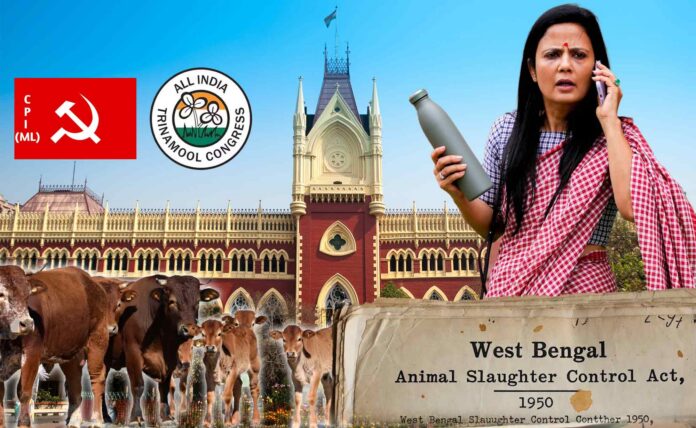
A Division Bench of the Calcutta High Court on Thursday dismissed a batch of petitions challenging the West Bengal government’s recent public notice imposing restrictions on cattle slaughter ahead of Eid-ul-Adha (Bakr Eid). The court observed that sacrificing a cow is “not part of any religious requirement/festival” and directed the State to amend its notice accordingly.
The bench comprising Chief Justice Sujoy Paul and Justice Partha Sarathi Sen was hearing the lead petition titled Ramkrishna Pal v. The State of West Bengal & Ors, along with connected matters. The petitioners included Trinamool Congress (TMC) MP Mahua Moitra, TMC MLA Akhruzzaman, along with representatives from the Communist Party of India (Marxist-Leninist) Liberation, cattle traders, and others.
The petitioners challenged the West Bengal government’s public notice dated 13 May 2026 issued under the West Bengal Animal Slaughter Control Act, 1950. The notice mandated that bulls, bullocks, cows, calves and buffaloes could not be slaughtered without a “certificate of lack of fitness” issued by a competent authority, and that such slaughter could take place only in government-approved slaughterhouses.
The petitioners contended that the restrictions violated their religious rights under Article 25 of the Constitution and sought an exemption for Qurbani (animal sacrifice) during Eid-ul-Adha, scheduled for 27-28 May 2026. They argued that sacrificing larger animals such as buffaloes or bulls was an economic necessity for the majority of Muslims, as the price of goats and sheep rises sharply before the festival.
Senior Advocates Bikash Ranjan Bhattacharjee and Shadan Farasat, among others, appeared for the petitioners. The State was represented by Senior Standing Counsel Nilanjan Bhattacharya, while the Union of India was represented by Additional Solicitor General Ashok Kumar Chakraborty.
Mahua Moitra’s counsel, Shadan Farasat, argued that qurbani under Islam requires the sacrifice of healthy animals and not old or incapacitated cattle. He urged the Court to invoke the exemption clause under Section 12 of the 1950 Act for Eid-ul-Azha.
Today the Hon’ble Chief Justice of Kolkata heard our petition against the new animal slaughter rules which have practically led to a total ban on the cattle trade. Order is awaited. pic.twitter.com/8cHiC69BLI
— Mahua Moitra (@MahuaMoitra) May 21, 2026
Dismissing the pleas for stay or quashing of the notice, the bench noted that the impugned notification had been issued in compliance with an earlier coordinate bench order in WP 328 of 2018, which had attained finality. The court observed that the Supreme Court has already held that the sacrifice of a cow is not an essential part of the festival of Id-Uz-Zuha (Eid-ul-Adha) and is not a religious requirement under Islam.
While refusing to interfere with the core restrictions, the High Court directed the State government to consider amending the notice forthwith by inserting two additional conditions: (i) slaughter of animals, including cows and buffaloes, in any open public place is strictly prohibited; and (ii) sacrifice of a cow is no part of the festival of Id-Uz-Zoha and is not a religious requirement under Islam.
The court held that the notification was merely a written implementation of directions previously issued by a coordinate bench. The bench said, “If the conditions mentioned in the impugned notice are examined in juxtaposition to the conditions mentioned by this Court in WP 328 of 2018, it will be crystal clear that the impugned public notice is issued for implementing the order passed by this Court in WP 328 of 2018.”
The High Court ruled, “We find no basis to stay or set aside the public notice dated 13.05.2026.” However, the court accepted another PIL seeking stricter implementation of anti-slaughter safeguards.
Granting some relief to the petitioners, the bench permitted the State to decide under Section 12 of the West Bengal Animal Slaughter Control Act, 1950, regarding exemptions for slaughter of animals other than cow for religious purposes and directed that such a decision be taken within 24 hours from the date of communication of the order, keeping in view the impending festival dates. The court noted that Section 12 empowers the state govt to grant exemptions.
