

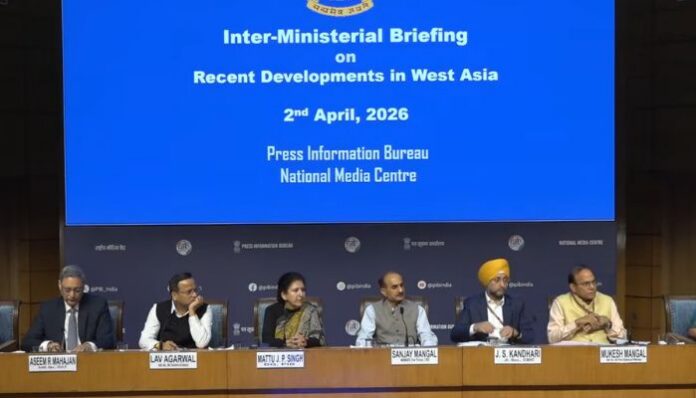
Amid the ongoing conflict in West Asia and its growing impact on global trade and energy supply, the Government of India, on Thursday, 2nd April, held the regular inter-ministerial briefing to assess the situation and outline key measures. The briefing focused on maintaining supply stability, supporting industries, and minimising disruptions caused by the crisis.
One of the major announcements made during the briefing was regarding customs duty relief on critical petrochemical products. Sanjay Mangal, IRS, said the government has decided to provide “full customs duty exemption on critical petrochemical products” for a temporary period of three months, till 30th June, 2026.
#WATCH | At an inter-ministerial briefing on West Asia developments, Sanjay Mangal, IRS , said the Government of India has granted full customs duty exemption on select critical petrochemical products till June 30, 2026, to address supply chain disruptions.
— DD News (@DDNewslive) April 2, 2026
He noted the move… pic.twitter.com/F5tMRYgdQ5
The move has been taken to deal with supply chain disruptions and ensure that industries continue to get essential inputs. The official explained that the aim is to “ensure continued availability of critical petrochemical inputs for domestic industry, reduce cost pressures on downstream sectors and safeguard supply stability in the country.”
This relief is expected to benefit several sectors such as plastics, textiles, pharmaceuticals, chemicals, and automotive manufacturing. It will also indirectly help consumers by keeping prices stable. However, the government also acknowledged that the decision may lead to a revenue loss of around ₹1,800 crore, though the exact impact may vary depending on how the situation evolves.
Trade challenges and strategic concerns
During the meeting, officials highlighted the serious challenges emerging due to disruptions in key global trade routes, especially the Strait of Hormuz. It was noted that nearly “20% of the world’s crude oil, natural gas and LPG” passes through this route, making it extremely important for global supply chains.
For India, the dependence is even higher. Lav Agarwal said that “45% of our crude imports and 90% of our LPG imports normally pass through” this route. With some ports facing closures and disruptions, Indian cargo, especially shipments to Europe and the US, is now taking longer routes, increasing both cost and time.
The government also pointed out that India’s strong trade ties with Gulf countries, worth around $178 billion, mean that several sectors are now under pressure. Industries like gems and jewellery, pharmaceuticals, agriculture (especially rice), engineering goods, chemicals, plastics, and petroleum products are seeing stress due to delays, rising freight costs, and payment issues.
The government’s coordinated response
To handle the situation, the Department of Commerce has already set up an inter-ministerial group in early March. Officials said this group meets daily and includes representatives from multiple departments such as commerce, ports, RBI, finance, external affairs, petroleum, customs, and railways.
#WATCH | At an inter-ministerial briefing, Lav Agarwal said we’re facing challenges in crude oil, natural gas, and LPG, as well as in chemical, petrochemical, and pharmaceutical sectors.
— DD News (@DDNewslive) April 2, 2026
To address this, the Department of Commerce formed an inter-ministerial group in March.… pic.twitter.com/mvEIgedpht
So far, more than 20 meetings have been held to monitor the situation in real time and reduce the impact on trade. A special sub-group has also been created to manage perishable cargo, while a dedicated West Asia crisis desk with a toll-free helpline has been set up to support exporters facing issues.
The government is also working closely with different ministries and industries to track sector-specific problems and provide quick solutions.
Support measures for exporters
The government has introduced several steps to support exporters during this difficult period. Schemes like Advance Authorisation and EPCG have been extended by three months, allowing exporters to import inputs duty-free and manage delays without penalties.
#WATCH | At an inter-ministerial briefing, Lav Agarwal said the Department of Commerce has provided exemptions and interventions to support exporters. Schemes like Advance Authorisation and EPCG allow duty-free import of inputs, and their validity has been extended by three… pic.twitter.com/jLfrwlomES
— DD News (@DDNewslive) April 2, 2026
Officials also highlighted the role of the RoDTEP scheme, under which taxes are reimbursed to exporters. With rates restored from 23rd March, exporters are expected to better handle rising costs related to freight, insurance, and raw materials.
Another key step is the issuance of Export Obligation Discharge Certificates (EODCs), which help exporters release their working capital. Around 12,000 such certificates have been issued in the past month, allowing businesses to reinvest and continue production.
Energy supply remains stable
On the energy front, Sujata Sharma reassured that there is no immediate concern. Officials said India’s crude oil supply is secured for the next 60 days, with sufficient inventories and refineries operating at full capacity.
#WATCH | At an inter-ministerial briefing, Sujata Sharma said India’s crude supply is secured for the next 60 days, with sufficient inventories and refineries operating at full capacity.
— DD News (@DDNewslive) April 2, 2026
She clarified there is no shortage of sulphur, retail fuel outlets are functioning normally,… pic.twitter.com/IxT9TnnHB6
They also clarified that “there is no shortage of sulphur” and that fuel supply across the country remains normal. Despite global volatility, petrol, diesel, and LPG prices have remained stable, with no increase in domestic cylinder rates.
Natural gas supply to households is also fully assured. The government is pushing for the expansion of PNG connections to reduce pressure on LPG demand, along with additional allocation of commercial LPG where needed.
Maritime safety and operations
The briefing also covered the safety of Indian seafarers in the conflict zone. At the meeting, Mukesh Mangal confirmed that all Indian seafarers are safe and that there have been no incidents involving Indian-flagged vessels in the past 24 hours.
Currently, 18 Indian vessels with 485 seafarers are in the Western Persian Gulf region, and authorities are closely monitoring the situation. So far, more than 975 seafarers have been safely brought back to India.
#WATCH | At an inter-ministerial briefing, Mukesh Mangal said all Indian seafarers in the West Asia region are safe, with no incidents involving Indian-flagged vessels in the past 24 hours.
— DD News (@DDNewslive) April 2, 2026
He noted that 18 Indian vessels with 485 seafarers remain in the Western Persian Gulf,… pic.twitter.com/OexUWeYh5e
At the same time, port operations across the country remain normal, with no congestion reported. The government is continuing coordination with various agencies to ensure smooth maritime operations.
