

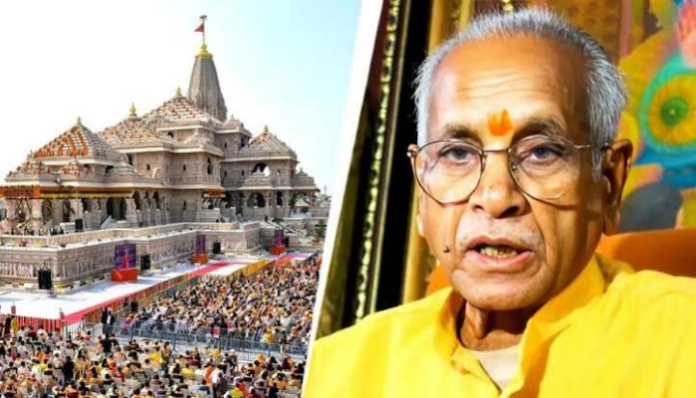
Champat Rai, the former general secretary of the Shri Ram Janmabhoomi Teerth Kshetra Trust, has been granted a clean chit by the Special Investigation Team (SIT) looking into the alleged misappropriation of donations at the Ram Mandir in Ayodhya. On 17th August (Monday), the team’s final report was presented to the trust by the Uttar Pradesh Home Department after reviewing it for future proceedings.
Anil Mishra, a former trust member, has also been cleared by the SIT. The two men had stepped down from their respective positions on 27th June following reports of embezzlement of donations at the temple. Insiders revealed that Rai denied any involvement in the theft of donations at the temple during questioning, reported NDTV.
He maintained that the accused were nabbed as a result of his complaint. The sources mentioned that Rai also informed authorities that it was his duty to make sure that there were no anomalies in the donation collection process and he took prompt action upon learning of the misconduct.
On 13th June, Chief Minister Yogi Adityanath ordered the formation of the first SIT in response to a plea from the trust. It was led by Lucknow Divisional Commissioner Vijay Vishwas Pant, and its members included Inspector General of Police (Lucknow range) Kiran S. and Special Secretary (Finance) Neel Ratan Kumar. A first information report (FIR) was filed in Ayodhya on 25th June, two days after the team delivered its preliminary report to the government on 23rd June.
Trust member Krishna Mohan filed a complaint, which led to the case being filed at the Shri Ram Janmabhoomi police station. Avinash Shukla, Anukalp Mishra, Lavkush Mishra, Manish Kumar Yadav, Karunesh Pandey, Ramashankar Mishra, Subhash Srivastava, and Ram Shankar Yadav alias Tinnu are the eight suspects identified in the FIR.
They have been taken into custody. Other anonymous individuals were also named, and all were booked under relevant provisions of the Bharatiya Nyaya Sanhita and the Prevention of Corruption Act.
According to the preliminary SIT assessment, there were approximately 70 instances of cash theft in the counting room between 27th April and 5th June. CCTV footage reportedly showed workers stealing and hiding money regularly. The probe also asserted violations of the trust and State Bank of India’s established operating practices, such as the absence of sufficient checkpoints at entry and exit spots.
Meanwhile, a second SIT established under the Supreme Court’s supervision is still conducting its investigation. It is headed by Kiran S, who is currently in charge of the investigation in the case filed in Ayodhya.
Background of the controversy
The row erupted on 7th June when Tej Narayan “Pawan” Pandey, a member of the Samajwadi Party, claimed that donations ranging from ₹5 crore to ₹7.5 crore had been stolen from temple offerings. Afterwards, the state government established the SIT on 13th June at the temple trust’s request. A preliminary investigation took place in Ayodhya from 15th to 20th June.
The SIT inspected every step of the contribution management process, including CCTV surveillance, accounting processes, storage, currency counting, collection boxes and access control. The initial inquiry revealed apparent inconsistencies in the manner cash and possessions were handled.
Another layer to the controversy was added when an external audit of the donations conducted last month unveiled that the entire ₹3,300 crore contributed by devotees towards the construction of the Ram Mandir has been completely accounted for. It was executed by independent third-party auditors, M/S V Sankar Aiyer & Co., owing to the mounting accusations.
It was determined that all of the ₹3,300 crores, which included ₹400 crores for site acquisition and ₹1,800 crores for building the structure, was collected through public contributions for the temple and was accounted for and had not been stolen or embezzled. The necessary transfers took place in line with stringent banking and financial procedures, and there were no cash transactions involving these amounts.
On the other hand, the Opposition and its ecosystem seized this issue as a significant opportunity to promote their propaganda. Leaders such as SP chief Akhilesh Yadav leveraged the situation to gain political traction. They persistently added their fabricated figures to amplify the perceived scale of the theft.
Soon enough, the Samajwadi Party and other parties claimed that it was a ₹200-crore “scam” which rapidly grew to ₹2,000 crore after a few days. Predictably, they did not present any evidence to back their accusations.
