

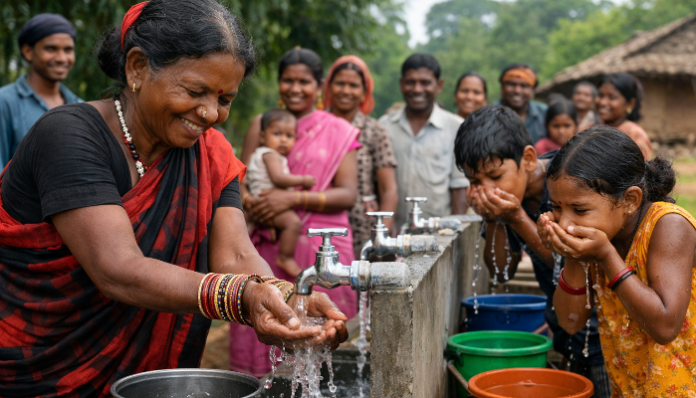
The end of Naxalism in Chhattisgarh has led to noticeable changes in multiple distant areas of the state. Nelangur, a remote hamlet in the Narayanpur district that was previously designated as a “highly sensitive” zone because of persistent Naxal threats, has undergone a dramatic transformation and now has working tap water connections. For locals who had been struggling with acute water scarcity, this is a crucial moment of relief. The vital development was shared by officials on 12th April (Sunday).
They informed that after a protracted battle with a major shortage of one of life’s necessities, every household in the community today has access to tap water for the first time. The event followed the declaration that Chhattisgarh, especially the Bastar region, which has struggled with Left-Wing Extremism (LWE) for more than 40 years, was liberated from the menace on 31st March. The region is divided into seven districts, including Narayanpur.
A government official stated, “Located in the rugged Orchha block near the Maharashtra border, Nelangur was once classified as a highly sensitive zone. The difficult terrain and past security concerns had made the delivery of basic services a monumental challenge for the state administration.”
According to a release from Narayanpur Collector Namrata Jain, the introduction of tap water is a result of persistent administrative initiatives to integrate the state’s most rural corners into the mainstream of development. She expressed, “The water supply system was established under the Jal Jeevan Mission. Water is being lifted from the source using solar-powered pumps and supplied directly to homes through pipelines. This has ensured a steady supply while reducing dependence on the conventional electricity grid.
She mentioned that the project has evolved the lives of the people who live in Nelangur, which is 52 kilometres from the district headquarters. The doorstep supply has enhanced hygiene standards and made daily routines easier for women who used to walk vast distances to obtain water. According to officials, the establishment of a security camp in the village in April of last year by the state police and the Indo-Tibetan Border Police (ITBP) marked a substantial acceleration of the region’s growth.
The Mukhyamantri Bus Seva scheme, which established a regular bus service between Narayanpur and Nelangur, also contributed to improved connectivity. The officials highlighted that the Jal Jeevan Mission’s successful execution in Nelangur demonstrates the government’s presence in border regions and promotes public confidence in the state’s post-conflict reconstruction measures.
On 31st March, Chhattisgarh was deemed Naxal-free after a persistent campaign by the government and the security forces into the strongholds of the red terror movement as many of its cadres and leaders were neutralised or opted to give up their arms. The government had repeatedly assured that the nation will be free from the Naxal violence by 31st March.
“Their Politburo and central structure have been almost completely dismantled. Our goal was a Naxal-free India by 31st March. The country will be informed once the entire process is formally completed, but I can say that we have become Naxal-free. It is the policy of our government that talks are held only with those who lay down their arms and a bullet is answered with a bullet,” Union Home Minister Amit Shah announced in the Lok Sabha.
