

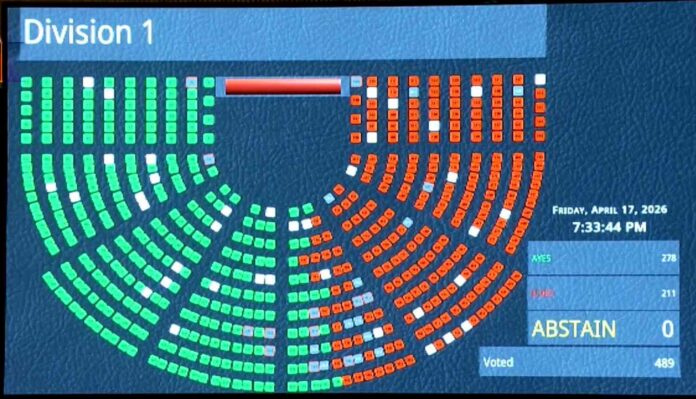
In a significant setback for the central government, the Constitution (131st Amendment) Bill, 2026, failed to pass after it could not secure the mandatory two-thirds majority in the House. With this failure, the Women’s Reservation Act will not be implemented, and the seats of the Lok Sabha will not be increased.
The bill received 278 votes in favour (ayes) and 211 against (noes), with 489 members present and voting and no abstentions. A constitutional amendment under Article 368 of the Constitution requires the support of at least two-thirds of the members present and voting.
Lok Sabha Speaker Om Birla says, "The Constitution (131st Amendment) Amendment Bill did not pass as it did not achieve a 2/3 majority during voting in the House." https://t.co/ucLnUltYnj pic.twitter.com/xcBUJ3RhAv
— ANI (@ANI) April 17, 2026
The legislation, introduced in the Lok Sabha on April 16 along with the Delimitation Bill, 2026, and the Union Territories Laws (Amendment) Bill, 2026, sought to overhaul India’s electoral framework. Key provisions included Removing the freeze on delimitation (based on the 1971 Census) and enabling fresh delimitation of Lok Sabha and state assembly constituencies using the latest census data, increasing the maximum strength of the Lok Sabha from 550 to 850 seats (815 from states and 35 from Union Territories). The bills also sought to adjust the implementation timeline of the 33% women’s reservation in Lok Sabha and state assemblies, enacted through the Constitution (106th Amendment) Act, 2023 by linking it directly to the new delimitation exercise.
The women’s reservation law, notified to come into force on April 16, 2026, had been contingent on delimitation and a subsequent census. The 131st Amendment Bill was intended to clear the path for both seat expansion and the quota’s rollout.
The government had pushed the bills as a package during the special session, arguing they would ensure better representation and fulfil long-pending electoral reforms. However, the opposition, primarily the INDIA bloc, including Congress, strongly opposed the move, describing it as an attack on the federal structure and a potential threat to the political representation of southern states. They forced a rare division of votes even at the introduction stage on April 16.
Opposition leaders, including Rahul Gandhi, had vowed to defeat the bill, calling it an “anti-national act” that could alter the balance of power between states.
The ruling NDA fell short of the required supermajority despite commanding a simple majority in the House. With the constitutional amendment failing in the Lok Sabha, the accompanying Delimitation Bill and related legislation are also effectively stalled.
This marks a rare defeat for the government on a major constitutional amendment and raises questions about the future of the women’s reservation quota, which had received near-unanimous support in 2023 but now faces fresh uncertainty.
