

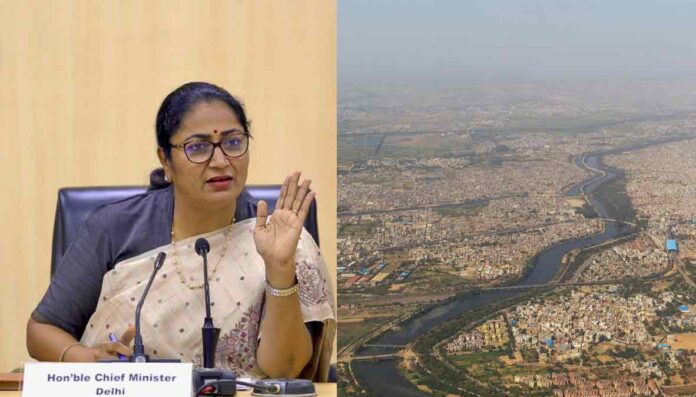
The Delhi government has approved a major ₹860-crore project to reduce pollution flowing into the Yamuna River by setting up 12 decentralised sewage treatment plants (DSTPs) along the Najafgarh drain, which is considered the biggest source of pollution entering the river. The project is part of the BJP government’s larger plan to improve the Yamuna’s condition and increase Delhi’s sewage treatment capacity to 1,250 MGD by June 2027.
The new treatment plants will come up at 12 locations, including Kair, Kakrola, Galibpur, Jaffarpur and Kazipur Shikarpur. Work orders have already been issued for these sites.
Untreated sewage a long-standing problem
Delhi Water Minister Parvesh Sahib Singh said many villages and colonies in the Najafgarh region still release untreated sewage directly into the drain, which finally reaches the Yamuna. He said this has remained an environmental issue for years, and the government is now trying to provide a permanent solution.
The new DSTPs will treat sewage near the source itself before it enters the drainage network, helping reduce pollution load on the river.
The project is expected to improve sanitation facilities in around 120 unauthorised colonies and 27 villages in outer Delhi. Officials also believe it will help tackle regular waterlogging and flooding problems during the monsoon season.
Project under the AMRUT scheme
The entire project will be funded under the Centre’s Atal Mission for Rejuvenation and Urban Transformation (AMRUT), launched in 2015 to strengthen water supply and sewage systems in urban areas.
The approved cost of Rs 860 crore includes the construction of the plants as well as their operation and maintenance for the next 15 years. The company executing the project will also remain responsible for maintaining the facilities during this period.
At present, the Delhi Jal Board operates 27 sewage treatment plants in the city, while 18 of them are currently being upgraded. Last year, the Delhi government had also approved 40 decentralised sewage treatment plants across Delhi.
Officials said Delhi currently has a sewage treatment capacity of around 600–700 MGD. The 12 new plants at Najafgarh will add another 40 MGD capacity.
Why the Najafgarh drain has become a major concern
Named after Mughal commander Mirza Najaf Khan, the Najafgarh drain is the final stretch of the 120-km Sahibi river that starts from the Aravalli hills and flows into the Yamuna after passing through Delhi.
The drain covers a catchment area of about 918 sq km and receives wastewater from nearly 123 smaller drains. The area around Najafgarh in southwest Delhi is densely populated and surrounded by nearly 70 villages.
Officials said increasing wastewater discharge and runoff have put heavy pressure on the drainage system, leading to repeated flooding in low-lying areas.
A recent urban drainage study also found high plastic pollution in the drain, recording microplastic levels of 5,400 MPs/m³ before monsoon and 2,400 MPs/m³ after monsoon. Pollutants included plastic fragments, films, fibres, pellets and foam.
