

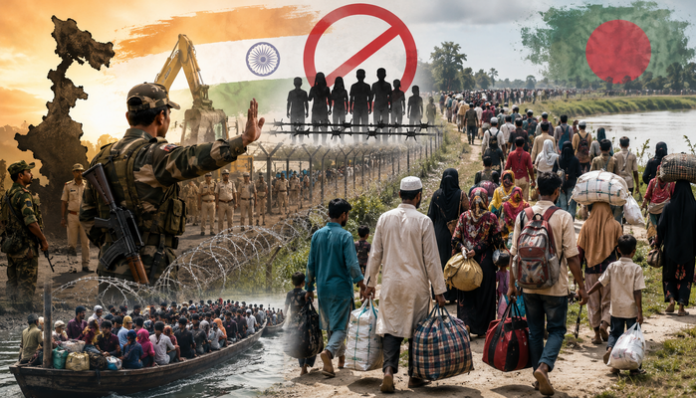
The BJP government’s policy of ‘Detect, Delete and Deport’ on illegal Bangladeshi immigrants in West Bengal has triggered the mass movement of infiltrators compelled to return to their home country. As the government has tightened the noose around illegal immigration, Illegal Bangladeshi immigrants are now flocking near the India-Bangladesh border with their families to head back to their country. This comes after Chief Minister Suvendu Adhikari directed the authorities to set up ‘holding centres’ and speed up the deportation process of illegal immigrants in the state.
According to India Today, hundreds of illegal Bangladeshi immigrants have been arriving at the Hakimpur border in West Bengal’s North 24 Parganas district for the past couple of days. The police have set up a registration desk at the Hakimpur border outpost, where the details of illegal immigrants arriving there are being recorded. The officials are preparing a database by verifying the documents of the illegal immigrants before transferring them to the holding centres. Records of around 350 Bangladeshi infiltrators have reportedly been prepared by the officials since 25th May.
Bangladeshi infiltrators entered India through middlemen
What is alarming is that most of these illegal Bangladeshi immigrants possess Indian documents, including Aadhaar cards, PAN cards, ration cards and even voter ID cards. Some of them arrived in India illegally decades ago, bore children and settled here. This could not have been possible without the support of local politicians. Speaking to India Today, several illegal Bangladeshi immigrants admitted that they got entry into India through agents or middlemen.
“We are poor people. That is why we came here,” an illegal Bangladeshi, Salam Dali, told India Today while waiting near the border with his wife and child. Dali is a carpenter who said he entered India from Khulna district in Bangladesh around five years ago after paying ₹8,000-10,000 to a middleman.
Due to the BJP government’s stringent approach towards the problem of illegal immigration, it has become difficult for illegal immigrants to remain and work in the state. Amid intensified verification and scrutiny, the illegal immigrants are compelled to head back to where they came from.
One Hidoy Mulla, who was born in 2003 to illegal Bangladeshi immigrant parents who came to India in 2001, is unhappy with the government’s policy. Mulla claimed that he grew up in Madhyamgram and possesses Aadhaar, PAN, ration card and school certificates. However, his voter ID applications were reportedly rejected multiple times. He said that since his parents are uneducated, they could not get any documents made.
Another illegal immigrant, Mohammad Shamsur Rahama, his wife Asiya Khatun and his brother Bilal also gathered near the border. The entire family is visually impaired and survives by begging at railway stations and streets in Kolkata. The family claimed they had lived in India for over a decade and had obtained Aadhaar and other documents while staying in the Khardah area.
Infiltrators forged documents and voted in local elections
Mohammad Ali Munshi claims to have been born in India after his father infiltrated the country decades ago. Munshi, who has an Aadhaar card and a ration card, does not want to go back to Bangladesh.
Mafuza Khatun’s story stands out as he claims to have voted multiple times in local elections in West Bengal. Khatun, originally from Bangladesh’s Khulna district, revealed that she got an Aadhaar card and a voter ID card made through local political and municipal channels. “We voted here for years. Now our voter IDs have been cancelled,” Khatun said. Several Bangladeshi women waiting at the border revealed that they had been working as domestic helpers, rag-pickers and labourers in Kolkata’s outskirts.
Many of the illegal immigrants have been shifted to holding centres set up across the North 24 Parganas district. The largest holding centre has been established at Tentulia inside the Pather Saathi building, where officials said 116 Bangladeshis are currently being housed. The authorities have made arrangements for food, medical care and security for those staying in the holding centres. According to officials, more holding centres are being set up to speed up the process of deportation
