

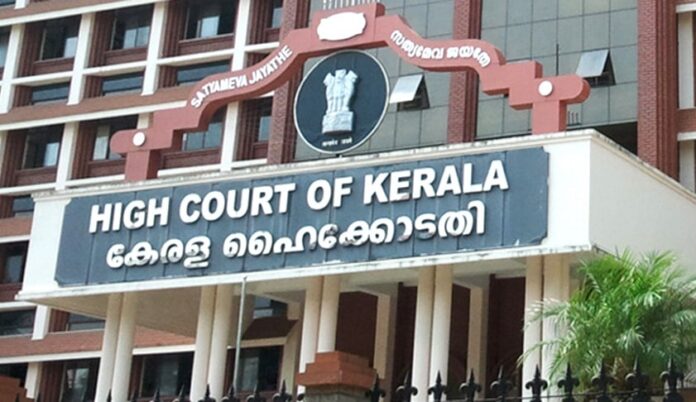
The Kerala High Court has strongly criticised the use of political agitation in educational institutions, observing that protests such as dharnas, hunger strikes and Satyagraha are incompatible with the functioning of academic institutions in a constitutional democracy.
A Division Bench comprising Justices Anil K Narendran and Muralee Krishna S made the observation while setting aside an interim order that had allowed 16 suspended students of Sree Sankaracharya University of Sanskrit, Kalady, to provisionally appear for examinations scheduled to commence on November 4.
The case, Sree Sankaracharya University of Sanskrit v. Archana PS & Ors., arose from a protest organised by students against the university administration. The students were suspended following an incident in which they allegedly conducted a symbolic funeral of Vice-Chancellor Ciza Thomas and subsequently obstructed and assaulted her while she was leaving her office.
Kerala High Court invokes its 2017 judgment against political activities on campuses
While examining the dispute, the Division Bench referred to a 2017 ruling delivered by another Division Bench of the Kerala High Court in Dr Antony Thomas v. VM Muhammed Rafique & Ors. The earlier judgment had taken a firm position against political activities disrupting the functioning of educational institutions and had warned that students participating in such activities could face expulsion or rustication.
Quoting the observations made in that judgment, the Court reiterated:
“Political activities like Dharna, hunger strikes and other practices like Satyagraha have no place in a constitutional democracy, much less in academic institutions.”
The 2017 ruling had further underlined that educational institutions exist to impart education, not to serve as platforms for political mobilisation.
It had cautioned that political parties could not use their influence or ambitions to hold educational institutions hostage or deprive other students of their right to pursue education in a peaceful environment.
The Court also drew attention to the distinction between legitimate constitutional participation and disruptive methods of agitation, emphasising that academic institutions must remain focused on their primary educational purpose.
Court recalls BR Ambedkar’s warning against Satyagraha and civil disobedience
Significantly, the Bench also referred to the words of Dr BR Ambedkar during his historic address to the Constituent Assembly on November 25, 1949, when he spoke about the methods citizens should adopt to preserve democracy.
Ambedkar had argued that people must remain committed to constitutional methods while pursuing their social and economic objectives. He specifically warned against relying on methods such as civil disobedience, non-cooperation and Satyagraha.
The Court reproduced his words:
“If we wish to maintain democracy not merely in form, but also in fact, what must we do? The first thing in my judgment we must do is to hold fast to constitutional methods of achieving our social and economic objectives. It means we must abandon the bloody methods of revolution. It means that we must abandon the method of civil disobedience, non-cooperation and Satyagraha.”
By invoking Ambedkar’s warning, the judgment placed the dispute within the broader constitutional debate on democratic conduct, institutional discipline and the limits of political agitation.
How the dispute involving 16 suspended students unfolded
The present controversy originated on August 13, 2026, when students at Sree Sankaracharya University of Sanskrit organised a symbolic funeral protest while the university’s Syndicate was holding a meeting.
The incident resulted in the registration of two FIRs at the Kalady Police Station.
On September 1, the university suspended 16 students and initiated disciplinary proceedings against them.
An enquiry committee subsequently heard the students on September 29 and 30 and recommended disciplinary action. However, its report could not be placed before the Syndicate for approval until certain procedural defects were rectified.
The suspended students then approached the High Court, arguing that their continued suspension without a final decision in the disciplinary proceedings was adversely affecting their academic progress. They claimed that the protest was intended to highlight inadequate facilities on campus and denied organising a symbolic funeral of the Vice-Chancellor.
With examinations approaching, the students sought permission to appear for them.
On October 30, a single judge allowed the students to provisionally sit for the examinations, prompting the university to challenge the decision before a Division Bench.
Why the Division Bench overturned the interim relief
Challenging the single judge’s order, the university argued that the deadline for examination registration had expired on October 23 and that the students had failed to submit their applications within the prescribed period.
It also highlighted that six of the suspended students were enrolled in doctoral research programmes and were not covered by the examination notification.
As for the remaining students, the university contended that they had neither fulfilled the mandatory 80 per cent attendance requirement nor completed the prescribed internal assessments necessary to qualify for the examinations.
The Division Bench found merit in the university’s submissions and set aside the single judge’s interim order, thereby withdrawing the provisional permission granted to the suspended students.
However, the Bench clarified that its observations were confined to the appeal before it and should not be construed as a final determination of the underlying dispute, which remains pending before the single judge.
The judgment once again brings into focus an important question concerning university campuses: where should the line be drawn between students’ freedom to express dissent and the obligation to maintain discipline and ensure that academic activities are not disrupted?
