

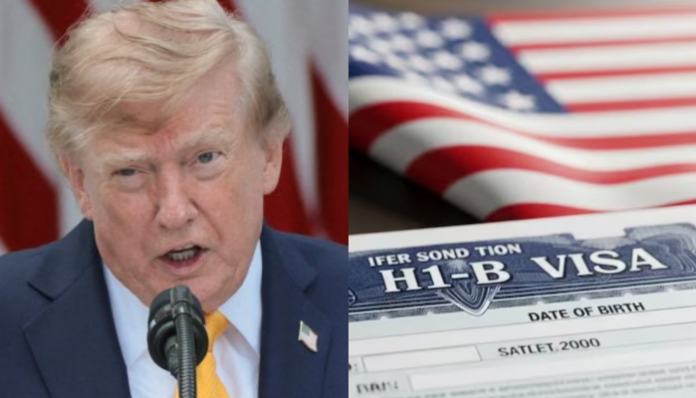
US President Donald Trump has extended the $100,000 payment requirement linked to certain H-1B visa petitions for another year, keeping the measure in place until 21st September, 2027. Along with the extension, the US administration has introduced tighter scrutiny of companies using the H-1B programme.
President #DonaldTrump extended for another year a $100,000 payment requirement for employers seeking to bring certain H-1B workers into the #US, saying the restriction has reduced the reliance on lower-paid foreign labour.#usvisa #H1BVisa https://t.co/H0Lo2X5bDH pic.twitter.com/LcK2qNo9dL
— Business Standard (@bsindia) September 19, 2026
The H-1B visa allows US companies to hire foreign professionals with specialised skills, particularly in technology, engineering and other skilled fields. The programme is important for Indian professionals, who account for the largest share of approved H-1B petitions.
What are the new H-1B rules?
The $100,000 requirement was first introduced by the Trump administration in September 2025. The earlier order was due to expire in September 2026 but has now been extended for another 12 months.
The measure does not mean that every H-1B worker has to pay $100,000 annually. Instead, the payment requirement applies to certain H-1B petitions connected with workers seeking entry into the US.
The Department of Homeland Security can grant exceptions in cases it considers to be in the national interest and where the hiring does not pose a threat to US security or welfare.
The rule is also facing legal challenges. A federal judge had previously ruled against the $100,000 charge and blocked the government from collecting it. Appeals are continuing, leaving the final legal status of the measure uncertain.
The administration has also ordered US agencies to increase scrutiny of companies using H-1B visas. Authorities have been asked to consider whether employers have recently laid off American workers or plan to do so while reviewing certain H-1B applications.
The Trump administration says the move is aimed at preventing companies from using foreign workers to replace American employees. Business and technology groups have argued that H-1B workers help companies fill specialised skill shortages.
Why the new rules are a challenge for India
The changes could create significant challenges for Indian professionals and IT companies because many of them also rely on the H-1B system.
According to US Citizenship and Immigration Services data for fiscal year 2024, people born in India accounted for 71% of approved H-1B petitions, while China accounted for about 12%. This means any major change to the programme could have a direct impact on a large number of Indian workers and companies recruiting from India.
The $100,000 payment requirement could make it much more expensive for US companies to hire or relocate Indian professionals. Companies facing higher immigration costs may reconsider bringing employees from India to the US.
This could particularly affect Indian IT and outsourcing companies that regularly send employees to the US for client projects.
Fewer opportunities for Indian professionals
If US companies decide to reduce their dependence on H-1B workers and hire more local employees, Indian technology professionals could face fewer job opportunities in the American market.
Software engineers, technology specialists and other skilled workers seeking long-term careers in the US could find the visa route more difficult and expensive.
Pressure on Indian IT companies
Indian IT and consulting companies could face additional pressure as the US increases scrutiny of employers using H-1B visas. Companies may have to carefully review their staffing and relocation plans to avoid higher costs and regulatory problems.
The administration has also said that it wants to prevent companies from replacing American workers with lower-paid foreign employees. This could lead to greater scrutiny of Indian outsourcing and staffing firms operating in the US.
Greater uncertainty for students and applicants
Indian students and professionals planning to build careers in the US could also face greater uncertainty. New applicants may have to consider higher costs, possible exemptions and changing rules before planning their move.
Those already in the US may also need to distinguish between new H-1B petitions, cases involving entry into the country and visa renewals, as the $100,000 requirement does not apply in exactly the same way to every category.
For India, the biggest challenge will be the uncertainty surrounding access to the US job market. The final impact will depend on how US agencies implement the rules and how American courts decide the ongoing legal challenges.
