

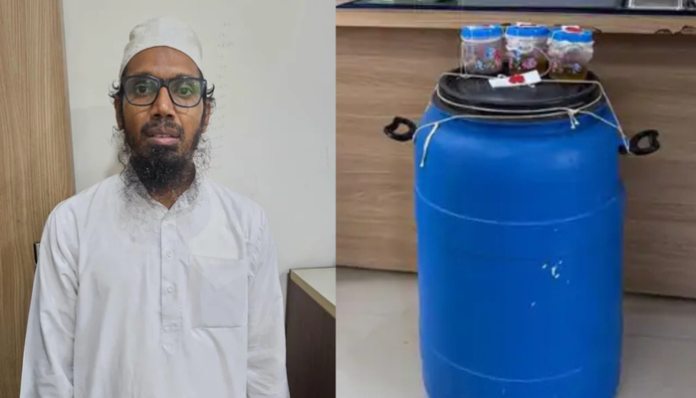
Dr Ahmed Mohiuddin Saiyed, the primary accused in the bio-terror plot which was busted by the Gujarat Anti-Terror Squad (ATS) earlier this month, wanted to get rich by selling the lethal poison Ricin, a report has revealed. Dr Mohiuddin, along with his two associates, Azad Suleman Sheikh and Mohammad Suhail Mohammad Saleem Khan, were arrested by the agency on 8th November in Banaskantha, Gujarat.
Mohiuddin’s brother, Farooqui, told the police that when he asked Mohiuddin about the parcels coming to the flat, he used to say that he was making a medicine which would make the entire family rich.
Dr Mohiuddin practised as a general physician and stayed alone in a flat in the five-story Asad Manzil apartment complex in Fort View Colony in Rajendranagar, Hyderabad. He completed his MBBS degree in China and provided patients with free internet consultations. The agency established Mohiuddin’s links with the Pakistani intelligence agency, the ISI, as confirmed by the Gujarat ATS DIG Sunil Joshi. The other two accused, 20-year-old tailor Azad Suleman Sheikh and 23-year-old student Mohammad Suhail Mohammad Saleem Khan, are from Shamli and Lakhimpur Kheri, respectively. The ATS seized ISIS literature and flags from Suhail’s home. They were charged under the Arms Act, the Bharatiya Nyaya Sanhita and the Unlawful Activities Prevention Act (UAPA).
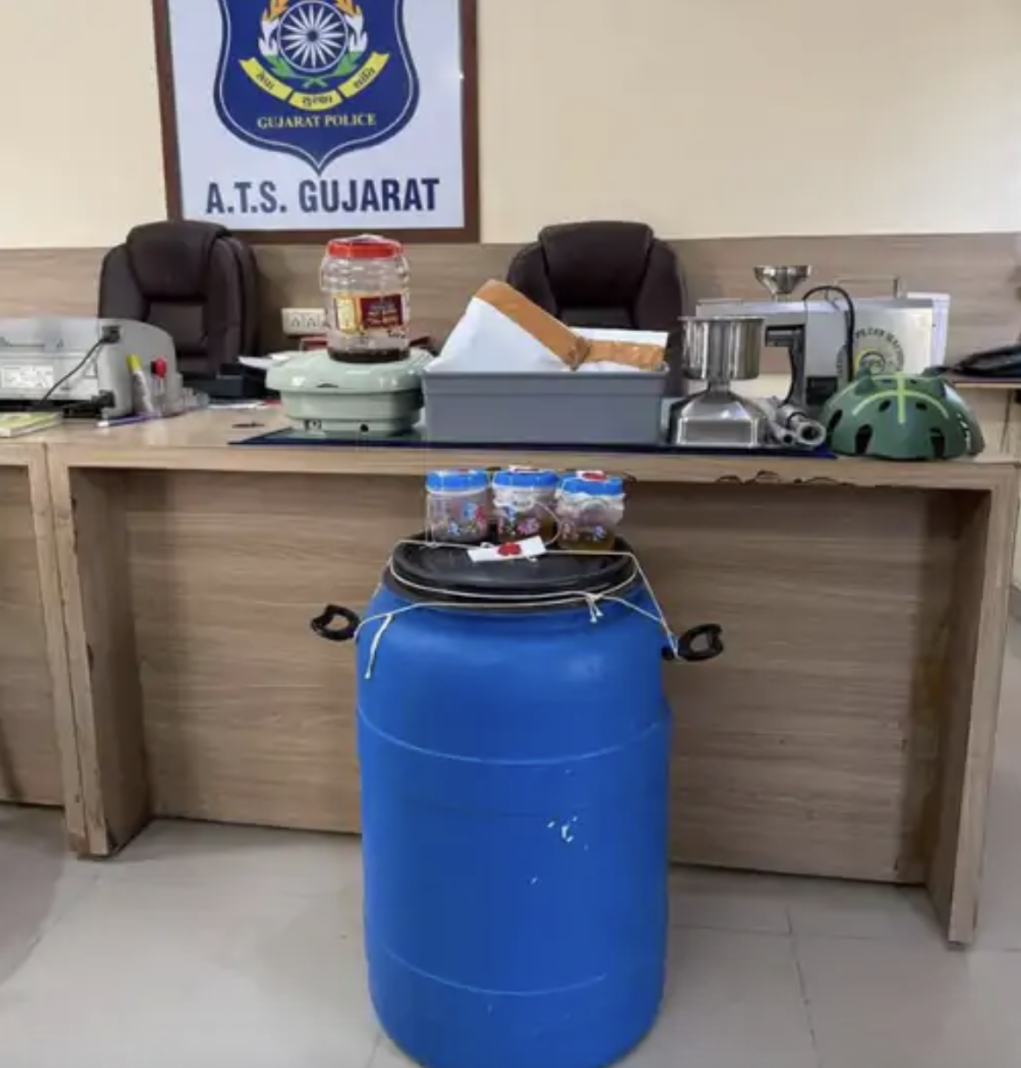
According to a report by Dainik Bhaskar, after the arrest of Dr Mohiuddin and his two associates, the Gujarat ATS discovered that the terror module the accused were part of was planning a large-scale chemical attack using Ricin. Dr Mohiuddin was receiving instructions from his foreign handler, Abu Khadija, who is connected to the Islamic State Khorasan Province (ISKP) and is based in Afghanistan. “ATS found evidence of social media chats between Moinuddin and his handler and searches on ChatGPT for methods of making dangerous chemicals,” the Gujarat ATS said.
The investigation reportedly revealed that Azad Suleman and Mohammad Suhail handed Dr Mohiuddin a bag of weapons at the direction of a Pakistan-based handler. Azad Suleman once travelled to Baramulla in Jammu and Kashmir with the intention of carrying out a terror attack. When he failed to find any targets there, he returned to Delhi. After coming to Delhi, he went to Haridwar and conducted a recce of major temples. During interrogation, the three accused disclosed that they were planning to extract Ricin from castor seeds, but they had not decided on the method of using it.
Even 2000 micrograms of Ricin is enough to prove lethal for a human: Professor Kharwar
As per the report, Ricin has been used in 40 major global conspiracies between 1978 and 2025. However, no cases of the use of the toxin have been reported in India so far. Ricin has been widely used by terrorist organisations linked to ISIS. This is the reason that the investigation agencies are also probing the ISKP and the Islamic State-Hind Province (ISHP) terror modules, which are connected with the ISIS.
Anand Asthana, a Lucknow-based chemical expert, told Dainik Bhaskar that Ricin is a very dangerous poison, which is prepared by refining small castor seeds. Asthana said that it is in the form of a white powder, and the finer the powder, the more dangerous it becomes. He said if the Ricin powder is scattered in a dusty area, there are chances of a large population getting affected by it. The effects of the poison may take two to three days to become noticeable, but it can lead to death. What adds to the lethality of the poison is that it has no antidote. This means once the poison is administered, death is almost certain. Asthana said that Ricin is soluble in water and can also be injected into a person’s body using a syringe. If ingested through water, its effects may appear within hours, and if injected using a syringe, it immediately mixes in the bloodstream.
First known use of Ricin was during WWII
The poison, Ricin, was discovered by a German scientist, Peter Hermann Stillmark, in 1888. The chemical, which is considered more lethal than cyanide, was used by the German army during WWII. According to a report by the Manohar Parrikar Institute for Defence Studies and Analysis, Ricin has been classified as a Category B bioterrorism agent by the US Centres for Disease Control and Prevention. The chemical is banned by the United Nations Security Council Resolution (UNSCR), and India’s Weapons of Mass Destruction Act of 2005 also prohibits the production or storage of such biotoxins.
