

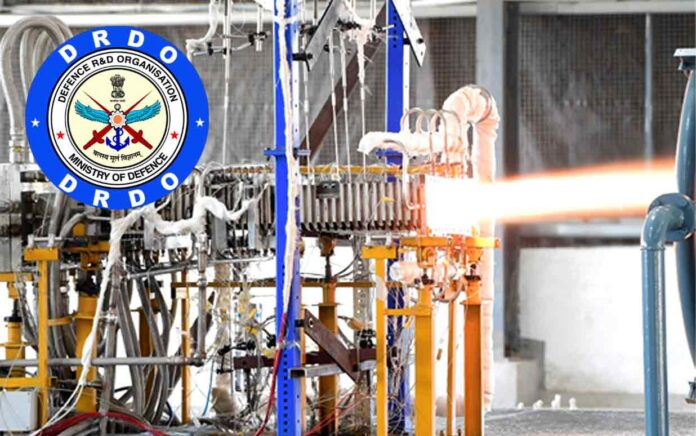
In a significant boost to India’s defence capabilities, the Defence Research and Development Organisation (DRDO) has successfully conducted a ground test of a full-scale actively cooled long-duration Scramjet Engine, marking a key advancement in the country’s Hypersonic Missile Programme. The test, carried out at the Scramjet Connect Pipe Test (SCPT) Facility by the DRDL in Hyderabad, achieved an impressive run time of over 12 minutes for the Actively Cooled Scramjet Full Scale Combustor.
This breakthrough validates the design of the advanced scramjet combustor and the state-of-the-art test facility, positioning India among a select group of nations mastering hypersonic propulsion technology. The test builds on an earlier subscale scramjet demonstration conducted on April 25, 2025, which also achieved long-duration performance.
The Combustor and test facility were designed and developed by the DRDL and realised by industry partners. The full-scale validation is a critical step toward developing operational hypersonic cruise missiles that could revolutionise aerial warfare with their speed, manoeuvrability, and ability to evade detection.
Hypersonic missiles, capable of traveling at speeds exceeding five times the speed of sound (over 6,100 km/h), rely on air-breathing engines like scramjets for sustained high-speed flight. Unlike traditional rocket engines, scramjets use atmospheric oxygen for combustion, enabling longer ranges and greater efficiency.
Defence Minister Rajnath Singh hailed the achievement, stating, “This successful test is a solid foundation for the nation’s Hypersonic Cruise Missile Development Program.” He extended compliments to DRDO, industry partners, and academia for their collaborative efforts. Similarly, Dr. Samir V Kamat, Secretary of the Department of Defence R&D and Chairman of DRDO, congratulated the teams involved, emphasizing the milestone’s role in advancing India’s self-reliance in cutting-edge aerospace technologies.
India’s pursuit of hypersonic capabilities dates back to 2004, when the DRDO first announced the indigenous development of the Hypersonic Technology Demonstrator Vehicle (HSTDV). This program aimed to demonstrate scramjet engine technology, with a key goal of achieving autonomous scramjet flight for at least 20 seconds using solid rocket boosters for initial acceleration. A major breakthrough came in September 2020, when the HSTDV was successfully flight-tested, validating the scramjet’s supersonic combustion at hypersonic speeds.
The program has since evolved to include projects like the Extended Trajectory-Long Duration Hypersonic Cruise Missile (ET-LDHCM), a scramjet-powered weapon system capable of carrying both conventional and nuclear payloads over long ranges. This missile is designed for extended hypersonic flight, leveraging active cooling to manage the extreme heat generated at such velocities.
Earlier ground tests, including a 120-second scramjet run in January 2025 and a 1,000-second endurance test in May 2025, have progressively scaled up the technology, enhancing India’s deterrence posture amid regional security challenges.
Scramjet technology eliminates moving parts in the engine, allowing for efficient supersonic combustion and making hypersonic vehicles lighter and more agile. With this latest success, India joins an elite club including the United States, Russia, and China, which have operational or near-operational hypersonic systems.
