

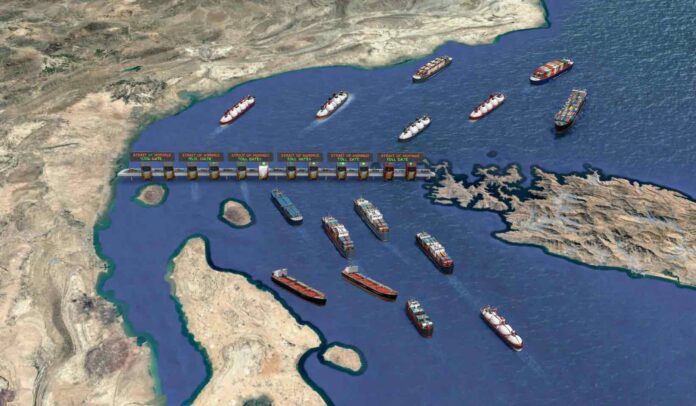
The European Union has firmly rejected any proposal to impose toll or transit fees on vessels transiting the Strait of Hormuz, emphasising that international law guarantees unrestricted freedom of navigation in the strategic waterway without any payment. The United Kingdom has also made similar comments.
The statement came today during a regular press conference in Brussels, delivered by European Commission spokesman Anouar El Anouni. In response to Iran’s suggestion that it could charge ships to pass through the strait as a condition for reopening the waterway, El Anouni declared: “International law provides for the freedom of navigation, which means… basically no payment or toll whatsoever.” He added that “Freedom of navigation is a public good and needs to be ensured.”
In parallel, UK Foreign Secretary Yvette Cooper also rejected the idea outright, declaring: “Countries cannot simply hijack those kinds of international transit routes and unilaterally apply tolls. They cannot do that as part of the laws of the sea and the United Nations arrangements.”
She added that “freedom of the seas must not be unilaterally withdrawn or sold off to individual bidders. Nor can there be any place for tolls on an international waterway,” noting its importance for the global economy and cost of living. Yvette Cooper warned against any attempt to “hijack” international transit routes and impose unilateral tolls.
The Strait of Hormuz, a critical chokepoint for global oil and gas shipments connecting the Persian Gulf to the Arabian Sea, has been at the centre of heightened tensions amid the ongoing 2026 Strait of Hormuz crisis. Iran has blocked or severely restricted shipping through the strait since late February 2026 in connection with regional conflicts involving Israel, the United States, and Iran.
As part of the ceasefire negotiations, Iran has proposed the right to collect tolls, potentially in coordination with Oman, as a precondition for restoring full access.
Such a move would represent a significant departure from long-standing principles of international maritime law, including those under the United Nations Convention on the Law of the Sea (UNCLOS), which prohibits unilateral fees on innocent passage through international straits unless specific services are provided. Both Iran and the United States have signed but not ratified UNCLOS, yet the norm of free navigation remains widely recognised.
Notably, the US has not objected to the toll proposal. Instead, President Donald Trump has even proposed forming an Iran-US joint venture to collect the fee. He called it ‘a beautiful thing’, adding that such a mechanism could help secure the strategic waterway while also generating revenue.
However, the ceasefire has fallen apart over disagreement on other issues, including the extension of the ceasefire to Lebanon, and Iran’s demand to continue uranium enrichment.
Despite a US-Iran ceasefire announced on Wednesday, shipping through the Strait of Hormuz has not resumed normally and remains effectively stalled. Marine tracking data shows only a handful of vessels, around four to seven bulk cargo ships in the first 24+ hours post-ceasefire, with minimal or no oil/LNG tanker traffic, compared to the pre-crisis average of over 140 vessels daily.
Confusion persists due to Iran’s new unilateral conditions, including requirements for ships to coordinate with Iranian armed forces, take alternative routes to avoid alleged sea mines, and navigate under “technical limitations.” Iran has also reiterated proposals for transit fees as part of its 10-point plan, though Oman and other Gulf states have pushed back against such fees.
