

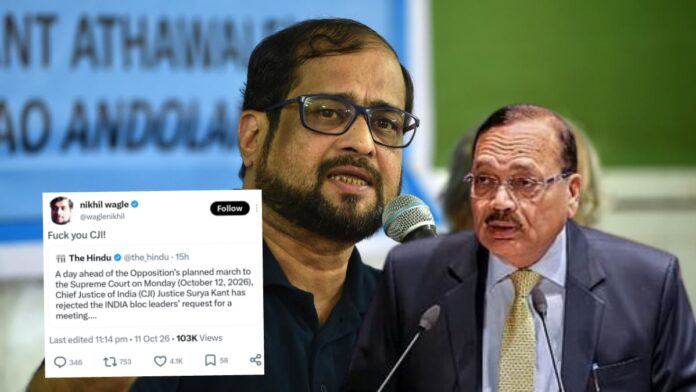
‘Journalist’ Nikhil Wagle appears to have discovered the virtues of measured language after his expletive-laden post targeting Chief Justice of India (CJI) Surya Kant landed him in legal trouble. Four days after publicly telling the CJI “F*ck you!”, Wagle has issued an unconditional apology, describing his outburst as an emotional reaction that does not reflect how he usually expresses himself.
In a letter dated October 15, 2026, addressed to the Attorney General for India, Wagle expressed regret over his October 11 post on X. The remark came after reports emerged that CJI Surya Kant had declined a request by INDI bloc leaders for a meeting ahead of their planned march to the Supreme Court.
Apparently, what began as an outburst on social media has now turned into an exercise in damage control.
From abusing the CJI to pleading for closure
In his letter, Wagle said he had been watching videos of the developments unfolding in New Delhi and had also read a statement attributed to senior advocate Kapil Sibal, who reportedly said that he had lost trust in the Supreme Court.
https://t.co/KI9xHFz7bF
— nikhil wagle (@waglenikhil) October 15, 2026
Wagle claimed that he reacted out of “anguish and frustration” before posting something he should not have.
“I have since deleted it, and I do not seek to justify it,” he wrote.
The journalist also invoked his nearly five decades in public life, insisting that he had never used abusive language in his speeches or writings and that the post did not reflect his usual manner of expression.
One is left wondering what happened to all that professional restraint in the moments before he pressed the post button.
Wagle further emphasised that he was not a member of any political party and professed his belief in the Constitution of India and the philosophy of Dr Babasaheb Ambedkar.
He then tendered an unconditional apology to the CJI and the Supreme Court, declaring that he held the institution in the highest esteem.
The apology, however, was accompanied by a request. Wagle urged the Attorney General to consider the circumstances behind his post and his expression of regret, and not to pursue the matter further.
In other words, after choosing to express his displeasure towards the country’s top judge in four words, Wagle now wants the authorities to take his five-decade-long career and emotional state into account.
Legal notice changes the tone
The apology follows a legal notice reportedly issued by Supreme Court Advocate-on-Record Amita Sachdeva over the post. The notice called for the post to be deleted and an unconditional public apology to be issued, warning of a possible move to initiate criminal contempt proceedings before the Supreme Court.
Wagle has since deleted the post and submitted his apology. Whether the Attorney General accepts his request and whether any further proceedings follow remain to be seen.
For someone who publicly directed an expletive at the CJI, Wagle’s latest letter strikes a markedly different tone. The defiance of the original post has given way to professions of respect for the judiciary, an explanation of emotional distress and an appeal to let the matter rest.
There is, of course, a difference between criticising a judicial decision and abusing the person occupying the highest judicial office in the country. Journalists are entitled to question institutions, judges and their decisions, but that freedom does not make every form of expression immune from legal scrutiny.
The man who had four words for the CJI now has an entire letter explaining why he should not be judged by those four words. The Attorney General will have to decide what happens next.
