

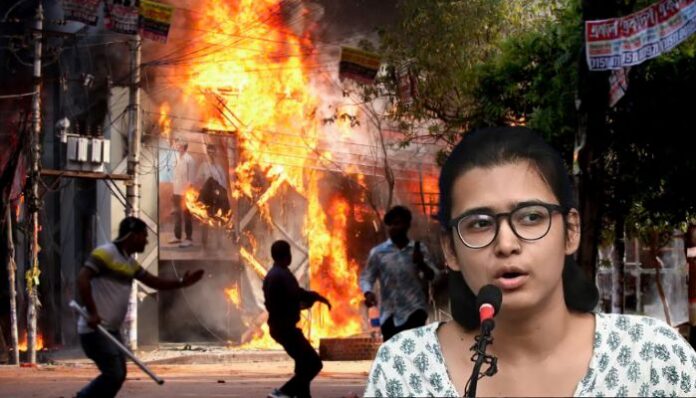
In a video message on Wednesday (14th October), far-left anarchist Neha Bora extended support for the 2024 regime change operation in Bangladesh that saw the undemocratic ouster of the then Prime Minister Sheikh Hasina. She expressed hope that such a ‘revolution’ could be replicated in India.
“We present you with our red salute. And we know that the Gen-Z movement that we are seeing everywhere in this country first started in Bangladesh. And congratulations to you for showing us the way, for showing us and extending solidarity to the young people of this country,” Neha Bora was heard saying.
“We know that the movement that began in Bangladesh was for democratic and voter rights. Today the movement that the young people are participating in and leading is also a movement for democratic and voting rights,” she brazened out.
“We know that the fight that you fight against religious fundamentalism in your country is also a fight that the Gen Z and the young people of this country fight today,” Neha Bora claimed.
OpIndia had consistently documented anti-Hindu violence in Bangladesh and the scale of atrocities against Hindus is nowhere close to the alleged religious fundamentalism in India.
Regime change operation in Bangladesh
In early July 2024, protests erupted in Dhaka, led by the Students Against Discrimination movement. The sequence of events and Sheikh Hasina’s statements regarding attempts being made to destabilise Bangladesh and oust her from power illegally, fuel the speculation that the Awami League leader’s forced resignation and escape from her homeland was not simply a consequence of student protests but that of a US-orchestrated regime change operation.
The turmoil in Bangladesh started in early 2024 and centred on a contentious quota system for government posts. The Court’s decision to keep a sizable proportion of jobs for specific groups, notably descendants of freedom fighters and women, prompted great outrage among university students. It all started over the decision of the High Court to reinstate the 30% reservation in government jobs to the descendants of the freedom fighters of the 1971 Liberation War. What started as peaceful protests soon took a violent turn.
In the first phase of the protests, it was reported that over 32 people died while nearly 1000 were injured as the country was grappling with high inflation, dwindling foreign reserves, and rising unemployment. On the 18th of July 2024, the anti-quota protesters set fire to the headquarters of the state broadcaster Bangladesh Television (BTV) in Dhaka. The police had to fire rubber bullets and use other non-lethal weapons to quell the protests by the students, causing more deaths and injuries.
In June 2024, the High Court of Bangladesh overruled the government’s decision, which triggered further demonstrations by student groups.The Supreme Court’s Appellate Division upheld the High Court’s decision on the 4th of July triggering widespread protests. After Sheikh Hasina’s appeal, the Bangladeshi apex court directed all petitioners to maintain the status quo till the 7th of August 2024.
During the second phase of the regime change operation, it was reported that over 150 people were injured, and two people had died. This came just two weeks after the country’s Supreme Court reduced the percentage of reserved government jobs from 56% to 7%. Initially, the anti-quota protestors sought revocation of reservation for families of freedom fighters. However, they then renewed their demands and sought “justice” for the 200 odd-people who were killed during the initial phase of violent protests and immediate release of detained protestors.
In Dhaka, Khulna, Sylhet, Narsingdi, Chattogram and Noakhali, after Jumma Namaz, numerous incidents of violence were reported. The protestors set a police box on fire at the Wasa intersection in Chattogram after Jumma Namaz. The protestors resorted to pelting stones and hurling brickbats. On 18th July 2024, PM Hasina called in the army to manage the escalating protests and violence.
In an attempt to quell the protest, the authorities suspended all internet services, including broadband, banned all Meta platforms, including Facebook, WhatsApp, Messenger, and Instagram, and announced a three-day vacation.
Amidst the violence and anarchy, the protestors demanded the resignation of Prime Minister Sheikh Hasina. By 4th August, over 100 people had died in the clashes between the Awami League supporters and the protestors. The deceased included 14 police personnel. Sheikh Hasina was forced to flee to India to save her life, giving way to Islamist Muhammad Yunus to take over.
