

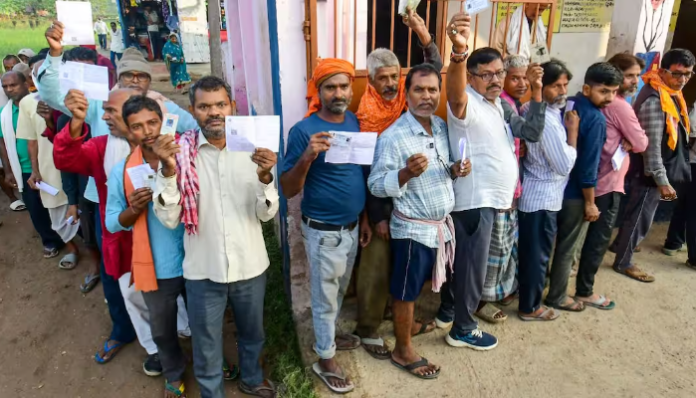
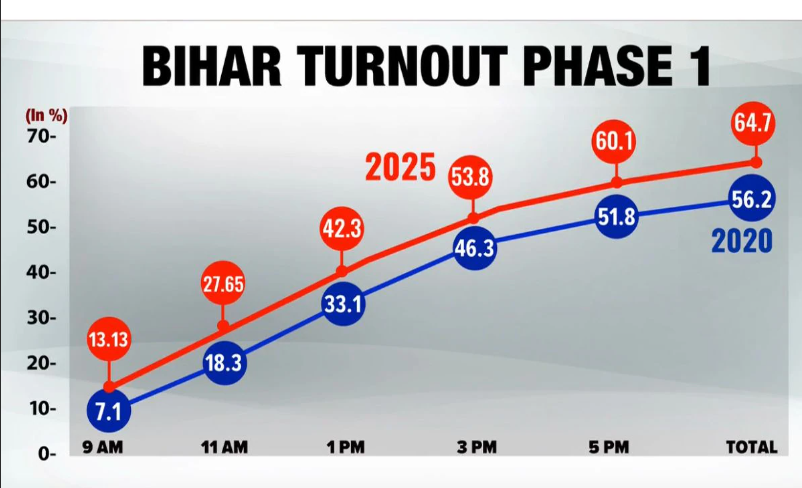
On 6th November, Bihar made history by recording the highest voter participation in the state’s history at 64.7%. The highest voter turnout in a Lok Sabha election in Bihar was 64.6% in 1998 and 62.66% in an assembly election in 2000 since the start of electoral politics in India in 1951-52. Meanwhile, 2020 assembly elections yielded a turnout of 57.29%.
The recent landmark development transpired after the state’s Special Intense Review (SIR) of the electoral roll which eliminated around 65 lakh voters who were dead, permanently relocated, untraceable and non-citizens. Now, 3.75 crore voters cast ballots to decide the fate of 1,314 candidates.
Bihar Elections 2025 Phase-I: Historic 64.66% Voter Turnout
— Election Commission of India (@ECISVEEP) November 6, 2025
✅ ECI’s new initiatives make voting a most pleasant experience for voters
Read more: https://t.co/KCj7grC8ql pic.twitter.com/DFuZWD4i9E
“Bihar has shown the way to the nation, through SIR with zero appeals, the highest voter turnout since 1951, purest electoral roll, enthusiastic participation of electors and a transparent and dedicated election machinery. Democracy has won. It has been an amazing journey for ECI,” Chief Election Commissioner (CEC) Gyanesh Kumar responded to the significant achievement.
Election Commission stated that its fresh campaign had made voting a “most pleasant experience for the voters” after the initial phase of the assembly poll which included 121 assembly seats as the process was completed amicably and joyfully.
Many significant firsts for Bihar
For the first time in the state’s history, the CEC and Election Commissioners Sukhbir Singh Sandhu and Vivek Joshi followed the events from the EC Control Room in Delhi via live webcasting of all 45,341 polling places. The maximum number of voters per polling place was recently lowered by the Election Commission from 1,500 to 1,200, hence increasing the number of booths throughout the state. The crowd control was improved by this adjustment with minor confusion over polling places.
“CEC Gyanesh Kumar personally engaged with the Presiding Officers and DEOs from the Control Room in ECI to ensure that the polling progressed smoothly” the official statement read. As part of the International Election Visitors’ Program (IEVP), sixteen foreign delegates from six different countries visited Bihar to observe the polling process which was another first in this election. According to the EC, the delegates praised the same being among the most efficiently conducted, transparent, effective and inclusive elections in the world.
It stated that by 11.20 pm last night, more than four lakh poll workers had arrived at the appropriate voting places. Mock polls were finished before 7 am today, and voting peacefully started at all 45,341 polling stations simultaneously in the presence of almost 67,902 polling agents chosen by 1,314 contending candidates.
The statement informed, “Over 90,000 Jeevika Didis/ female volunteers along with one CAPF personnel were deployed across all polling Stations for the identification of Purdahnasheen women.” In accordance with ECI’s most recent directives, Presiding Officers updated the Voter Turnout data at the end of the poll before departing the polling place, “resulting in minimal delay in updation of approximate voter turnout trends.”
Colour photographs of candidates were used on electronic voting machines during the Bihar elections. Voters were able to leave their phones at the polling places, which was another first. Easy readability was achieved by modified voter information slips. Voting could take place without lengthy lines or additional waiting hours because the number of voters per polling place was limited to 1200. Wheelchairs, volunteers, and an e-rickshaw were provided to help those with impairments get to the polling places.
Peaceful voting process
All 18 districts saw peaceful and incident-free voting, according to the Bihar Police Headquarters. Over 45,000 district police officers, 50 companies of the Bihar Military Police and 1,500 companies of the Central Armed Police Forces (CAPF) were sent to secure the process. Furthermore, 3,671 chowkidars and dafadars, 19,817 trainee constables, and 22,000 house guards helped with voter assistance and queue management.
Additionally, Bihar Police used satellite phones, boats, mounted units, and drones in hilly, riverine, and formerly Naxal-affected areas. From the state control room, the DGP and top officials kept an eye on the situation and gave prompt orders as needed.
In an effort to stop unlawful migration, 459 checkpoints were set up around Bihar’s borders with Jharkhand, Uttar Pradesh, West Bengal, and Nepal. These checkpoints were completely sealed 48 hours prior to the election. Additionally, thorough inspections were carried out at interstate and interdistrict locations.
Joint teams of the Flying Squad (FST), Static Surveillance (SST) and CAPF forces made significant seizures prior to the polls. The Bihar Police stated that to stop voter bribery or influence, about 3.04 lakh litres of alcohol, narcotics worth Rs 19.26 crore, precious metals worth Rs 4.26 crore, cash and other inducement materials worth Rs 7.35 crore were seized.
The police took also preventive action against 4,08,459 people including 53,523 who were pressuring vulnerable voters. 1,090 active offenders were removed from districts under CCA-3 and 23 infamous criminals were incarcerated under CCA-12 under the Crime Control Act (CCA). Ahead of the election, thousands of outstanding non-bailable warrants and property confiscation orders were carried out.
On 11th November 122 constituencies will cast ballots in the second phase of the Bihar Assembly elections and the results will be announced on 14th November.
