

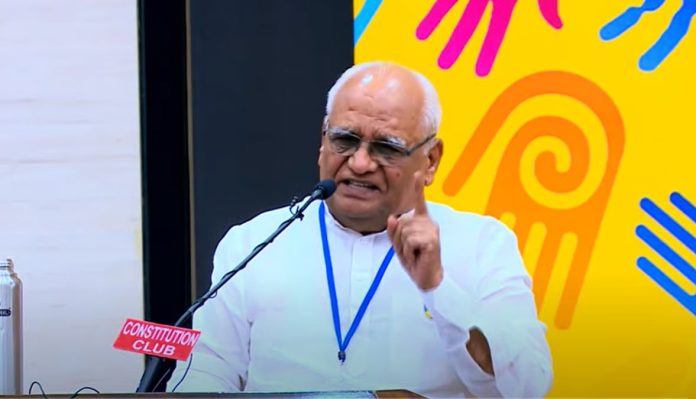
Retired Bombay High Court judge B.G. Kolse Patil has done it again. At a Sufi saints’ conference in Basavakalyan, Bidar district, organised by MLC Salim Ahmed and inaugurated by Karnataka’s Environment Minister Eshwar Khandre, the ex-judge used the platform not for spirituality, but for a blistering anti-Hindu rant. He declared that Hinduism was not a religion but merely a Persian word allegedly manipulated by Brahmins to “enslave society.”
He did not stop there. He accused the Rashtriya Swayamsevak Sangh (RSS) of being behind every riot in the country, including the 1984 Sikh riots, boldly asserting that ordinary Indians were “scared to speak” against the RSS. His words triggered a wave of outrage, but they fit a disturbing pattern.
Kolse Patil has repeatedly courted controversy as an ‘activist’ who deliberately targets Hindus, especially Brahmins, in the most provocative manner possible. His speeches have long portrayed Brahmins as the supposed villains of India’s history while painting the RSS as the root cause of every conflict in modern India.
In 2016, he had openly declared that Hindutva was merely a deceptive facade for what he called “Brahmanism,” insisting that defeating the RSS was crucial for India to progress. Over the years, such rhetoric has become his trademark, inflammatory, conspiratorial, and deeply offensive to millions.
His record becomes even more troubling with his reckless accusations against the RSS, including the outlandish allegation that the organisation received funding from Pakistan’s ISI. He has insinuated, without a shred of evidence, that senior RSS leaders were involved in a plot to destabilise India. These statements were made not on fringe online platforms, but at public events attended by radical Islamist groups, making his motivations all the more suspect.
The former judge’s most shocking moment came during the nationwide anti-CAA protests. At a protest organised by Jamaat-e-Islami Hind in January 2020, he was captured on video inciting the Muslim mob to “hit the streets,” threatening violence as the only way to defeat the Modi government.
In January 2020, Patil was booked by the Pune Police for making defamatory remarks against Veer Savarkar.
— OpIndia.com (@OpIndia_com) December 4, 2023
He claimed that Veer Savarkar was convicted of rape in London without furnishing any evidence.
This is the video –
(18/n) pic.twitter.com/cz5V404Qh9
By pushing Muslims to choose whether they want to “rot and die” or “fight and die,” he openly called for civil unrest. He further abused the highest elected leadership of India by referring to Prime Minister Narendra Modi and Home Minister Amit Shah as “dogs,” demonstrating a level of hatred that completely dismantles his pretence of activism.
His misinformation campaign around the Citizenship Amendment Act was equally dangerous. He falsely claimed that the law was crafted only to protect Hindus excluded from NRC in Assam and insisted that Muslims were being thrown into “detention centres” that awaited the rest of them. His speech came precisely when India was facing violent, orchestrated riots, showing he was not merely commenting, but fanning the flames of anarchy.
Kolse Patil’s name is also deeply entangled with the infamous Elgar Parishad event of 2017, which led to the Bhima Koregaon riots. Investigators reported that the programme served as a gathering ground for Urban Naxal networks intent on destabilising the state. Patil himself was identified as a key organiser and ideological driver of the event. His proximity to those later arrested for plotting to assassinate the Prime Minister raised serious questions about his role in extremist mobilisation.
His legal run-ins also extend to his defamatory assaults on national icons. In January, Pune Police booked him for spreading malicious lies about Veer Savarkar. Patil baselessly alleged that Savarkar was convicted for rape in England and that he opposed India’s freedom struggle. Such statements are not only historically incorrect but crafted specifically to malign revered figures of India’s independence movement.
Adding to his disreputable conduct is a sexual harassment accusation leveled by a journalist who visited his residence for an interview. She alleged that Patil made inappropriate remarks about her clothing and suggested a “friendship,” revealing behaviour deeply unbecoming of a former judge who once presided over matters of justice and dignity.
The Bidar speech only reinforces his disturbing pattern of hate-filled propaganda. He again painted Brahmins as “cowards,” repeated his claim that “Hindu” is a derogatory term, and encouraged the audience, particularly religious leaders, to attack Hindu identity in public discourse. In doing so, he insulted the spiritual and cultural foundation of India while fuelling communal antagonism.
Supporters attempt to portray Kolse Patil as a crusader against caste dominance. But his consistent actions reveal something far more sinister: a man who thrives on stoking anti-Hindu hatred, spreading misinformation, legitimising radical forces, and instigating mobs to violence. His speeches are not dissent, they are deliberate attacks on India’s social harmony and constitutional order.
