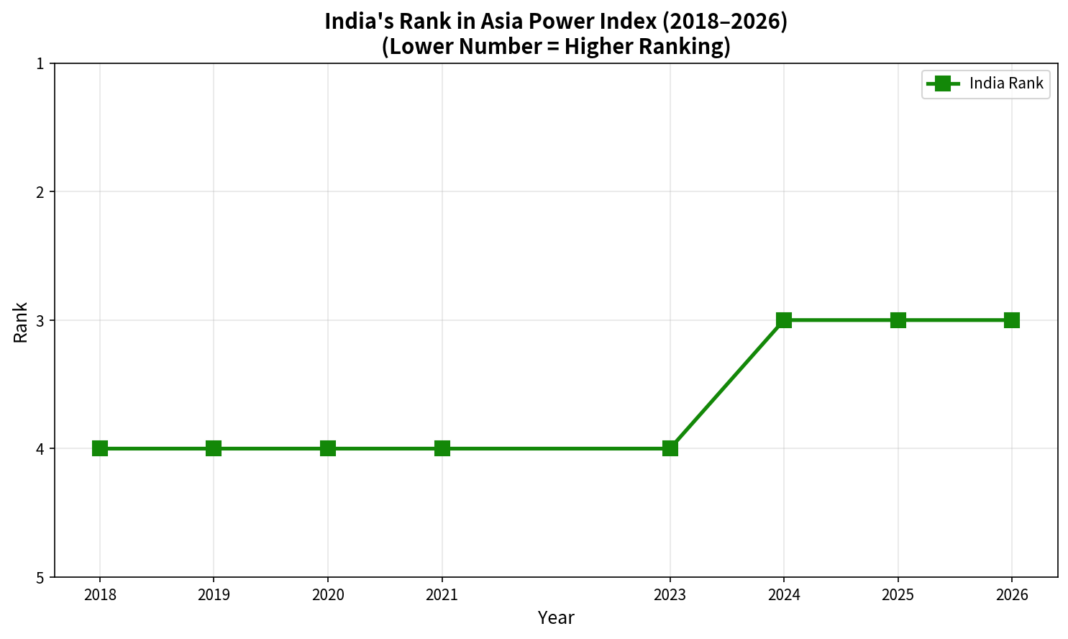
India now ranks third in Asia for comprehensive power, according to the Lowy Institute’s 2026 Asia Power Index. Its score of 40.5 points clears the 40-point “major power” line and puts it ahead of Japan (38.6). The path was not a straight line. Across the index’s eight editions, India started at 41.5, slid to 36.3 in 2023 and then rebuilt. The reports tie that U-shaped journey to the pandemic, to strong growth and demographics, and to a persistent gap between India’s size and its influence.
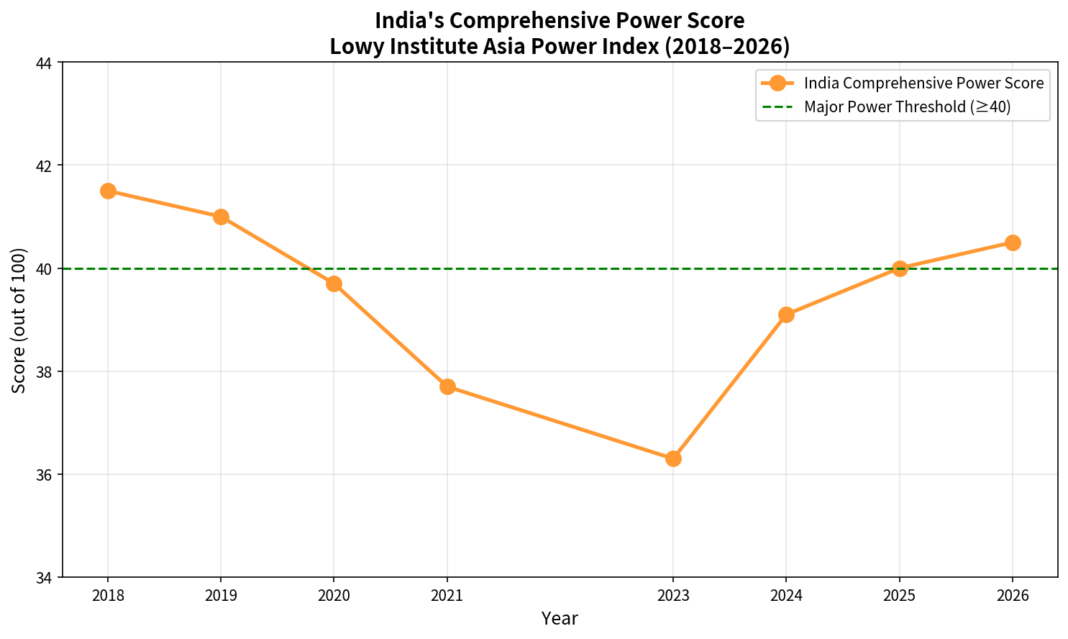
The numbers trace that arc. India scored 41.5 and ranked fourth in 2018, then 41.0 in 2019, both inside the major-power tier. It slipped to 39.7 in 2020 and 37.7 in 2021, which moved it into the middle-power group. There was no 2022 edition. The 2023 edition recorded the low of 36.3, still fourth. India then rose to third with 39.1 in 2024, passed the 40-point line again with 40.0 in 2025 and reached 40.5 in 2026.
2018: A strong start, with a warning
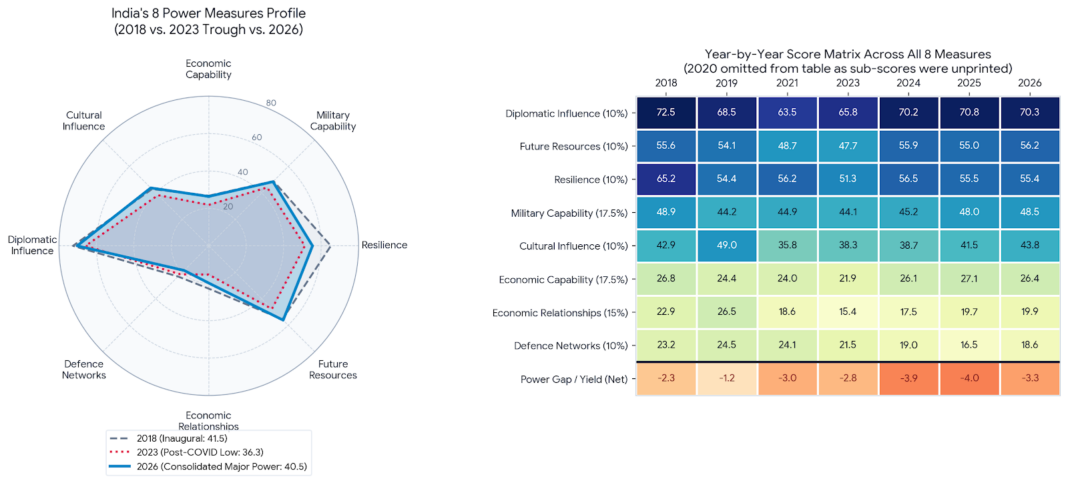
The inaugural index ranked 25 countries and placed India fourth on 41.5 points, just 0.6 behind Japan and inside the major-power tier. India’s strengths were resources and diplomacy. It ranked third for Future Resources (55.6), fourth for Diplomatic Influence (72.5) and fifth for Resilience (65.2). The report’s verdict was that “New Delhi is a giant of the future.” It also flagged a weakness that would follow India for years: despite the Act East Policy, India trailed in Defence Networks (23.2, tied tenth) and Economic Relationships (22.9, seventh).
2019: Cultural strength, uneven influence
India held fourth place with 41.0 points. Cultural Influence jumped to 49.0, fourth in the region, and the report said India was ranked fourth for military capability. India also ranked sixth for Economic Relationships (26.5) and eighth for Defence Networks (24.5), though Diplomatic Influence fell two places to sixth (68.5). The analysts projected that India’s economy would double and approach parity with the United States by 2030. Their caution was equally clear: “India is the only country with demographic scale to match China.” The same sentence added that India would not be the next China.
2020: The pandemic knocks India below the line
India remained fourth, but its score fell to 39.7, just under the major-power threshold. The Lowy team wrote that “India falls just short of the major power threshold in 2020.” COVID-19 cut India’s 2030 GDP forecast by about 13 percent, roughly US$3 trillion at purchasing power parity, the deepest cut among Index countries. That lowered its Future Resources score by nearly five points. There were bright spots. India’s Diplomatic Influence rose two places to fourth, overtaking South Korea and Russia, and Defence Networks improved one place to seventh, helped by Quad engagement. India’s withdrawal from the Regional Comprehensive Economic Partnership (RCEP) pushed it down to seventh in Economic Relationships.
2021: COVID era
India’s score fell another 2.0 points to 37.7. The report said India and Japan had each lost more ground. India did boost its Resilience and Military Capability in 2021, but its handling of the severe Delta wave in May damaged its reputation despite its role in vaccine manufacturing and donations. Economic Relationships ranked eighth.
2022: No edition, but a turning point in the data
The Lowy Institute did not publish a 2022 edition, so there is no 2022 score. The following edition covered 2022 data, and it recorded several developments. India’s Diplomatic Influence rose one place to fourth, with experts rating its leaders highly for pursuing national interests in Asia and globally. India agreed to sell BrahMos anti-ship missiles to the Philippines, a landmark arms-export deal.
2023: A slight trough
The 2023 edition put India at 36.3 points, the lowest in the series. India stayed fourth, but Japan (37.2) was just ahead, and both countries had dropped out of the major-power category. The Power Gap stood at -2.8. Economic Relationships was the clearest weakness: “India ranks ninth for Economic Relationships in Asia.” The report added that the score had fallen every year since 2018. The report still noted that India scored highly on Future Resources, reflecting its likely greater share of economic, military and demographic weight in decades to come.
2024: India overtakes Japan
The reversal came in 2024. India gained 2.8 points to reach 39.1, and the report said: “India has overtaken Japan to become the third-ranked power in Asia.” Japan scored 38.9. Strong post-COVID growth lifted Economic Capability by 4.2 points to 26.1. Future Resources jumped 8.2 points to 55.9, which the report linked to India’s youthful population and potential demographic dividend.
Diplomatic Influence rose to 70.2 as experts rated Prime Minister Narendra Modi’s global leadership and strategic ambition more highly. India took part in the sixth-highest number of dialogues with Index countries.
2025: Major-power status regained
In 2025, India reached 40.0 points, re-entering the major-power tier and widening its lead over Japan (38.8). The report stated that “India’s comprehensive power score exceeded 40 points” in 2025. Both economic and military capability improved. The report attributed part of the military gain to better expert appraisals, “likely influenced” by India’s performance in Operation Sindoor in May 2025.
Economic Relationships improved in ranking to ninth (19.7), for the first time since 2018. India overtook China as the destination for the most inward investment. Cultural Influence rose to 41.5, helped by tourism and new direct flights, such as India–Brunei. The limits remained. Defence Networks scored to 16.5.
2026: Consolidation, with a narrower gap to China
The 2026 edition gave India 40.5 points, ahead of Japan on 38.6. The report concluded that “India consolidated its position as a major power in 2026.” The gap with China was the smallest since 2018. Economic Capability scored to 26.4. An IMF methodology change and a drop of nearly US$20 billion in outbound investment, but India held third place. Future Resources rose to a series high of 56.2.
Diplomatic Influence held at 70.3, and experts now rate Modi the region’s second-most effective leader, up three places. Economic Relationships rose two places to seventh (19.9), Defence Networks rose two places to ninth (18.6) helped by BrahMos sales to Southeast Asia and Cultural Influence climbed to 43.8. India’s Power Gap is now narrowed to -3.3, its first improvement since 2023.
The Modi factor: leadership and diplomacy
Diplomatic influence is India’s best-rated measure, and it is where expert views of Prime Minister Narendra Modi’s leadership count most. India ranked fourth on it in six of the eight editions, scoring 72.5 in 2018 and 70.3 in 2026. Its Future Resources score, driven by growth and demographics, rose from 55.6 to a series high of 56.2 over the same period.
The reports record rising expert ratings of Modi over time. The 2023 edition said experts rated India’s leaders highly for advancing national interests in Asia and globally in 2022. In 2024, they rated his global leadership and strategic ambition more highly, and the report said India’s non-alignment had modestly benefited its global standing. In 2026, his regional leadership improved markedly, and he is now judged “the second-most effective regional leader in Asia”. That put him up three places.
The reports also record strategic choices made by his government. They cite the Act East Policy (2018 and 2019), Quad engagement that lifted Defence Networks (2020), and BrahMos missile sales to the Philippines (2022) and Southeast Asia (2026). The 2025 report adds that expert appraisals of India’s military capability improved after Operation Sindoor in May 2025.
Reading the numbers
Two points matter for any account of India’s rise. First, India’s 2026 score (40.5). Its rank has improved from fourth to third, while India recovered after its pandemic-era losses. Second, the reports link Modi’s leadership to India’s standing mainly through expert ratings of leadership, ambition and diplomacy in 2022, 2024 and 2026. Most of India’s gains come from growth, demographics and forecasts. The Index’s message is clear that India’s resources are rising faster and the future is bright.