

Following the order of the Madhya Pradesh High Court declaring that Bhojshala in Dhar is a Hindu temple, the ASI issued directions on May 16 implementing the High Court order. It granted the Hindu community unrestricted access to the Bhojshala complex for worship of Goddess Saraswati and related learning activities, 365 days a year. The monument remains a protected site under the Ancient Monuments and Archaeological Sites and Remains (AMASR) Act, 1958, with the ASI retaining full administrative control.
Entry timings and activities will be regulated by the Superintending Archaeologist in consultation with the district administration to ensure conservation. Dhar Collector Rajiv Ranjan Meena said that the arrangements at the site were being carried out in accordance with the court order and directions issued by the Archaeological Survey of India. Dhar Superintendent of Police Sachin Sharma also said that a coordination meeting was held to ensure smooth implementation of the court’s directives and that police deployment remained in place to maintain law and order.
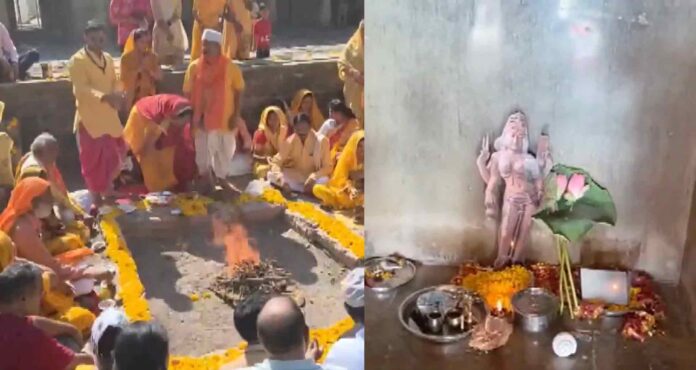
Hindu groups celebrated the ruling as a “historic” outcome of a centuries-long struggle. On May 16, devotees thronged the site, performed puja, aarti, and Saraswati Vandana amid heavy security deployment of over 1,200 personnel. On Sunday, Hind saints performed holy hawan in the hawan kund of Bhojshala complex. A large number of devotees reached the site to participate in the rituals.
Union Minister Savitri Thakur also visited the Bhojshala Temple on Sunday for prayer rituals. She said that the site will remain open to the Hindu community permanently, allowing them to offer prayers and seek darshan.
In a significant announcement, Bhojshala Mukti Yagya convener Gopal Sharma today said the complex would now be known as “Maa Saraswati Kanthabharan”. He said that symbolic rituals and prayers were conducted at the complex following the court order. He noted that the court has ordered the central government to reinstall the idol that the British took to London back into Bhojshala.
Human Rights Commission Member Priyank Kanungo has said that a grand temple will be built at the Bhojshala site after the Madhya Pradesh High Court ruled that it is a Hindu temple dedicated to Saraswati. Welcoming the verdict on the Bhojshala-Kamal Maulana mosque dispute, he said, “Just as a magnificent temple has been constructed in Ayodhya, a magnificent temple will be built at Bhojshala as well.”
He described it as part of India’s cultural renaissance under Prime Minister Narendra Modi. Kanungo added, “India is currently in a phase of cultural renaissance, and our generation is a witness to this spiritual and cultural resurgence. As India moves towards becoming a ‘Viksit Bharat’ under the leadership of Prime Minister Modi, carrying its heritage along, the name of Bhojshala has now been added to this journey.”
Ending the long-standing dispute over the Bhojshala-Kamal Maula complex in Dhar district, the Madhya Pradesh High Court on May 15 ruled that the site is fundamentally a temple dedicated to Goddess Vagdevi (Saraswati) and a centre of Sanskrit learning established during the reign of Raja Bhoj of the Parmar dynasty in the 11th century.
The Indore bench of the High Court quashed the Archaeological Survey of India’s (ASI) April 7, 2003 order, which had permitted the Muslim community to offer namaz on Fridays while restricting Hindu worship largely to Tuesdays and Basant Panchami. The court emphasised the historical and religious character of the site based on evidence including an ASI scientific survey, architectural findings, and continuity of Hindu traditions. It suggested that the state government consider allotting alternative land in Dhar district for a mosque to balance religious rights.
The Muslim side, represented by the Kamal Maula Mosque Committee and supported by entities like the All India Muslim Personal Law Board (AIMPLB), has strongly rejected the verdict as “one-sided.” They plan to challenge it in the Supreme Court, citing alleged flaws in the ASI survey, procedural issues, and conflict with the Places of Worship Act, 1991.
Caveats have already been filed by the Hindu site in anticipation of appeal by Muslims.
