

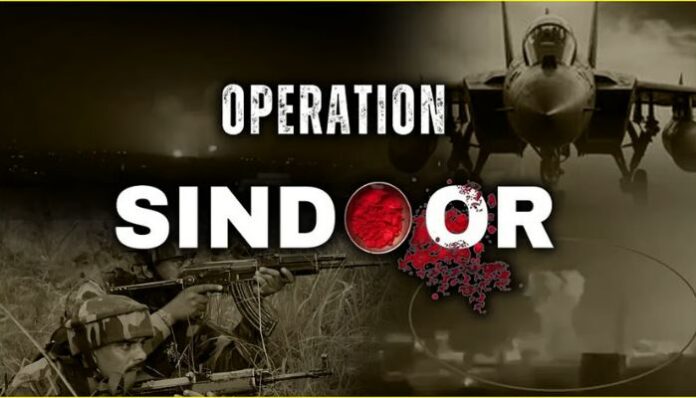
India’s Operation Sindoor in May 2025 exposed an important weakness in Pakistan’s long-standing nuclear strategy: nuclear weapons may prevent some forms of escalation, but they cannot stop every military confrontation. Pakistan had spent decades presenting its nuclear arsenal as a guarantee against major Indian military action. But the brief conflict showed that the nuclear shield has limits. India was still able to launch strikes deep inside Pakistan, forcing Islamabad to respond while carefully managing the risk of further escalation.
A report published by the Bulletin of the Atomic Scientists shows that Pakistan’s military establishment has promoted the idea of “full-spectrum deterrence” for years. The basic argument was that its nuclear weapons would prevent India from taking military action at almost any level. The events of May 2025 decimated that belief.
The three-day confrontation showed that nuclear weapons did not prevent a crisis from developing. The fear of nuclear escalation also did not stop India from carrying out strikes. Pakistan therefore faced a difficult situation: it had to respond to India’s military action while making sure that its response did not accidentally trigger a much larger conflict.
This is where Operation Sindoor exposed what can be described as Pakistan’s nuclear bluff. The weapons remained powerful, but their usefulness during an actual conventional conflict was far more limited than the rhetoric surrounding them suggested. As the experience showed, “Nuclear weapons have limits.” They can create fear and discourage certain actions, but they cannot provide an answer to every security challenge.
Pakistan celebrates conventional military power
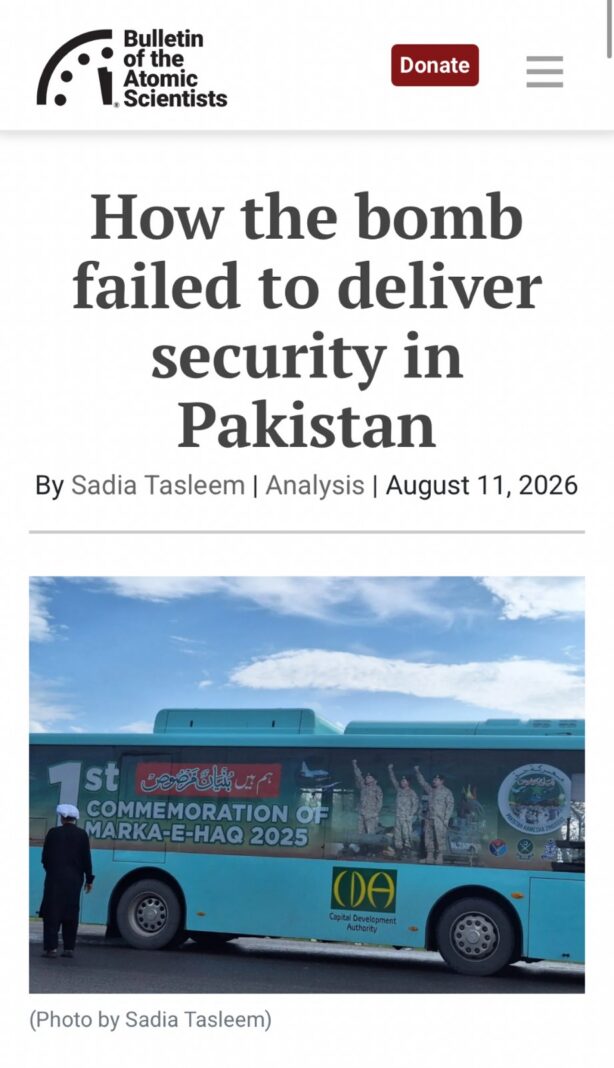
The change in Pakistan’s messaging became particularly visible during the first anniversary of the May 2025 conflict in 2026. Pakistan gave considerable importance to Marka-e-Haq, its official narrative around the military confrontation. Celebrations were held by government departments, provincial governments, universities, cultural institutions, diplomatic missions and the armed forces.
The contrast with Youm-e-Takbeer, which marks Pakistan’s first nuclear tests in May 1998, was striking. The anniversary received comparatively little public attention. Senior leaders issued statements, but there was no similar large-scale celebration of Pakistan’s nuclear achievement.
The visual messaging was even more revealing. Public spaces in Islamabad and elsewhere were filled with images of military leaders, conventional weapons and what Pakistan described as battlefield achievements. Yet nuclear weapons and nuclear-capable missiles were largely missing from these displays.
That appears significant because the Pakistani military has a strong political interest in presenting itself as the country’s active defender. Conventional military victories provide visible proof of that role. Nuclear weapons, despite their destructive power, cannot easily be presented as an everyday demonstration of military strength.
The bomb became part of the problem
Operation Sindoor also highlighted another problem with Pakistan’s nuclear strategy. During the crisis, nuclear weapons were not simply unable to provide a solution; their presence added another layer of danger.
Every military decision had to be taken with the possibility of nuclear miscalculation in mind. A conventional missile launch, for example, could potentially be misunderstood by the other side. Pakistan therefore had to think not only about whether a military response would be effective, but also about how India might interpret that response.
Reports that Pakistan had convened, or was preparing to convene, its National Command Authority further showed how serious the situation had become. Whether the meeting actually took place was less important than the fact that nuclear command and control had entered public discussion during an active military crisis. The possibility itself showed how quickly a conventional confrontation could acquire a dangerous nuclear dimension.
A lesson beyond Pakistan
Pakistan’s experience does not prove that nuclear deterrence is completely useless. Nuclear weapons can still make countries think twice before entering a full-scale war. But Operation Sindoor demonstrated why it is misleading to treat nuclear weapons as a guarantee of security.
The events of May 2025 created a clear gap between Pakistan’s earlier claims about “full-spectrum deterrence” and what actually happened on the ground. Nuclear weapons did not prevent military action, did not end the crisis and did not remove the need for conventional military capabilities.
That is why Pakistan’s growing focus on conventional defence, including increased defence spending and the creation of the Army Rocket Force Command, is significant. The emphasis appears to be shifting towards visible conventional military strength.
For countries considering nuclear weapons, Pakistan’s experience offers a wider warning. The important question is not only what the bomb can deter, but also what risks and restrictions it creates. Operation Sindoor showed that nuclear weapons may raise the cost of war, but they cannot make a country immune from conflict. In Pakistan’s case, the nuclear shield looked less like an all-purpose guarantee and more like a powerful weapon with very clear limits.
