

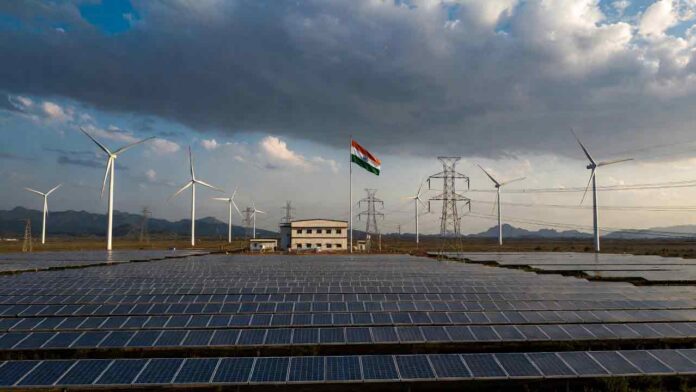
India has achieved a remarkable milestone in its power sector, adding a record 52,537 MW (over 52.5 gigawatts) of electricity generation capacity in just the first 10 months of the financial year 2025-26 (April 2025 to January 31, 2026), according to a press release from the Ministry of Power issued on February 15, 2026.
This addition represents more than an 11% increase in the country’s total installed power capacity during this period. The total installed electricity generation capacity in India now stands at 520,510.95 MW, approximately 520.5 GW, as of January 31, 2026.
A remarkable fact in this addition is that renewable energy sources contributed to the majority of the expansion. Out of the total 52,537 MW added, 39,657 MW of power, approximately 75.5%, came from renewable energy sources.
Solar power led the way with 34,955 MW, making it the single largest contributor and reflecting India’s aggressive push in large solar power projects. This was followed by 4,613 MW from wind power.
The Ministry of Power described this achievement as the highest-ever capacity addition recorded in a single financial year to date, surpassing the previous full-year record of 34,054 MW set in FY 2024-25.
As of January 31, 2026, India’s overall energy mix continues to shift toward cleaner sources, with non-fossil fuel capacity—including renewables, large hydro, and nuclear—reaching 271,969.33 MW. Renewable energy sources specifically stand at 263,189.33 MW, while fossil fuel-based capacity totals 248,541.62 MW and nuclear capacity remains at 8,780 MW.
This rapid pace of renewable capacity addition builds on earlier milestones in 2025, such as surpassing the 500 GW total installed capacity threshold and achieving more than 50% non-fossil fuel share ahead of schedule. The surge supports India’s international climate commitments, including the target of 500 GW of non-fossil fuel capacity by 2030. It also underscores the effectiveness of supportive policies, accelerated project implementation, and robust investment—particularly in solar—positioning the country as a global leader in clean energy growth at a time of steadily rising electricity demand.
