

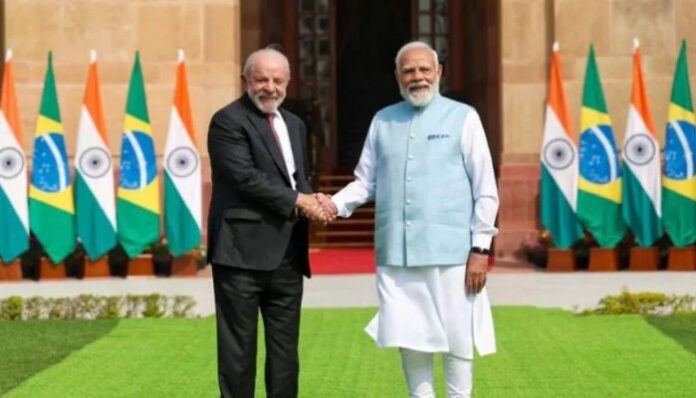
India and Brazil have agreed to increase their bilateral trade target to $30 billion by 2030, which is a huge boost to the economic partnership between the two major democracies of the Global South. The decision was taken during talks between Prime Minister Narendra Modi and Brazilian President Luiz Inacio Lula da Silva on Saturday (21st February).
🚨India, Brazil set $30 billion trade target by 2030, sign mineral pacts. pic.twitter.com/AydPBBMpKU
— Indian Infra Report (@Indianinfoguide) February 22, 2026
This target has replaced the earlier target of $20 billion, which was agreed upon during Prime Minister Modi’s visit to Brasilia in July 2025.
Trade target increased after assessment
According to Secretary (East) in the Ministry of External Affairs, P Kumaran, President Lula felt that the previous target did not fully reflect the strength and potential of the partnership. With trade already crossing $15 billion in 2025, a 25 % over 2024, both leaders agreed that doubling the figure to $30 billion by 2030 was realistic.
President Lula has come to India with 11 ministers and around 300 business representatives, underlining Brazil’s intent to expand trade and investment ties.
Key mineral and steel agreements
During the talks, the two countries signed agreements on rare earth and critical minerals, along with cooperation in mining linked to the steel supply chain. Prime Minister Modi described the rare earth pact as a major step towards building resilient supply chains.
India is working to reduce dependence on China for critical minerals used in electronics, renewable energy and defence production. Brazil, which has vast reserves of iron ore and other key minerals, is seen as an important partner in this effort.
Digital, health and MSME cooperation
The leaders also finalised a joint action plan titled “Digital Partnership for the Future.” Agreements were signed for cooperation in the coastal sector, MSME entrepreneurship and crafts, and between Brazil’s Health Regulatory Agency and India’s Central Drugs Standard Control Organisation.
Healthcare cooperation was a key focus. Modi said India would increase the supply of affordable and quality medicines to Brazil. Lula noted that both countries have long supported equal access to generic medicines at the World Health Organisation.
Wider strategic partnership
The discussions at Hyderabad House covered energy, oil and gas, renewable energy, biofuels, agriculture, livestock, healthcare, space and satellite cooperation. The leaders also explored defence collaboration, including maintenance of Scorpene submarines involving Mazagon Dock Shipbuilders Limited and the Indian and Brazilian Navies.
Modi encouraged Brazilian aviation firm Embraer, which plans to assemble its E175 regional jet in India, to set up a maintenance, repair and overhaul facility as well.
Both sides discussed expanding the India-Mercosur Preferential Trade Agreement to deepen economic ties. Global issues, including changes in US trade policy and high tariffs affecting both countries, were also reviewed.
Focus on multilateralism and the Global South
The two leaders stressed the need to strengthen multilateralism in a time of global uncertainty. Modi said India and Brazil, as democratic nations, would continue to work together for the priorities of the Global South. Lula described the partnership as one between a “digital superpower” and a “renewable energy superpower.”
They also reaffirmed their stand against terrorism and discussed global conflicts, including the situation in Ukraine and the need to ease the suffering of the Palestinian people.
President Lula arrived in India on 18th February, attended the India AI Impact Summit, and received a ceremonial welcome at Rashtrapati Bhavan before holding delegation-level talks. This marks his fifth visit to India as President.
With a higher trade goal and fresh agreements across minerals, digital cooperation, defence and healthcare, India and Brazil have signalled their intent to take the partnership to a stronger level by 2030.
