

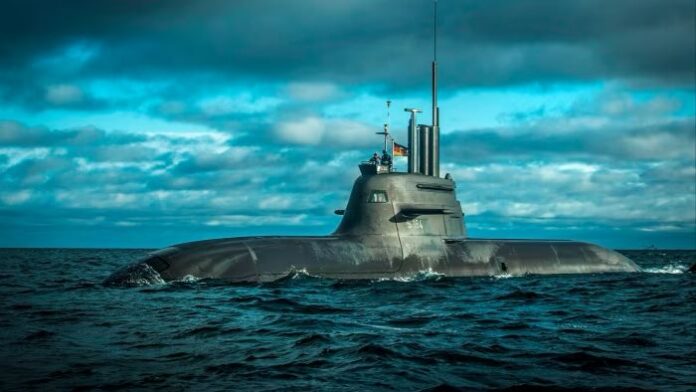
Germany is set to sign a major submarine deal with India, signalling a significant expansion in defence cooperation between the two countries amid a rapidly changing geopolitical environment.
German Ambassador to India Jasper Wieck said on Wednesday, 23 September, that Berlin was ready to sign an estimated $8 billion government-to-government agreement with New Delhi for the construction of six conventional submarines in India. Describing the proposed agreement as “forward-leaning”, Wieck said Germany had accommodated India’s requirements and was prepared to sign the deal as early as the following day.
“From the German side, we should sign tomorrow,” Wieck told reporters in New Delhi.
Germany backs submarine production in India
The project involves Germany’s Thyssenkrupp Marine Systems (TKMS) partnering with state-owned Mazagon Dock Shipbuilders Limited (MDL) to manufacture six submarines in India.
The submarines are expected to feature air-independent propulsion (AIP), enabling them to remain submerged for substantially longer periods without having to surface for atmospheric oxygen. They will also incorporate modern weapons, sensors and countermeasure systems.
The decision to build the submarines in India is significant beyond the acquisition itself. According to Wieck, integrating the various components into vessels manufactured domestically could create opportunities for deeper cooperation between Indian and German companies across a wider range of defence technologies.
The project is being pursued under India’s Strategic Partnership model, which seeks to combine the capabilities of Indian defence manufacturers with foreign original equipment manufacturers for the domestic production of advanced military platforms and technology transfer.
Berlin signals major shift in defence policy towards India
Germany’s willingness to move ahead with the project also reflects a broader change in Berlin’s approach to defence cooperation with New Delhi.
Wieck said Germany had undergone a “180-degree shift” in its policy on defence exports and was now more willing to provide licences and facilitate technology transfers to India. He described India as a trusted partner, indicating that Berlin sees defence cooperation with New Delhi as a long-term strategic relationship rather than a one-off arms transaction.
The shift comes as both countries reassess their security requirements amid growing geopolitical uncertainty.
Wieck pointed to the war in Ukraine and the increasing importance of unmanned systems as factors contributing to what he described as an “unfriendly geostrategic environment”. Germany and India, he said, are both investing heavily in strengthening their armed forces in response.
India looks beyond its traditional defence suppliers
For New Delhi, the submarine project also fits into a broader effort to diversify its defence partnerships.
India has historically relied heavily on Russian-origin military equipment, but in recent years it has sought to expand cooperation with a wider group of suppliers and technology partners. Greater defence engagement with Germany provides New Delhi with another European source for advanced military technology while strengthening strategic ties with one of Europe’s major powers.
The partnership is particularly significant as India continues to deepen defence relationships with European countries, including Germany and France.
The German submarine project could therefore become a foundation for cooperation extending well beyond naval platforms.
Wieck identified unmanned systems, cyber capabilities, missile technology and sensors as potential areas for expanded bilateral defence cooperation.
Defence ties extend beyond the submarine deal
India and Germany have also been steadily expanding military-to-military engagement.
Their armed forces have participated in air and maritime exercises, while Germany has deployed a liaison officer to the Indo-Pacific Information Fusion Centre in New Delhi. The arrangement is aimed at improving maritime domain awareness and information-sharing across the Indian Ocean region.
The proposed submarine agreement thus comes against the backdrop of a much wider strategic realignment. For Germany, India represents an increasingly important security partner in the Indo-Pacific. For India, closer defence cooperation with Berlin offers access to advanced European technology while supporting its broader objective of building defence manufacturing capabilities domestically.
If signed as expected, the submarine deal could mark one of the most consequential steps yet in the evolution of the India-Germany defence partnership.
