You’ve probably gotten used to reading a certain kind of news on your phone and in the newspapers — where every time there’s a new face, a new slogan, and a new “environment” or “people’s movement” story. Sometimes someone says the trees and rivers must be saved, sometimes someone stands up to stop development in the name of heritage, and sometimes suddenly some strange-sounding NGOs and political parties hit the streets over Goa’s land and Section 39A.
You smile and say, “Arre, this is democracy. Such protests keep happening in every state.”
But just stop for a moment and flip through the pages of history and geopolitics. Whenever in any country, any society, or any sensitive geography the script of a “movement” is written from outside, and it is brought down to the ground wearing the mask of “local people’s concerns,” it doesn’t remain just a protest. It becomes the next episode of a long game. And today we will examine that entire ideological chain, that network, and that blueprint which starts from a book in 1962, goes through Greenpeace, some faces of the Church, civil society NGOs, and stops at the ‘Cockroach Janta Party’ that reached Goa in November 2026.
And yes, before we land on Goa’s soil, it is very important to remind you of an old point. In the context of the Cockroach Janta Party, i.e. CJP, we have talked about this earlier — how Gene Sharp’s book From Dictatorship to Democracy became the blueprint for regime change operations from the Arab Spring to many places around the world. How the so-called non-violence, civil resistance, and “people’s voice” vocabulary is used to bring about a change of power, which we call the regime-change blueprint. The same model was also adopted by CJP when they came down to Jantar Mantar… Now another aspect appears to be getting added to the same chain — a book that was painted in the colours of Christian faith and spiritual enlightenment, and which later gave climate activism such an ideological and spiritual cloak that asking questions in front of it is considered “unethical” or “anti-people.”
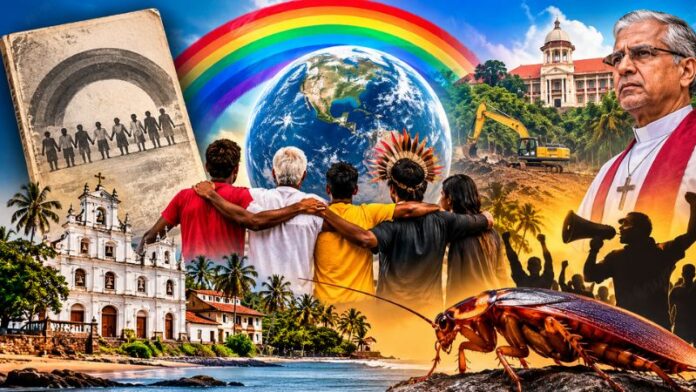
Let’s begin from America in 1962. That year a small book is published — Warriors of the Rainbow. The writers are William Willoya and Vinson Brown. Willoya was a Christian preacher, and Brown was the owner of Naturegraph Publishers. The biggest story sold about this book was that it was some “ancient Native American prophecy.” Whereas the reality is that it was not any ancient tribal tradition, but an evangelical Christian tract. Meaning, it was simply a small book for Christian preaching.
What was written in the book? That when the earth will be in crisis, trees will start drying up, rivers will turn black, then people of different colours — red, white, yellow and black — will unite and become ‘Rainbow Warriors’ and save the earth. It sounds very poetic and cute. But its real purpose was not to save tribal traditions, but was linked to Christian spiritual awakening.
Many scholars call it a “fake folklore.” In the real traditions of tribes like the Hopi, Cree or Lakota, there is no solid basis for it. Still, it was promoted as “ancient knowledge.” Some people honestly believed it to be true, and some carried it forward as a notion and an idea.
Now look at the 1970s. This idea reaches Greenpeace. One of the early and influential members of Greenpeace was Bob Hunter. He read this book and made it the spiritual foundation of his movement. The slogan “We are Rainbow Warriors” gave climate activism a global identity, and that identity was “We are all one.”
This is where a big change came. Protecting the environment was no longer just a matter of policy, science or economy. A mysterious, biblical and spiritual claim got attached to it. When any issue takes the form of a ‘mission’ or ‘faith’, its methods also change. Now a whole chain starts becoming visible — an idea that came out of a Christian tract, global climate activism built from it, and then the same language and framing descends into local movements.
Now the same language reaches Goa. Around 2014, the name of Abhijit Prabhudesai and the ‘Federation of Rainbow Warriors’ comes to the fore in Goa. In an interview given to Civil Society magazine, he himself said that this name was taken from the vision of the American natives. His roots were linked to the organisation of Goa’s farmers, but the framing was global. He said that “the circle of life has broken. People will unite and protest. They will be called Rainbow Warriors.”
Prabhudesai and his team ran several big campaigns in Goa — against mining, against coal transportation and double tracking, the Amche Mollem movement, against the Coastal Zone Plan, against the Tamnar power line and highway expansion. Names like Diana Tavares, Siddharth Karapurkar, Jose Coutinho, Leah Gomes, Vilma Dias kept appearing repeatedly. The argument was that development should not happen without the consent of the people, and gram sabhas should be heard.
During this period, some priests of the Church also appeared active. Father Bolmax Fidelis Pereira, parish priest of Chicalim. He was a botanist, a teacher, and also an environmental activist. His range did not seem limited to just one issue. About five months ago he was seen promoting CJP, expressing anger against the central government, and remember, this was the same period when many activists, along with the Church, were registering their anger against the FCRA bill and language like fatwas was also coming out.
He remained one of the prominent faces who connected the youth in the ‘Amche Mollem’ movement. He remained active in the opposition to coal and double tracking. In 2026, he stood with the people of Palem-Siridao at Azad Maidan in opposition to Section 39A. He said “Enough is Enough” and called land conversion a threat to ecology.
In May 2026, at the age of 50, this eco-father’s Ram Naam Satya happened. Goa’s environmental movements themselves called him the ‘eco-priest’. Orville Dourado Rodrigues of Goyancho Ekvott had called him the ‘driving force’ who raised the youth, and Abhijit Prabhudesai also often mentioned his absence. Father Albano Fernandes also participated in the protests at Azad Maidan. Of course, no official statement comes from the Church institutionally, but the continuous activity of some priests at the personal level points towards a pattern. The question is that whenever a big movement happens in Goa regarding land, mining or ecology, why do some faces connected to the Church keep appearing in the centre again and again?
Is this only personal sentiment, or is it part of a larger network that becomes active on every sensitive issue with a fixed script?
In the same chronology, an organisation named ‘Enough is Enough’ also comes forward. Former Chief Justice of Allahabad High Court Ferdino Rebello is its leader. In a way, these are the angry uncles of the Prashant Bhushan type of this organisation. Names like Claude Alvares and Norma Alvares (founders of Goa Foundation), Devidas Amonkar, Elvis Gomes, Govind Shirodkar, Swapnesh Sherlekar are connected to it. The demand was made that Section 39A and 17(2) be abolished. A ten-point charter was made, and proposals were passed in several gram sabhas including Palem-Siridao, Tivim, Aldona, Assagao.
Now understand a subtlety here. In some villages of Goa, some Hindu names also appear standing in opposition. In Aldona and Assagao there is a large Catholic population, while in Tivim there is a Hindu majority. Meaning, the same community is not everywhere on the ground. But the organisational structure and ideological leadership of the movement appears to come out of those same civil society networks that have already been active in climate activism. Goa Foundation, Rainbow Warriors, Goyancho Ekvott — these names keep circling in the same circle again and again.
Now it is also necessary to know what the real debate regarding Section 39A is. It is part of the Goa Town and Country Planning Act. The government says that this is a step to permanently protect eco-sensitive areas. Those opposing say that this will benefit the builders and put Goa’s identity in danger. Both sides have their arguments. The problem arises when the same network, the same language and the same framework is applied to every new project.
And then comes November 2026… ‘Cockroach Janta Party’ enters Goa. The founder is Abhijit Dipke, from Aurangabad in Maharashtra, Dalit background, supposedly studied from Boston University, earlier worked in the social media team of the Aam Aadmi Party. On CJI’s statement, the post “What if all cockroaches come together?” went viral, CJP was formed, the ‘Kya Bolti Public’ campaign started, and as soon as they reached Goa the first priority was declared — and that is to abolish Section 39A.
Dipke says that “If 39A remains, Goa will not remain. Goenkars will not remain.” He raises questions on the Karapur project, talks about the nexus of builders and leaders, and says that “Goa is Goa because of its people, not because of builders.” Names like Saurabh Das and Ashutosh Ranka are associated with him, who call themselves ‘watchdogs’ and say that changing the government is not the goal.
But just think! A person whose political journey has been linked to the Aam Aadmi Party, Delhi and Maharashtra, whose launching happens directly from abroad to Delhi, who are a direct part of the regime-change mould of Gene Sharp’s book’s CANVAS… why does he suddenly make Goa’s land and Section 39A the biggest issue of his campaign? Is this the own voice of Goa’s youth, or a new political form of the already running civil society and activist network?
Here the entire story of the changing of the idea and its execution becomes visible. The fakelore of ‘Rainbow Warriors’ that came out of the 1962 Christian book, then Greenpeace’s global climate activism, then Abhijit Prabhudesai’s local version in Goa, the participation of some priests connected to the Church, the organised opposition of organisations like Goa Foundation and ‘Enough is Enough’, and now the same issue being adopted by a new political group with Aam Aadmi Party background.
This is a complete ecosystem. In it there is the framing of “Save the Earth,” the language of calling development “loot,” and the art of connecting external ideas and new political faces in the name of protecting local identity. People of Congress and AAP are also seen in the protests, CJP calls itself independent, but the way of choosing issues shows the same old network.
Now another important question, which is often ignored. When accusations of “looting the land” are being levelled against the government and builders in opposition to Section 39A, then one must also remember those cases related to land in Goa where serious allegations were made against the Church or officials connected to it. Some time ago the ED filed a chargesheet against two former procurators of the Archdiocese of Goa and Daman — Father Arlino de Melo and Father Victor Conceicao Rodrigues.
According to the investigating agency, on a tenanted land of about 2,479 square metres in Caranzalem, the name of the Archdiocese was registered through forged documents, and in 2007 that land was sold to Models Real Estate Developers for just 61.97 lakh rupees, from which later allegedly more than 27 crore rupees of ‘proceeds of crime’ were generated and properties were attached. Before this, the case of Vanxim Island had also come forward, where there was local opposition on the allegations of selling tenanted land to a resort developer, although the Church rejected the allegations.
These examples show that the story of land deals and irregularities is actually completely opposite to the image that these Church fathers are planting along with CJP. When a special narrative is created in the name of ‘saving Goa’s land’, then it is necessary to also put these old cases and facts forward so that the picture does not remain incomplete.
Now look at this entire pattern a little bigger, in the national context. This is not an isolated incident. Lift the timeline and see — in Nicobar attempts are made to stop big projects in the name of saving turtles, at the time of Vizhinjam port fatwa-like things come out from the Church’s side, in Lakshadweep Muslims did opposition, and now the same pattern is being repeated around Section 39A in Goa.
Why is this a matter of concern? Why is this a warning bell for India? Because when in strategic, coastal and sensitive areas the same kind of opposition keeps rising again and again regarding development, infrastructure and laws, its impact does not remain limited to just one project or one state. The capacity of the state starts looking weak, the possibilities of investment and employment get affected, and most of all, an artificial polarisation and distrust is created within the local society.
Goa’s identity is not just mountains, fields and sea. The livelihood, education, health and better opportunities of the people there are equally important. If every development is rejected by calling it “builders’ loot,” then where will the opportunities for the youth come from?
The story is the same, from ‘Rainbow Warriors’ to ‘Cockroach’. Only the faces change, the names change, and the issue changes. But the framework remains the same… the umbilical cord of the ecosystem remains the same…
Let the people of Goa themselves decide what kind of future they want. But before taking the decision it is necessary to understand where this idea came from, why this name was chosen, and which network is working behind it. Because until we recognise the ideological frameworks and strategies hidden behind words and slogans, until then some new ‘warrior’ or new ‘watchdog’ will keep coming and deciding the direction of our own story on our own land.