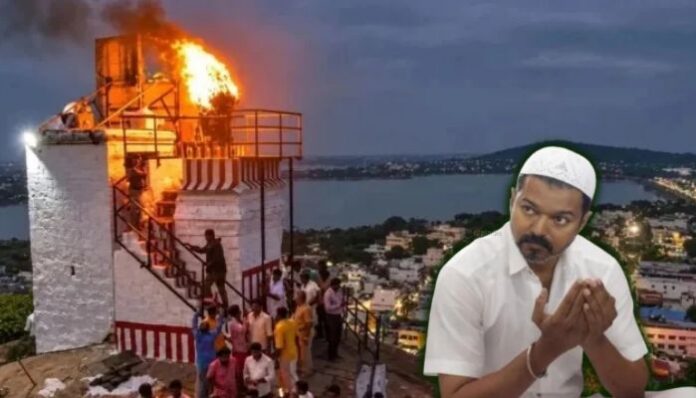
Political secularism is so inextricably enmeshed in Muslim appeasement and Hindu neglect that governments helmed by ‘secular’ parties go to any lengths to ensure that Hindu rights are crushed. The excuse is almost always the ‘greater good’ of society, maintenance of ‘communal harmony’, ‘law and order ‘, and whatnot. In Tamil Nadu, the CM C Joseph Vijay-led TVK government has moved a review petition on 22nd November against the recent Supreme Court order allowing Hindus to light the Karthigai Deepam at the Deepathoon atop Thiruparankundram Hill on 24th November.
Supreme Court allows lighting of Karthigai Deepam atop the Thiruparankundram Hill in Madurai
On 20th November, the Supreme Court allowed the lighting of ‘Karthigai Deepam’ atop the Thiruparankundram hill in Madurai, during the Karthigai Deepam festival on November 24, 2026.
A Bench comprising Justices Aravind Kumar and Vipul M. Pancholi passed the order with the condition that only authorised persons from the Devasthanam (temple administration) and government officials will be able to conduct the lamp lighting ceremony.
The court granted the interim relief considering the present circumstances. It noted that if the lighting of the lamp was not allowed on the festival, no subsequent relief would be able to make up for that.
However, the court emphasised that the permission was a one-time measure for this year’s festival alone. The Bench further cautioned that the permission creates no right of custom, access or ownership regarding the hill.
“At this stage, it is neither necessary nor appropriate to express any opinion on the competing claims,” the bench said.
Muslims fume over Supreme Court allowing one-time lighting of Karthigai Deepam, TVK government rushes to file review petition
As soon as the Supreme Court granted one-time permission for lighting of Karthigai Deepam at the Deepathoon atop the Thiruparankundram Hill, the ruling ‘secular’ Tamilaga Vettri Kazhagam (TVK) government raised objections.
The opposition parties, except the BJP, opposed the Supreme Court ruling.
Demonstrating their vehemence for upholding secularism at the cost of trampling over Hindu sentiments, the opposition parties, including the DMK, accused the TVK government of delay in filing a review petition.
The Congress party, which is an alliance partner in the TVK-led government, also defended the review petition, citing communal harmony.
Meanwhile, the CPI and CPI(M) welcomed the petition and called the Supreme Court ruling ‘erroneous’.
It was only the BJP and AIADMK spokespersons who condemned the TVK government’s review petition.
The TVK is reported to be holding a meeting of MLAs of its alliance parties at its official residence tonight over the Deepam issue.
Such is the state of affairs in Tamil Nadu that there is a very thin Hindu-side representation in Tamil Nadu politics, with most mainstream political parties constantly engage in a competition of outmanoeuvering each other in being anti-Hindu.
Why TVK government filed review petition even though the Supreme Court ruling granted only one-time permission for lighting the Karthigai Deepam?
The Supreme Court ruling has granted only a one-time permission to light the Deepam, and yet the TVK government and the allied and opposed political parties alike have been charged up to prevent the Hindu ritual.
The question arises: Why? What is the real chagrin of the TVK government?
In its review petition, the HR&CE Commissioner under the TVK government has contended that granting one-time permission amounts to granting final relief at the interlocutory stage itself.
It asks whether the Supreme Court should have issued a mandatory interim direction without the petitioners establishing a strong prima facie case and demonstrating that the balance of convenience favoured them.
The petition invoked provisions of the Tamil Nadu Hindu Religious and Charitable Endowments Act, 1959.
It highlighted that under Section 28(1), trustees are responsible for administering the affairs of religious institutions. Section 63(e) empowers the Joint Commissioner to inquire into and decide questions concerning established usage in a religious institution.
The TVK government’s review petition says that the question of where the Hindu temple’s traditional lamp should be lit must be addressed through the appropriate statutory and institutional process instead of determining it through an interim judicial direction.
It also argued that there is no established customary or legal right to light the lamp at the stone pillar atop the hill.
The review petition also claims that the Hindu petitioners have not presented documentary evidence establishing that the location was historically used for the ceremony.
The TVK government essentially expressed its apprehension that granting even one-time permission for lighting the traditional lamp, Karthigai Deepam, would set a precedent for future claims.
It says that allowing the lighting of the traditional lamp can be interpreted as the Supreme Court’s validation of the same and by extension, the claim laid by the petitioners.
Pertinently, the review petition is worried about the Deepathoon’s proximity to a nearby Islamic shrine named Sikandar Badhusha Dargah.
The CM C Joseph Vijay-led government is concerned that lighting a traditional Hindu lamp at this spot close to a Dargah could pose a risk of disturbing communal harmony.
These, however, are technical answers. The real answer to the question about why the TVK government is against a one-time order lies in the motive that has birthed this whole pushback against the Supreme Court order.
The real chagrin of the TVK and the other ‘secular’ parties is not any legal overreach but inherent bias against Hindus and ideological-political compulsion to appease Muslims.
The Supreme Court order is narrow: one lighting, one day festival, with no ruling on title.
And yet, the government still moved to stay the lighting of the traditional Karthigai Deepam atop the Thiruparankundram Hill, with hours to go.
This indicates that the government has an objection to the ritual itself. If the lamp is lit and the TVK government ensures unquestioned implementation of the court order, it will end up upsetting Muslims.
In fact, this whole ‘communal harmony will be disrupted’ argument put forth by Muslim-appeasing pretentious ‘secular’ parties, not only in this case, but in general, essentially means that if Hindus do not relinquish their believed religious rights even if they have a court ruling in their favour, Muslims might get upset, and possibly to the extent that they might turn violent and exercise street veto.
Remember, before and after the Supreme Court order on the Ayodhya Ram Janmabhoomi dispute case, Islamo-leftists continuously gaslighted Hindus for seeking legal remedy for reclaiming their temple.
From the Ram Janmabhoomi Movement to the struggle for Kashi Vishwanath, Krishna Janmabhoomi and many other Hindu temples encroached upon, repurposed or destroyed by Muslims, Hindus have constantly been vilified for even approaching courts to reclaim what they believe are their temples.
Arguments change: ‘instead of a temple, we should build schools, hospitals’, ‘instead of developing scientific temper, communal tensions are being stoked through manoeuvres to reclaim old temples’, and whatnot.
This is true in other contexts as well.
However, what doesn’t change is constant, direct, indirect, rhetorical or in the form of actions, reminder to the Hindu community that it is solely their responsibility to adjust their religious beliefs, festivals, traditions and suppress their religiosity to preserve ‘communal harmony’, ‘secularism’, and ‘peace ‘, while the Muslims are not required to shoulder this burden.
Just weeks back, the Islamo-leftist coterie was working overtime to advocate allowing Muslim men in Garba events during Navratri because they believe that the festival represents ‘inclusivity’, which, somehow for them, is incomplete without Muslim representation.
If a movie like Chhaava shows the atrocities committed by the Mughal tyrant Aurangzeb against Chhatrapati Sambhaji Maharaj and Muslims somehow get offended and run riots against Hindus in Maharashtra, Islamo-leftists blame the movie, the producer, and the actors but not Muslim intolerance.
Congress opposed Karthigai Deepam at Deepathoon during the DMK era, and it continues to do so when in alliance with TVK
The Congress party, though only a small alliance partner with 5 seats, has publicly opposed the lighting of Karthigai Deepam at the Deepathoon. Its spokesperson, Manickam Tagore, is reported to have said that the RSS, Hindu Munnani, the BJP and “the BJP’s B-team like Annamalai” want to create ‘communal tension ‘.
“The intention of the govt is very clear: we don’t want to disturb the communal harmony and goodwill in Tamil Nadu, while the RSS, Hindu Munnani, the BJP, and the BJP’s B-team like Annamalai all want to create communal tension in Tamil Nadu. We are all standing here in Thiruparankundram,” Tagore said.
Congress had taken a similar position when it was a partner in the previous DMK government.
The Congress party and its leaders, particularly Rahul Gandhi, have in recent years been trying desperately to portray themselves as greater and truer Hindus than the ‘political Hindus’ of the BJP.
From the controversial invocation of Lord Shiva, his Abhay Mudra in the Lok Sabha, to using sculptures depicting Shiva-Shakti as Ardhnarishwar to defend his recent man-child talk, ‘Mumma sitting in Papa’s lap’, Rahul Gandhi has been trying to show that he truly understands and stands for Hinduism.
However, his party’s vilification of Hindu Munnani and the extended Hindu community for seeking legal remedy for lighting the traditional lamp at Deepathoon shows that the Congress’s stance and rhetoric on issues concerning Hindus change in states as per political convenience.
Decades back, cutting poonool or Janeu, smashing idols of Hindu deities by Periyarists was glorified as a fight for equality, social justice and freedom from superstition. Now opposing Karthigai Deepam at Deepathoon is being portrayed as not an anti-Hindu act but an act of preserving ‘communal harmony’.
This is how conveniently opposing Hindu causes and interests is packaged and presented as a struggle to protect secularism, tolerance, communal harmony, the idea of India, and whatnot.
After Hindus successfully reclaimed the Ayodhya Ram Mandir, the Islamo-leftist coterie lives in constant fear that another religious or civilisational victory, big or small, would only bolster the motivations of the Hindu community to reverse more and more historical wrongs.
Thus, even a strictly one-time court order, a petition demanding an ASI survey of a historical site and even rhetorical expression of the Hindu intent not to forfeit their believed rights anymore, is unsettling and unacceptable for the anti-Hindu and Muslim-appeasing political-ideological cabal.
The Karthigai Deepam dispute
The litigation stems from a dispute concerning the Thirupparankundram hill in Madurai, Tamil Nadu. The hill accommodates three religious sites relating to Hindus, Jains and Muslims.
At its foothills is the Arulmigu Subramaniya Swamy Temple, one of the six sacred abodes of Lord Murugan.
The hilltop is home to the Sikandar Badusha Avuliya Dargah, a shrine associated with the Sufi saint Sikandar Badusha. In addition to these, the hill also contains ancient Jain caves, inscriptions and rock beds.
The hill has long been associated with Hindu traditions. The fresh dispute arose last year after Hindu devotees, who wanted to light the Hindu ceremonial lamp (Karthigai Deepam) atop the hill, faced opposition from people from the Muslim community and the Tamil Nadu government.
The Muslims and the government opposed the lamp lighting on the stone pillar located atop the hill, citing the stone pillar’s proximity to the Sikandar Badusha Dargah.
In December 2025, a single-judge Bench of Justice G R Swaminathan allowed the Hindu devotees’ plea and directed the Arulmigu Subramania Swamy Temple administration to light the lamp at the stone pillar called Deepathoon.
Thereafter, the matter reached the Madras High Court last year. A single-judge bench of Justice G R Swaminathan allowed the Hindu devotees’ plea and directed the Arulmigu Subramania Swamy Temple administration to light the lamp at the stone pillar in December.
Subsequently, a Division Bench of the High Court upheld the Single Bench’s decision in January 2026. The present order comes in the appeals filed by the Tamil Nadu government against the decision of the Division Bench of the High Court.
TVK’s Muslim and Christian appeasement policies
The TVK government in Tamil Nadu has been accused of squandering state funds on freebies and Muslim appeasement-driven schemes even as the state’s financial health is deteriorating.
Recently, the TVK government announced that the state government will cover the full undergraduate tuition fees for Muslim female students admitted under the government quota in government, government-aided, and self-financing colleges. For this, the government allocated ₹20 crore.
Minister A M Shahjahan also announced the expansion of the Tamil Nadu Waqf Board scholarship for Muslim girls, from Classes 1-8 to Classes 9-10 at ₹2,000 per year. The scheme is expected to benefit 41,384 Muslim schoolgirls for Rs 8.28 crore.
An announcement was also made about a ‘minorities’ women’s college in Chennai through the Waqf Board, with an initial grant of ₹2.45 crore.
Moreover, the Vijay government has also announced a ₹100 crore interest-free revolving fund for loans to develop income-generating assets like marriage halls, commercial complexes, etc. on Muslim and Christian properties.
The state government will also construct a new headquarters for the Tamil Nadu Waqf Board at an estimated cost of ₹40 crore. The administrative grant for the state Waqf Board will also be raised to ₹5 crore.