

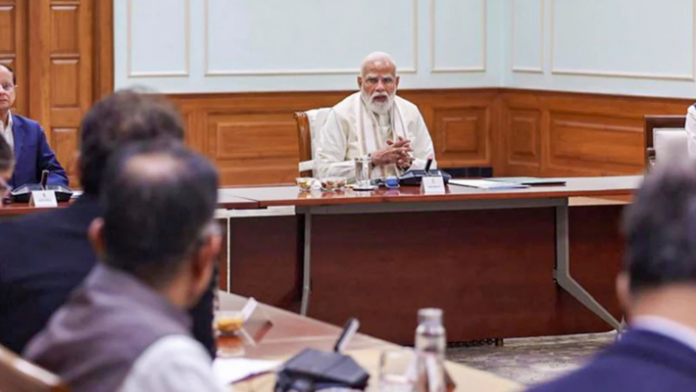
Prime Minister Modi chaired a meeting of the Economic Advisory Council (EAC) on Saturday to discuss ideas, including measures to boost the country’s economic growth amid global instability. According to the discussions held at the meeting, India is likely to attract around $70 billion in foreign funds due to the steps taken by the government and the Reserve Bank of India (RBI) a day before.
The measures taken by the Ministry of Finance include removing tax on long-term and short-term capital gains and withholding tax on investment by FIIs in government bonds. In RBI’s Monetary Policy Committee (MPC) meeting held on Friday, the Governor Sanjay Malhotra announced that the policy repo rate will be kept unchanged at 5.25% and a neutral stance amid geopolitical tensions, inflation concerns and supply chain disruptions will be maintained. The RBI made it easier for banks to mobilise foreign deposits and for PSUs to raise external commercial borrowings.
Additionally, the RBI announced several other measures to boost foreign inflows, including a temporary concessional forex swap facility for Public Sector Undertakings for their External Commercial Borrowings and the revival of the very successful Foreign Currency Non-Resident (Bank) Deposits scheme of 2013, with the central bank bearing the full exchange rate hedging cost.
After the EAC meeting, PM Modi said that discussions were held relating to India’s economic transformation and long-term development priorities. “Deliberated on a wide range of issues relating to India’s economic transformation and long-term development priorities. Also shared perspectives on adding more momentum to the reforms journey and ensuring “Ease of Living” as well as ‘Ease of Doing Business’,” PM Modi wrote on X after the meeting.
Chaired a meeting of the Economic Advisory Council to the Prime Minister. Deliberated on a wide range of issues relating to India’s economic transformation and long-term development priorities. Also shared perspectives on adding more momentum to the reforms journey and ensuring… pic.twitter.com/1BkP1EyuFe
— Narendra Modi (@narendramodi) June 6, 2026
Notably, the inflow of funds depends on the inclusion of government bonds in the Bloomberg Global Aggregate Bond Index. Many global funds keep an eye on these bond indices and invest accordingly. India’s finding a place in the index is crucial for attracting indirect investment flows. The inflows into the government debt market are helpful in lowering the interest paid by the Centre on its borrowings.
According to the Indian Express, economic experts believe that the measures taken by the Finance Ministry and the RBI are likely to accelerate the inclusion of Indian sovereign debt in the Bloomberg Global Aggregate Bond Index. This could lead to the inflow of $20-25 billion over the 10 months.
In January this year, Bloomberg Index Services Ltd (BISL) had deferred the inclusion of Indian government bonds into its flagship global index, saying it would provide another update by mid-2026. “Overall, responses indicated broad support for the long-term trajectory of the Indian government bond market and for its potential eventual inclusion in global investment grade benchmarks,” the BISL said in a statement issued on January 13. “At the same time, a number of respondents highlighted important operational and market-infrastructure considerations that merit further evaluation before inclusion in a flagship global investment grade index,” it added.
