

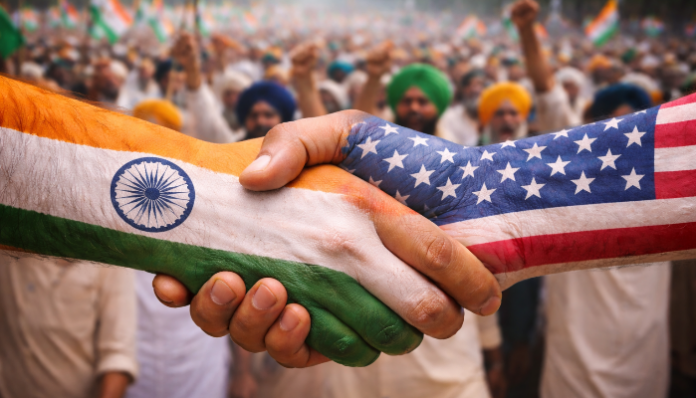
Some organisations of famers including the Sayunkt Kisan Morcha (SKM) and All India Kisan Sabha (AIKS) have voiced their disapproval regarding the interim trade deal framework between India and the United States that was announced recently. They have also called for nationwide protests against it and endorsed the general strike on 12th February (Thursday).
The SKM demanded the immediate resignation of Union Commerce and Industry Minister Piyush Goyal in a statement released on 7th February (Saturday), accusing that the framework of the pact between the two nations represented a “total surrender” of Indian agriculture to multinational companies of the US.
🚨 Farmers’ groups oppose India–US trade deal, back Feb 12 strike
— Nabila Jamal (@nabilajamal_) February 9, 2026
Samyukt Kisan Morcha (SKM), AIKS and other farmer bodies term the proposed interim India–US trade deal a “surrender” of Indian agriculture to US multinationals
SKM says protests will be held nationwide, including… pic.twitter.com/kqSAFC0eZj
“The framework is an abject rejection of the claim of the Commerce Minister Piyush Goyal that the agriculture and dairy sectors are out of the Free Trade Agreements and the Government of India will not make any compromise on the interests of agriculture. The commerce minister is consciously propagating falsehood and betraying the farmers and the entire people. SKM considers the role of the commerce minister as a traitor and demands his immediate resignation. Also, SKM demands that the prime minister desist from signing the India-US Free Trade Agreement or face massive pan-India united mass struggles,” read the official statement.
The SKM encouraged all political parties, trade unions, organisations representing farmers and agricultural workers along to participate in the 12th February agitation. The members also announced that effigies of US President Donald Trump and Prime Minister Narendra Modi would be burnt during the demonstrations that will take place in hamlets all around the nation.
The SKM (Non-Political) claimed that Indian farmers would not accept any such deal in a formal release and informed it would soon convene a meeting to launch widespread demonstrations over the issue. Jagjit Singh Dallewal complained that the joint statement outlined that India consented to talk about and settle non-tariff barriers placed on US agricultural and food products, despite Goyal’s tweet assuring that agriculture and the dairy sector are going to be protected.
He argued that these two stances are incompatible and the joint statement makes it apparent that the centre is ready to open Indian markets to American agricultural products under pressure from the US which will result in major losses for the country’s farmers.
AIKS leader Krishna Prasad contended that the development would have a significant effect on the dairy industry as well as the agriculture sector by creating a market for products like soybean oil, red sorghum for animal feed and dried distillers grains. He claimed that India’s interests were not served by the accords with the US and the European Union which were made to boost their “stagnant” economies.
Darshan Pal, the leader of the Punjab-based Krantikari Kisan Union, mentioned that the group would protest by burning effigies of Trump and Modi. According to him, farmers who are currently struggling with poor income and loan repayment would be further impacted by the agreement. Rakesh Tikait of the Bhartiya Kisan Union (BKU) stated that people are wondering how the deal will affect them and asked farmers to join the protest. Meanwhile, alleged activist Sunilam wanted the matter to be raised in the Parliament.
How opposition peddled its agenda to mislead farmers
OpIndia had previously explained how individuals such as Aam Aadmi Party’s Sanjay Singh and propagandist Yogendra Yadav disseminated disinformation about the India-US deal to incite farmers. Singh stated that PM Modi had “lied to the nation” and “betrayed crores of farmers” by allowing the US to access India’s agricultural market at zero percent tax and added that the move was aimed to save Gautam Adani after he was subjected to corruption allegations by US Department of Justice.
जिसका डर था, वही हुआ।
— Yogendra Yadav (@_YogendraYadav) February 7, 2026
इंडो-यूएस ट्रेड डील के संयुक्त बयान ने साफ़ कर दिया है कि पहली बार भारतीय कृषि को अंतरराष्ट्रीय व्यापार समझौते का हिस्सा बनाया जा रहा है। कुछ कृषि उत्पादों पर आयात शुल्क शून्य कर दिए गए हैं, मक्का-सोया जैसे उत्पाद पिछले दरवाज़े से प्रवेश कर रहे हैं और आगे… pic.twitter.com/bonvOx7D1a
Yadav further contributed to the narrative by insisting that while certain products will be imported without any import duties, others such as maize and soya are set to infiltrate the Indian market through the “back door.” He called upon farmers to unite against what he described as an “attack.” According to him, the Modi government is also prepared to loosen restrictions on the importation of dairy products and genetically modified crops from animals on non-vegetarian diets.
It is important to note that there is no basis for these allegations, as the Trump administration has not issued any such statement and now it has been illustrated how these falsehoods were penetrated only to instigate strikes and protests against the government. It is utterly untrue for opposition to maintain that India has already signed the trade agreement with the United States because the two parties have only struck a framework for an interim trade agreement. The Free Trade Agreement has not yet been finalised, much less signed.
Major agricultural goods such as rice, wheat and maize, among others are not included in the joint statement. Similarly, soybean oil and dried distillers grains (DDG) won’t enter through the ‘backdoor.’ The concept that India does not import farm products and is currently being pressured to do so by the United States is another major fallacy circulated by the opposition and its ecosystem. On the contrary, India has historically been an important buyer of agricultural products as a result of its enormous domestic need. Moreover, no country on the planet can satisfy all of its agricultural requirements independently.
However, the opposition and its supporters are not concerned about these realities, as their sole objective is to denounce the Modi government regardless of the merits of its decisions or the consequences of their own devious actions on national interests and they have once again acted in the same manner in relation to the India-US trade pact.
