

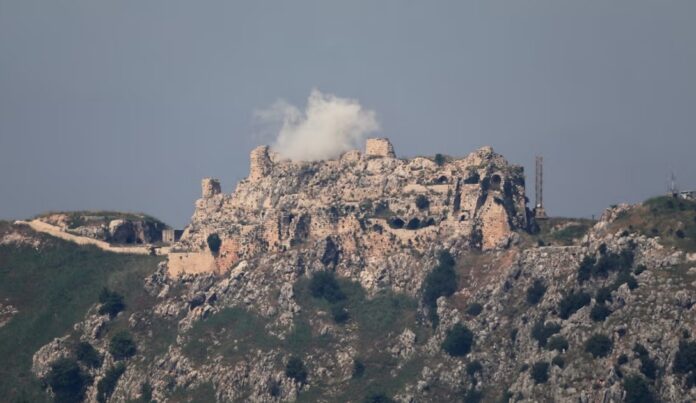
Israeli troops have seized the historic Beaufort Castle and its commanding ridge in southern Lebanon, marking the deepest ground incursion into the country since Israel’s withdrawal in 2000. The Israel Defense Forces (IDF) announced the capture on Sunday following days of intense airstrikes, artillery barrages, and ground clashes with Hezbollah fighters in the rugged terrain.
The medieval fortress, built by Crusaders in the 12th century atop a steep mountain near the city of Nabatiyeh and roughly 15 km from the Israeli border, overlooks wide swaths of southern Lebanon and parts of northern Israel. Its capture represents a significant tactical advance for Israel in its ongoing operations against the Iran-backed Hezbollah militia in Lebanon, even as a nominal ceasefire from weeks earlier holds tenuously.
Israeli Defense Minister Israel Katz hailed the operation as a major achievement. In a statement, he posted images of the Israeli flag raised over the castle ruins and declared: “44 years after the heroic Battle of Beaufort, and on this day commemorating the soldiers who fell in the First Lebanon War (1982), our troops have returned to the summit of Beaufort and once again raised the Israeli flag there.”
44 שנים אחרי קרב הגבורה על הבופור, וביום האזכרה לחללי מלחמת שלום הגליל ובהם חיילי גולני שנפלו בקרב על הבופור – לוחמי צה"ל ובראשם חטיבת גולני, שבו אל פסגת הבופור והניפו עליה מחדש את דגל ישראל ואת דגל גולני.
— ישראל כ”ץ Israel Katz (@Israel_katz) May 31, 2026
בהנחיית ראש הממשלה נתניהו ובהנחייתי, צה"ל הרחיב את התמרון בלבנון, חצה את… pic.twitter.com/NjtlYSZqu4
Katz added: “Under Prime Minister Benjamin Netanyahu and my direction, the IDF expanded the operations in Lebanon, crossed the Litani River, and captured the Beaufort Ridge — one of the most important strategic points for defending the communities of the Galilee and safeguarding the security of our forces.” He called it a “clear message to our enemies: anyone who threatens Israeli civilians will lose their strategic assets one by one.”
Prime Minister Benjamin Netanyahu described the capture as “a dramatic stage and a dramatic shift in the policy we are leading,” directing forces to “deepen and expand our hold on areas that had been under Hezbollah’s control.” He emphasized that Israel has “returned to Beaufort differently… united, determined, and stronger than ever.”
הלוחמים הגיבורים שלנו כבשו את הבופור ואנחנו ממשיכים עד שנשלים את המשימה pic.twitter.com/j0oBy2z9cG
— Benjamin Netanyahu – בנימין נתניהו (@netanyahu) May 31, 2026
The Israeli army’s Arabic spokesperson Avichay Adraee posted a photograph on X showing Israeli troops walking outside the castle. He said, “The control of Shaqif Castle is not just a military achievement, but a new shattering of the symbolism of the arrogance of the terrorist Hezbollah party, which threatened us with weakness only for its fortresses to crumble before our strikes.”
بين وعود الشعارات وحقيقة الميدان.. هنا الخبر اليقين. جنودنا يكتبون بوقفتهم على قلعة الشقيف فصلاً جديدًا من العزة 🇮🇱🇮🇱
— افيخاي ادرعي (@AvichayAdraee) May 31, 2026
لا يبنى المجد بالخطابات، بل بوقع خطى الجنود. السيطرة على قلعةالشقيف ليست مجرد إنجاز عسكري، بل هي تحطيم جديد لرمزية غرور حزب الله الارهابي الذي هددنا بالوهن… pic.twitter.com/WCSlyLaZES
The IDF stated that Golani Brigade troops, supported by other units, led the operation to establish operational control over the Beaufort Ridge and Wadi al-Saluki area, targeting Hezbollah positions and infrastructure. One Israeli soldier was reported killed during the fighting.
IDF said that a significant number of IDF ground soldiers were involved in the operation, which was “currently expanding to additional areas”. The development indicates that Israeli ground forces are moving ever deeper into Lebanese territory beyond their original demarcation line of the Litani river.
Beaufort Castle: Symbol of military control
Beaufort Castle, known as “Qala’at al-Shaqif” in Arabic, has long been a symbol of military control in the region due to its elevated position. Constructed around 1139 by Crusader forces, with earlier fortifications possibly dating back further, it was later captured by Saladin’s forces and has changed hands across centuries of regional conflicts.
In modern history, Israeli forces first captured the castle in 1982 during the First Lebanon War from Palestinian Liberation Organization (PLO) fighters. The IDF held the site for 18 years as a key outpost until the full withdrawal from southern Lebanon in 2000. During that period, it became a focal point of resistance and a symbol of division within Israeli society over the costs of the occupation.
Hezbollah later utilised the surrounding ridge for military infrastructure, launching attacks and managing operations against Israeli communities, including the Galilee Panhandle and Metula.
Strategically, the ridge provides commanding views over key routes, the Litani River valley, and surrounding areas, making it ideal for observation, artillery positioning, and disrupting enemy movements. The IDF described the area as hosting significant Hezbollah infrastructure built with Iranian assistance, from which hundreds of projectiles had been launched toward Israel. Controlling it allows Israel to expand its “forward defence line,” dismantle launch sites, and reduce direct threats to northern Israeli civilians.
The move comes amid heightened tensions, following one of the heaviest days of Hezbollah fire toward northern Israel since the April ceasefire, which prompted school closures and restrictions in Israel. Lebanese officials, including the culture minister, have expressed concern over potential damage to the UNESCO-protected site, though reports indicate the castle structure remains largely intact amid the ruins.
