

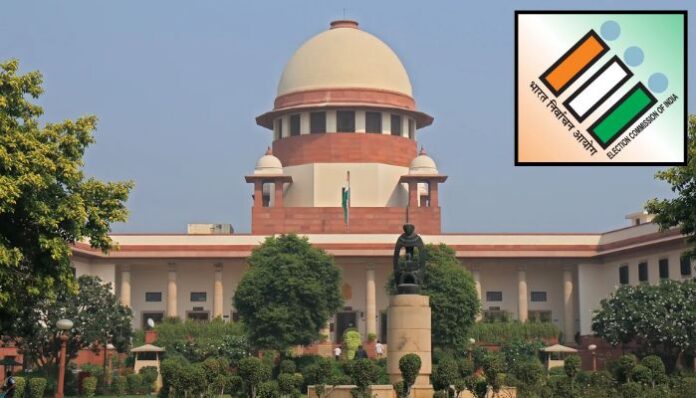
The Supreme Court on Tuesday, 27th May, upheld the Election Commission of India’s decision to conduct a Special Intensive Revision (SIR) of electoral rolls and said the exercise was aimed at strengthening free and fair elections in the country.
Observing that the SIR exercise is “a step towards an accurate and inclusive electoral roll,” the Supreme Court said that the process “breathes life into the Constitution” by strengthening the foundations of free and fair elections.
A bench comprising Chief Justice Surya Kant and Justice Joymalya Bagchi delivered the judgment while hearing petitions challenging the Election Commission’s notification issued last year for carrying out the SIR process in Bihar.
Big Victory For Election Commission, SC Upholds EC's Power To Conduct SIR — 'We Are Equally Satisfied…'https://t.co/sOU8GqdWBe
— NDTV Profit (@NDTVProfitIndia) May 27, 2026
Supreme Court backs Election Commission’s powers
The Court ruled that the Election Commission has the authority to conduct such revisions under Article 324 of the Constitution, along with provisions of the Representation of the People Act, 1950.
While delivering the verdict, Chief Justice Surya Kant said the SIR process was directly connected to maintaining the integrity and accuracy of electoral rolls, which are essential for fair elections.
“When the statute itself authorises a special revision at any time, the exercise cannot be invalidated merely because it does not follow every ordinary procedure used during routine revision,” the Court observed.
The Court held that the procedure adopted by the ECI in conducting SIR did not violate the law and had nexus with the Constitutional goal of free and fair elections.
— Live Law (@LiveLawIndia) May 27, 2026
Read more: https://t.co/xIWOZKIQFc#SupremeCourt #SIR #ECI pic.twitter.com/UjOt0tgVzV
The bench further stated that the SIR exercise did not go beyond the powers granted to the Election Commission. Instead, it was aimed at protecting the constitutional requirement of free and fair elections.
The Court also rejected arguments that the revision process violated existing election laws or unfairly questioned the citizenship of voters already listed in electoral rolls.
“Calling upon electors to furnish supporting material does not amount to negation of the citizenship presumption. It is simply a verification process,” Chief Justice Kant said.
ECI can examine citizenship issues for the voter rolls
The Supreme Court clarified that the Election Commission has the power to examine questions related to citizenship while preparing electoral rolls. However, it also made clear that the Commission’s findings would apply only to voter registration and would not decide a person’s citizenship status permanently.
The Court said that if the Election Commission finds doubts regarding someone’s eligibility, the matter must be referred to the competent authority under the Citizenship Act for a final decision.
The bench also directed the Election Commission to forward the names of individuals deleted from the 2003 electoral rolls over doubtful citizenship to the Central Government within four weeks.
Background of the case
The controversy began after the Election Commission launched a Special Intensive Revision of electoral rolls in Bihar last year, ahead of the Assembly elections. Several organisations, including the Association for Democratic Reforms and the National Federation for Indian Women, challenged the process in the Supreme Court.
The petitioners argued that the SIR exercise could lead to the arbitrary deletion of voters and might disenfranchise lakhs of genuine citizens. However, the Election Commission defended the move, saying it was necessary to remove duplicate and inaccurate entries from voter lists.
Initially, around 65 lakh names were deleted from Bihar’s draft electoral rolls, though the figure later came down to 47 lakh after revisions and appeals. The Election Commission later extended the SIR exercise to states like West Bengal, Kerala and Tamil Nadu as well.
