

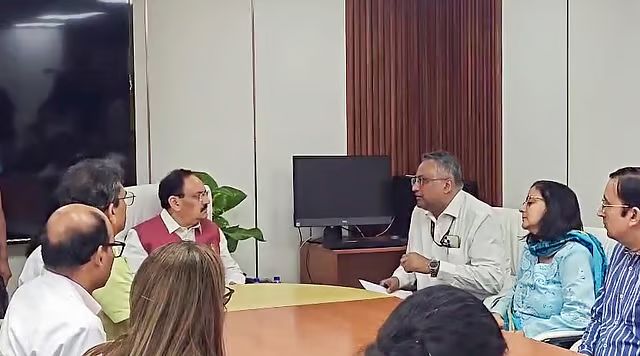
Union Health Minister JP Nadda on Tuesday visited the injured protesters admitted to Ram Manohar Lohia (RML) Hospital, a day after violent demonstrations over the alleged NEET-UG 2026 paper leak rocked the national capital. The visit came as the Centre sought to contain the political fallout from Monday’s clashes and opened channels of communication with protest leaders.
The protests, spearheaded by the Cockroach Janta Party (CJP), saw thousands attempt a ‘Sansad Chalo’ march towards Parliament, demanding the resignation of Union Education Minister Dharmendra Pradhan. The demonstration descended into violent clashes with Delhi Police, leaving scores of protesters and police personnel injured while bringing large parts of central Delhi to a standstill.
Earlier in the day, Nadda also met a CJP delegation comprising national spokesperson Ashutosh Ranka and chief spokesperson Saurav Das at his residence. Speaking briefly after the meeting while heading to the NDA Parliamentary Party meeting, ‘Mangal Milan’, Nadda remarked, “It was fine, it is always fine.”
According to the CJP, the delegation pressed three principal demands before the Union Minister: the resignation of Dharmendra Pradhan, ₹1 crore compensation for the families of NEET aspirants who allegedly died by suicide, and the immediate release of activist Sonam Wangchuk, who remains hospitalised. The party asserted that its agitation would continue until the government accepted these demands.
In a post on X, Ranka claimed the delegation had insisted on Pradhan’s immediate resignation or removal. He said Nadda assured them the matter would be taken up “at the appropriate level”, though no firm commitment was offered.
Nadda, however, presented a different version of events. In his own post on X, he said the initiative for dialogue had come from the protesters and described the meeting as cordial. He added that after extensive discussions, the delegation submitted a written memorandum at around 4 pm.
The CJP disputed this account, claiming it was the government that initiated the outreach. It further alleged that Nadda sought time to consult the government’s top leadership on the demands relating to Wangchuk’s release, Pradhan’s resignation and compensation for affected families.
Monday’s ‘Sansad Chalo’ march witnessed dramatic scenes across central Delhi as police used batons and tear gas to prevent protesters from advancing towards Parliament. Students, parents, senior citizens and supporters carrying the Tricolour and placards participated in the demonstration, demanding accountability over the alleged examination paper leak.
Delhi Police said more than 118 personnel, including senior officers, were injured in the violence, while around 60 protesters also sustained injuries. The police alleged that demonstrators hurled stones, attempted to breach barricades and vandalised public property. The CJP, meanwhile, accused the police of using excessive force and alleged pellet guns were fired at protesters, a charge that police have not responded to publicly.
The confrontation also echoed inside Parliament, where Opposition members repeatedly disrupted proceedings over the issue, intensifying pressure on the government as the NEET controversy continued to dominate the political discourse.
