

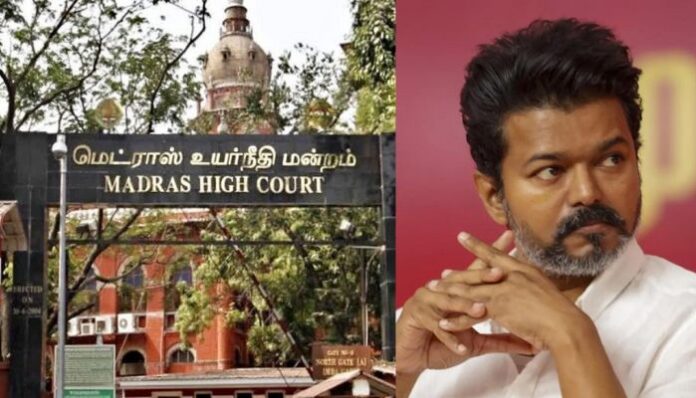
On Friday, 6th January, the Madras High Court turned down a writ petition from actor-turned-politician Vijay, who founded the Tamilaga Vettri Kazhagam (TVK) party. He was challenging a ₹1.5 crore penalty slapped on him by the Income Tax Department. The penalty came because he didn’t voluntarily report an extra ₹15 crore income back in the financial year 2015-16.
Justice Senthilkumar Ramamoorthy declined to quash the penalty order. The court ruled that the Income Tax Department had issued the penalty within the time limit provided under the Income Tax Act. Vijay’s main contention was that the penalty proceedings were initiated too late and were thus invalid. However, the court rejected such a claim and dismissed his petition.
How the case began
The case relates to a search and seizure operation conducted by the Income Tax authorities at Vijay’s premises on 30th September, 2015. During the raid, officials apparently found documents suggesting that certain income had not been disclosed earlier.
The producers of Vijay starrer Puli, released in 2015, had reportedly paid ₹4.93 crores in cash apart from ₹16 crores through cheque forms. The Tax Deducted at Source was only for the cheque payments, but not for the cash payment.
When investigated and questioned about this, Vijay supposedly admitted to accepting the amount of ₹5 Crore in cash and agreed to pay the necessary taxes. Later, in an attempt to cooperate and settle the case, Vijay agreed to add an income of ₹15 Crore for that year, which would include the amount in cash.
On 29th July, 2016, Vijay filed his income tax return for the assessment year 2016-17, declaring a total income of ₹35.42 crore. This amount included the additional ₹15 crore. He also claimed certain deductions, including depreciation of ₹17.81 lakh on assets and an exemption of ₹64.71 lakh for fans’ club expenses.
However, the department rejected these claims. In an assessment order dated 30 December, 2017, Vijay’s taxable income was revised to ₹38.25 crore. The order noted that the additional income was disclosed only because of the search operation. Based on this, the department imposed a penalty under the Income Tax Act.
Vijay had earlier filed statutory appeals on some parts of the assessment.
Court’s observations
The Income Tax Department argued that the penalty was imposed strictly as per the law and within the permitted time frame. It also maintained that the income disclosure was not voluntary but was made only after the search and seizure.
Agreeing with the department, Justice Ramamoorthy ruled that the penalty order was valid and issued within the legal time limit. However, the court made it clear that Vijay is free to approach the appropriate appellate authority if he wishes to challenge the penalty on other grounds. Those aspects were not examined in the present writ petition. With this ruling, the Madras HC has effectively closed Vijay’s challenge on the issue of limitation, though the larger legal process may continue if he decides to pursue further appeals.
