

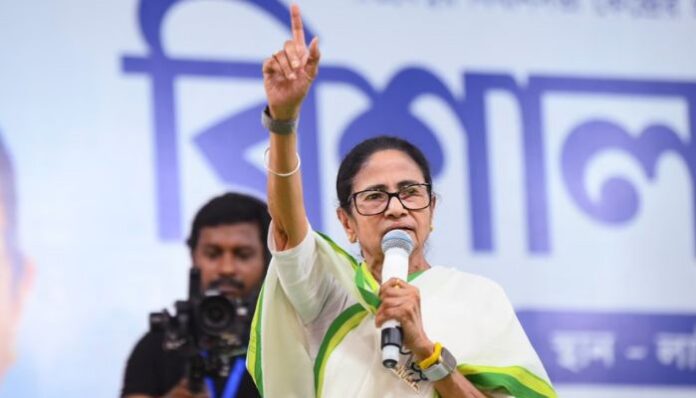
In the middle of the West Bengal Assembly election campaign, Chief Minister Mamata Banerjee has once again sparked a political debate with her sharp remarks targeting the Bharatiya Janata Party (BJP). Speaking at a rally in Samsherganj, she warned voters that if her party, the Trinamool Congress (TMC), is not re-elected, the BJP would “bury the Bengali language.”
VIDEO | West Bengal Assembly elections: “If TMC is not voted back to power, BJP will bury the Bengali language,” says CM Mamata Banerjee at a poll rally in Samsherganj.#WestBengalPollsWithPTI
— Press Trust of India (@PTI_News) April 5, 2026
(Source: Third Party)
(Full video available on PTI Videos – https://t.co/dv5TRAShcC) pic.twitter.com/YfJSjPLaqT
She went a step further, calling the BJP “satanic” and urging people to vote for TMC candidate Amirul. According to her, if people fail to support TMC, the BJP would take control of regions like Malda, Murshidabad, and North Bengal. She also claimed that multiple conspiracies are underway, suggesting that certain forces are trying to change the social and political fabric of the state.
Past remarks and controversy over religious messaging
This is not the first time Mamata Banerjee’s speeches have stirred controversy. Over the years, critics have accused her of making statements that appear aimed at consolidating Muslim votes.
Earlier this year, during an Eid gathering, she made a statement saying, “Hum kafir nahin hai,” while addressing a crowd. She added that her supporters are not afraid and know how to fight, and even said, “We will fight against them. We will finish them.” The use of the word “kafir” triggered strong reactions, as many pointed out that the term is often used in a religious context to describe non-Muslims.
The controversy did not stop there. Mamata Banerjee also used the word “jihad” in a political context while calling for strong resistance against the BJP. Later, she defended herself by saying that in Bengali usage, the term meant a strong protest rather than anything religious.
Meanwhile, BJP leader Subramanian Swamy, who has often positioned himself as a strong Hindu voice, was criticised by some for overlooking Mamata’s past statements for political reasons.
Post-poll violence and allegations
The issue of post-election violence in West Bengal continues to be a major point of attack against the TMC government. After the 2021 Assembly elections, several reports of violence surfaced, particularly targeting BJP workers.
The Vishwa Hindu Parishad (VHP) claimed that more than 3,500 villages were affected and over 40,000 Hindus, including many from SC and ST communities, suffered losses. According to the organisation, homes, shops, and crops were destroyed, and there were serious allegations of atrocities against women.
Critics of the state government have repeatedly linked this violence to political rivalry and accused the ruling party of failing to control law and order.
“If we are not there…” was a warning that raised eyebrows
Adding to the controversy, Mamata Banerjee recently made another statement that many saw as a direct appeal to religious sentiments. She warned that her presence in power ensures people’s safety, saying that if her government were not there, “a certain community” could unite and surround others, finishing them off “in one second.”
This remark has been widely debated, with opponents claiming that it indirectly suggests fear of one community against another, while her supporters argue that it was meant as a political warning about instability
Political strategy or polarisation?
Mamata Banerjee has long been a vocal critic of Prime Minister Narendra Modi and the BJP. However, her recent statements, ranging from calling the BJP “satanic” to invoking religious terms like “kafir” and “jihad,” along with warnings about community tensions, have intensified the political narrative ahead of elections.
While TMC maintains that it is fighting for inclusivity and regional identity, the BJP and other critics argue that such remarks are part of a broader strategy to polarise voters along religious lines.
As West Bengal heads toward crucial elections, these statements are likely to remain at the centre of political discourse, shaping both campaign strategies and voter perception.
