

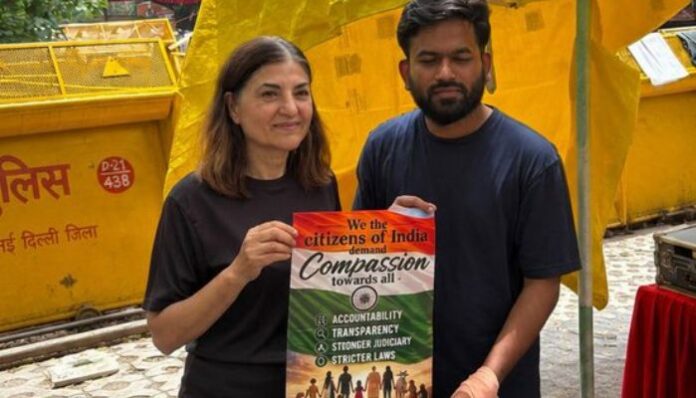
Ambika Shukla, sister of former Union minister Maneka Gandhi, joined the ongoing Cockroach Janta Party (CJP) protest at Jantar Mantar in New Delhi on Sunday, 12th July, and expressed support for what she described as a broader movement for compassion and justice in society.
Speaking to reporters at the protest site, Shukla said her participation was linked to issues such as animal welfare and support for vulnerable communities, which are completely unrelated to the motive of the organised so-called protest.
“Our effort is to build an India that is honest and compassionate for everyone, for weaker sections, for animals and for persons with disabilities,” she said.
Shukla also praised the protesters who have continued their agitation for several days despite difficult conditions. “We are happy that our friends standing here have shown that today’s generation is ready to fight for the country, ready to stand for principles and prepared to walk this path to take the country in the right direction,” she said.
Maneka Gandhi's Sister Reached Cockroach Janta Party protest to raise voice of Weaker section including "Animals".pic.twitter.com/HIZAeA1efD
— News Algebra (@NewsAlgebraIND) July 12, 2026
Referring to activist Sonam Wangchuk, she said, “The country needs an education minister like Sonam Wangchuk, and I fully support the CJP and its founder, Abhijeet Dipke.”
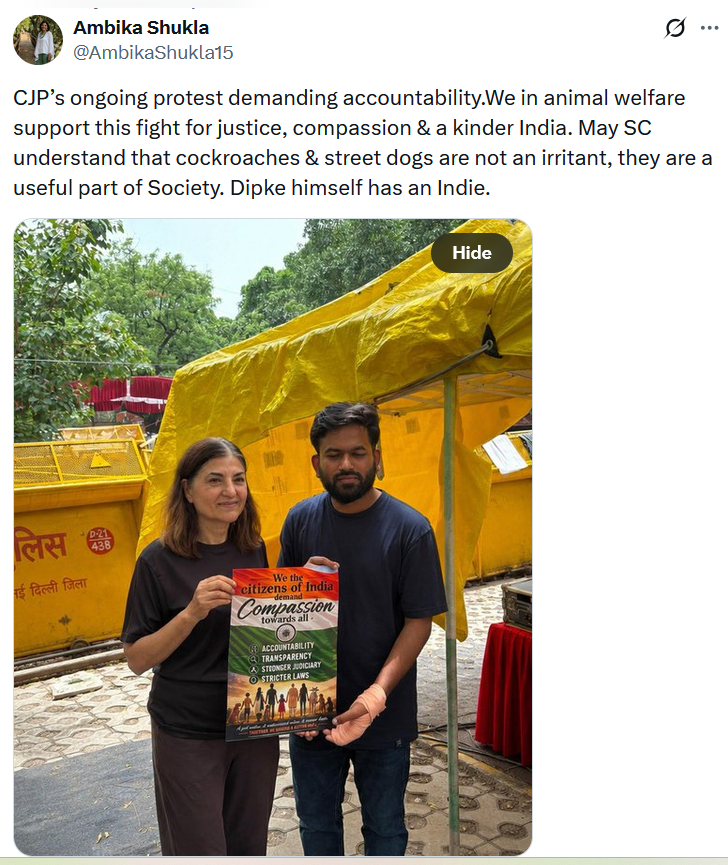
She further said, “Our education system has many weaknesses. We need to make animal welfare a part of the syllabus so that future generations learn compassion for animals. We are hopeful that the whole of India will rise and support them.”
Who is Ambika Shukla?
Ambika Shukla is an animal welfare activist and the sister of former Union minister and BJP MP Maneka Gandhi. She has been associated with campaigns related to animal rights and welfare issues for several years and has often participated in demonstrations and public campaigns concerning stray animals and animal protection laws.
Earlier this year, she was also in the news for her comments during protests against the relocation of stray dogs from Delhi-NCR to shelters following a Supreme Court order. During that protest, her remarks on rabies and stray dog attacks created huge controversy on social media as she downplayed the seriousness of the disease and spread misinformation about rabies treatment.
Shukla downplayed the risks of rabies, calling it a “mild virus” and suggesting that simply washing a wound with soap could neutralise it.
“Rabies only spreads if the virus enters the bloodstream through saliva or an open wound,” Shukla said in a video shared by the X handle ‘The Red Mike’. “But the virus is so delicate that if you wash the wound with soap, it dies.” She also claimed rabies is rare in India, citing just 54 cases in a population of over a billion. “Dogs don’t bite as much as it’s made out to be,” she added.
Protests began over NEET paper leak controversy
The protest at Jantar Mantar was originally organised over allegations of irregularities in the NEET examination and demands for accountability in the handling of the paper leak controversy. Protesters had also sought the resignation of Union Education Minister Dharmendra Pradhan over the issue.
However, as the demonstrations continued, the focus of the protest gradually turned into a drama stage and beyond examination-related concerns, protesters included every other discussion, such as supporting terrorists Umar Khalid and Sharjeel Imam and playing the victim card of being a Muslim in India.
The protest became a drama stage
The shift in themes became particularly visible after speeches by student leaders and activists that touched on issues unrelated to NEET, including discussions of jailed terrorists Umar Khalid and Sharjeel Imam.
During one such address, JNUSU leader Danish Ali questioned the continued imprisonment of the two terrorists and argued that they were being punished for challenging the government.
Ali also alleged that Muslims in India were increasingly being made to feel insecure and treated as second-class citizens. Her remarks sparked debate online, with critics questioning why a protest centred on the NEET controversy had moved towards broader political and ideological issues.
This was not the first controversy linked to the protests. During an earlier demonstration at Jantar Mantar in June, videos circulated on social media showing protesters confronting journalists who had arrived to cover the event.
The footage triggered criticism from sections of the media and social media users, who argued that journalists should be allowed to report freely without intimidation.
