

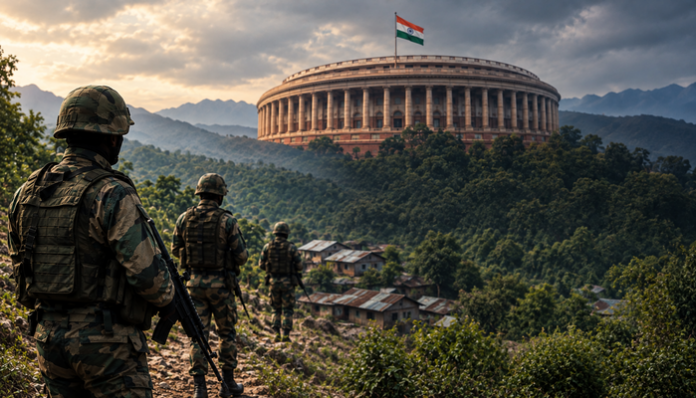
The Union Ministry of Home Affairs (MHA) on Friday (September 25, 2026) extended the Armed Forces (Special Powers) Act, 1958 (AFSPA) in the disturbed areas of Manipur, Nagaland and Arunachal Pradesh for a period of six months with effect from October 1, 2026.
In Nagaland, the AFSPA has been retained in the nine districts of Dimapur, Niuland, Chumoukedima, Mon, Kiphire, Noklak, Phek, Peren and Meluri, besides specified police station areas in Kohima, Mokokchung, Longleng, Wokha and Zunheboto districts. It covers the areas of Khuzama, Kohima North, Kohima South, Zubza and Kezocha police stations in Kohima district, Mangkolemba, Mokokchung-I, Longtho, Tuli, Longchem and Anaki ‘C’ in Mokokchung, Yanglok in Longleng, Bhandari, Champang and Ralan in Wokha and Ghatahi, Pughoboto, Satakha, Suruhoto, Zunheboto and Aghunato in Zunheboto district.
In Arunachal Pradesh, the Act will be effective in Tirap, Changlang and Longding districts and the areas falling within the jurisdiction of Namsai, Mahadevpur and Chowkham police stations in Namsai district, bordering Assam.
The Act will remain effective in the entire state of Manipur, barring areas falling under the jurisdiction of 13 Police stations in five districts. The excluded areas include police station jurisdictions in Imphal West, Imphal East, Thoubal, Bishnupur and Kakching districts.
The Centre had removed the application of the law from areas under 15 police stations across six districts in April 2022. A year after that, in April 2023, the four police station areas were excluded from the category of “disturbed area”. In 2004, the law was removed from the Imphal Municipality area, covering seven Assembly constituencies.
The Centre keeps reviewing the implementation of the law based on the existing security and law-and-order situation in the areas where the Act is effective. The current extension comes amid continued security concerns and incidents of unrest in three states.
Recently, security concerns emerged in various areas across the three states. In Manipur, certain incidents in hill districts of Kangpokpi, Tamenglong, Noney, Ukhrul and Kamjong triggered security concerns. On September 24, 2026, four Naga civilians were reportedly killed at Pilong, in Kamjong, by Myanmar-based perpetrators.
The incident was followed by demands for enhanced security measures and stringent action against the culprits. Several incidents of violence were recently reported in many Naga villages along the Imphal-Tamenglong road in Kangpokpi, resulting in casualties and vandalism. Kuki militant groups have been blamed for the occurrences.
Apart from the three states, the AFSPA is also currently effective in three districts of Assam, namely Tinsukia, Charaideo and Sivasagar. The Act has been effective in the state since April. Earlier, it was effective across the state, and was reduced to 23 districts and partially removed from one more district. Subsequently, it was limited to eight districts by April 2023 and later reduced to three districts. In addition to the northeastern states of India, the law is also active in Jammu & Kashmir.
What is AFSPA?
The Armed Forces (Special Powers) Act, 1958, grants the security forces special powers to maintain law and order in areas designated as “disturbed” under it. It was enacted to curb armed insurgency and separatist violence in the state of Assam at the time. The law was introduced to deal with an internal disturbance by the intervention of armed forces when the civil administration becomes incapable of dealing with it. The armed forces are deployed in aid of the civil authorities.
