

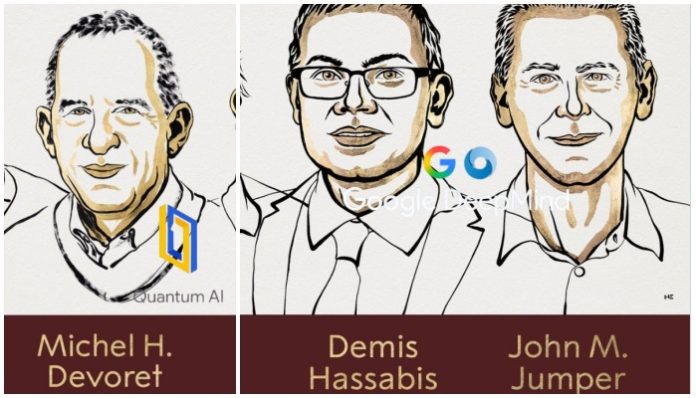
Google has just won its third Nobel Prize in two years, and the fifth by association.
On October 7, 2025, the Nobel Prize in Physics was awarded to Michel Devoret, Chief Scientist of Quantum Hardware at Google Quantum AI, and John Martinis, former Quantum AI hardware lead, for groundbreaking experiments revealing quantum mechanical effects in macroscopic systems.
BREAKING NEWS
— The Nobel Prize (@NobelPrize) October 7, 2025
The Royal Swedish Academy of Sciences has decided to award the 2025 #NobelPrize in Physics to John Clarke, Michel H. Devoret and John M. Martinis “for the discovery of macroscopic quantum mechanical tunnelling and energy quantisation in an electric circuit.” pic.twitter.com/XkDUKWbHpz
The 2024 Nobel Prize in Chemistry was shared by Demis Hassabis, the CEO of Google DeepMind, and John Jumper, the Director at DeepMind, for their revolutionary AI-driven protein design tool, AlphaFold.
BREAKING NEWS
— The Nobel Prize (@NobelPrize) October 9, 2024
The Royal Swedish Academy of Sciences has decided to award the 2024 #NobelPrize in Chemistry with one half to David Baker “for computational protein design” and the other half jointly to Demis Hassabis and John M. Jumper “for protein structure prediction.” pic.twitter.com/gYrdFFcD4T
Geoffrey Hinton, a former Google VP and researcher, won the Nobel Prize in Physics in 2024 for foundational work on artificial neural networks.
Including two former associations, that is, John Martinis for the Nobel Prize in Physics in 2025, and Geoffrey Hinton for the Nobel Prize in Physics in 2024, Google has now been associated with 5 Nobel prizes in cutting-edge, advanced scientific research. The prizes highlight the company’s pivotal role in advancing AI and quantum technologies, cementing Google’s place at the frontier of innovation.
Nobel Prizes in scientific fields are often dominated by top universities. Though Google seems to be leading now, it is not the top private company to have won Nobel Prizes.
Bell Labs, a subsidiary of AT&T, has 11 Nobel Prizes in total, 9 in Physics, 1 in Chemistry, and 1 in Economics. IBM has 4 Nobel Prizes in Physics and 1 in Physiology and Medicine. DuPont has 2 in Chemistry and 1 in Physics, and General Electric has one each in Physics and Chemistry. Merck & Co. has 2 Nobel Prizes in Physiology and Medicine. All these companies are of USA origin, though the Nobel Prizes sometimes involve researchers of different countries.
