

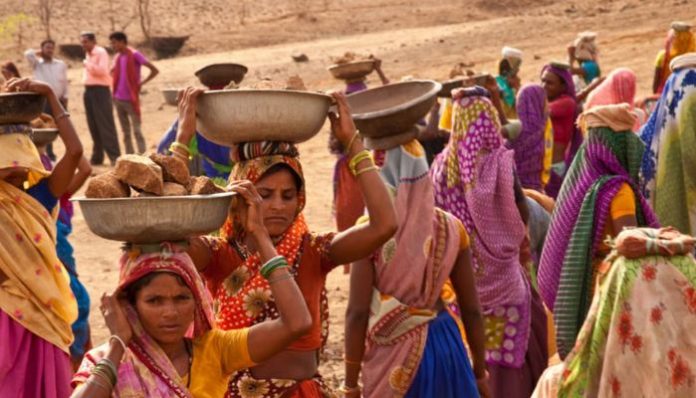
The Centre is considering a significant revamp of the Mahatma Gandhi National Rural Employment Guarantee Act (MGNREGA), including increasing the guaranteed number of workdays for rural households from the current 100 days to 125 days. According to the media reports, the amended Bill was cleared by the Union Cabinet in its meeting held on Friday, 12th December.
Along with expanding the number of guaranteed workdays, the government is also weighing a change in the name of the law. According to the sources, the Act may be renamed the Pujya Bapu Rural Employment Guarantee Act, which would require a formal amendment to the existing legislation.
The National Rural Employment Guarantee Act was first passed in 2005. In 2009, during the UPA government’s tenure, it was renamed the Mahatma Gandhi National Rural Employment Guarantee Act, effective from 2nd October that year. If the NDA government decides to rename it again and increase the work guarantee to 125 days, Parliament will have to pass amendments to the law.
When the UPA renamed the Act in 2009, it had argued that linking Mahatma Gandhi’s name to the law would strengthen its focus on equality and inclusion, especially for marginalised communities.
Fewer households reaching the 100-day limit
Although the law promises up to 100 days of employment to every eligible rural household, actual work provided on the ground remains much lower. In 2024-25, the average number of days of employment per household was only around 50. Official data shows that just 40.70 lakh households managed to complete the full 100 days of work last year.
The numbers are even lower in the current financial year. So far, only about 6.74 lakh families have reached the 100-day ceiling, highlighting the gap between what the law guarantees and what many workers actually receive.
Linked to future finance commission plans
The proposal to expand the scheme comes at a time when the government has already started the approval process to continue MGNREGA under the Sixteenth Finance Commission’s recommendations. These awards will come into effect from 1st April, 2026, making this an important moment for the government to decide the future shape of the scheme.
In 2022, the Ministry of Rural Development, which oversees MGNREGA, had set up a committee to examine how the scheme was performing across states and to look into governance-related issues. The committee submitted its report last year, and its findings are believed to have fed into the current discussions.
Over the years, several states such as Andhra Pradesh, Madhya Pradesh, Chhattisgarh and Rajasthan have repeatedly asked the Centre to raise the 100-day work limit. While states are allowed to provide work beyond 100 days, they have to bear the cost themselves, and only a few have been able to do so consistently.
States funding extra work on their own
In 2024-25, MGNREGA generated about 290 crore person-days of work across the country. However, only 4.35 crore person-days came from state governments using their own funds. States like Maharashtra, Chhattisgarh, Odisha, Himachal Pradesh, Kerala, Rajasthan, Madhya Pradesh and Telangana are among those that have used their own budgets to extend employment beyond the central limit.
Legally, Section 3(1) of the MGNREG Act mentions “not less than one hundred days” of work per household in a year. But in practice, 100 days has become the upper limit because the scheme’s software does not allow entries beyond that threshold unless a state or Union Territory makes a special request.
Even now, there are some exceptions built into the law. For instance, Scheduled Tribe households living in forest areas can get up to 150 days of work if they do not own any private land apart from what they have received under the Forest Rights Act. Similarly, under Section 3(4) of the Act, the Centre can allow an additional 50 days of work in areas affected by drought or officially notified natural disasters.
Scale, spending and changing demand
Since its launch in 2005, MGNREGA has generated over 4,872 crore person-days of employment. The total spending under the scheme so far stands at around ₹11.74 lakh crore. Initially rolled out in 200 backward districts in 2006-07, it was expanded to 130 more districts the following year and covered the entire country by 2008-09.
Demand for MGNREGA peaked during the COVID-19 pandemic. In 2020-21, a record 7.55 crore rural families sought work under the scheme as migrant workers returned to their villages during lockdowns. Since then, participation has steadily declined, from 7.25 crore families in 2021-22 to 5.79 crore in 2024-25. Data from the last three years does not include West Bengal, where the scheme has remained suspended since March 2022.
In the ongoing 2025-26 financial year, around 4.71 crore families, involving 6.25 crore individuals, have availed work under MGNREGA until 12th December.
