

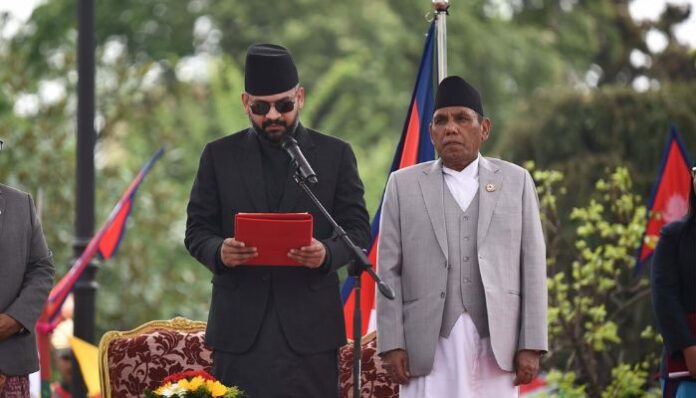
In a historic moment for Nepal, Balendra Shah, popularly known as Balen Shah, took oath as the country’s Prime Minister on Friday, 27th March in a ceremony held at the President’s Office, Sheetal Niwas. The event stood out as the oath ceremony was conducted in a Vedic–Sanatan tradition for the first time, drawing wide attention across the country.
#WATCH | Kathmandu: Rastriya Swatantra Party (RSP) leader Balendra Shah takes oath as Prime Minister of Nepal
— ANI (@ANI) March 27, 2026
Video source: Nepal Television/YouTube pic.twitter.com/Th6NxTZWwm
President Ramchandra Paudel administered the oath of office and secrecy to Rastriya Swatantra Party leader Balendra Shah, who was appointed under constitutional provisions earlier in the day. The ceremony included traditional rituals like shankhnaad, recitations by 108 Batuks, and chanting by Buddhist monks, making it a unique blend of cultural practices.
At just 35, Shah has become one of Nepal’s youngest prime ministers and also the first leader from the Madhesi community to hold the post. His rise has been remarkable from a rapper and structural engineer to Kathmandu’s mayor in 2022, and now the Prime Minister. He won the Jhapa-5 seat in the March 5 parliamentary elections, defeating senior Communist Pparty leader and former prime minister KP Sharma Oli in what was considered his stronghold.
Nepal it seems now has World’s Youngest Government Leaders in Power!! Most of the Ministers are in 30s and 40s. Only Finance Minister is above 50. The new Government in Nepal is led by 36 year old @ShahBalen as the Prime Minister. pic.twitter.com/XrVCTBMpB8
— Aditya Raj Kaul (@AdityaRajKaul) March 27, 2026
Soon after taking oath, Shah announced his Cabinet, which includes 14 ministers, many of whom are in their 30s and 40s. 10 out of 15 members, including the Prime Minister, are under 40 years old, with the oldest being Finance Minister Swarnim Wagle at 51. The relatively young team has quickly become a talking point on social media, with many praising the shift towards a younger leadership and fulfilling the wishes of Gen Z, who had toppled the Oli government in September 2025.
This reflects the momentum from last year’s Gen Z-led protests that toppled the previous government amid widespread frustration over corruption, political instability, and lack of opportunities for Nepal’s young population.
Among key appointments, Swarnim Wagle has taken charge as Deputy Prime Minister and Finance Minister, while Sudan Gurung will handle the Home Ministry. Shishir Khanal has been given the Foreign Affairs portfolio. Other ministers include leaders handling key departments such as education, health, energy, agriculture, labour, law, and infrastructure. Shah has also retained important portfolios like Defence and Industry.
The 14 ministers in the Balen Shah government are Swarnim Wagle, Sudan Gurung, Shishir Khanal, Sunil Lamsal, Biraj Bhakta Shrestha, Khadak Raj Paudel, Sasmit Pokharel, Nisha Mehta, Bikram Timalsina, Pratibha Rawal, Sobita Gautam, Geeta Chaudhary, Dipak Kumar Shah, and Sita Badi. The cabinet features five women ministers, which one-third of the ministers are women.
Prime Minister Narendra Modi extended warm congratulations to Shah on his swearing-in.
नेपाल के प्रधानमंत्री पद की शपथ लेने पर बालेंद्र शाह जी को हार्दिक बधाई!
— Narendra Modi (@narendramodi) March 27, 2026
आपका कार्यभार संभालना नेपाल की जनता द्वारा आपके नेतृत्व में भरोसे को जताता है। मुझे विश्वास है कि हम मिलकर भारत-नेपाल की मित्रता और सहयोग को एक नई ऊंचाई पर ले जाएंगे, जो दोनों देशों के लोगों के पारस्परिक…
Shah, a structural engineer and former mayor of Kathmandu, rose to prominence as an independent voice critical of traditional parties. His RSP secured a massive mandate, nearly two-thirds of seats in the House of Representatives, capitalizing on public discontent with established politicians. His leadership, along with a young Cabinet, is being seen as a fresh political shift in Nepal’s governance.
The new administration faces significant challenges: reviving Nepal’s economy, creating jobs to stem youth emigration, tackling corruption, and maintaining balanced relations with neighbours India and China. Finance Minister Wagle, an economist with international experience, is expected to play a central role in economic reforms.
