

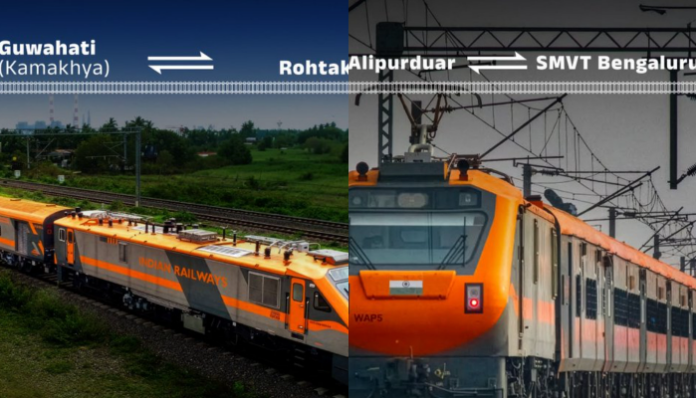
On 13th January (Tuesday), Railway Minister Ashwini Vaishnaw declared that nine Amrit Bharat Express trains would soon be flagged off from West Bengal and Assam to various regions of the nation. He explained the origin and destination stations of the trains and added that the non-AC service will link West Bengal and Assam with Bihar, Uttar Pradesh, Odisha, Andhra Pradesh, Tamil Nadu, Maharashtra and Karnataka.
The nine new trains to be launched are Guwahati (Kamakhya)-Rohtak Amrit Bharat Express, Dibrugarh-Lucknow (Gomti Nagar) Amrit Bharat Express, New Jalpaiguri-Nagercoil Amrit Bharat Express, New Jalpaiguri-Tiruchirappalli Amrit Bharat Express, Alipurduar-SMVT Bengaluru Amrit Bharat Express, Alipurduar-Mumbai (Panvel) Amrit Bharat Express, Kolkata (Santragachi)-Tambaram Amrit Bharat Express, Kolkata (Howrah)-Anand Vihar Terminal Amrit Bharat Express, and Kolkata (Sealdah)-Banaras Amrit Bharat Express.
9 New Amrit Bharat Express trains to be flagged off soon!
— Ashwini Vaishnaw (@AshwiniVaishnaw) January 13, 2026
Routes 🧵👇 pic.twitter.com/bjq9HoZOI5
The railways ministry stated, “Designed to cater to heavy passenger volumes, especially during festive seasons and peak migration periods, these trains will provide reliable, affordable and comfortable connectivity for travellers commuting for employment, education and family needs across different parts of the country,” in an official statement.
Notably, a significant portion of the nation’s migrant labour force and long-distance rail travellers reside in Assam, Bihar and West Bengal, where the new Amrit Bharat Express trains are scheduled to be launched. The development will increase the number of modern and cost-effective trains and offer affordable extended connectivity.
These trains are intended to become critical lifelines for migrant workers, students, traders and families that frequently travel between the eastern part and the southern educational, industrial and commercial hubs. They will improve communication between the Dooars region in the northeast and the country’s major industrial and urban centres in the south and west.
The trains will also serve as reliable social and economic links for geographically isolated but strategically significant areas, enhancing access to markets, employment, healthcare and education. These will help industrial, seaside and pilgrimage areas by facilitating easier travel along the eastern stretch.
Foldable snack tables, cellphone and bottle holders, radium floor strips, cosy seats and beds, modern restrooms with electro-pneumatic flushing, fire suppression systems, and accommodations for disabled travellers are just a few of the conveniences that people are set to experience inside the trains. Their comfort is further improved with pantry cars and fast charging stations.
