

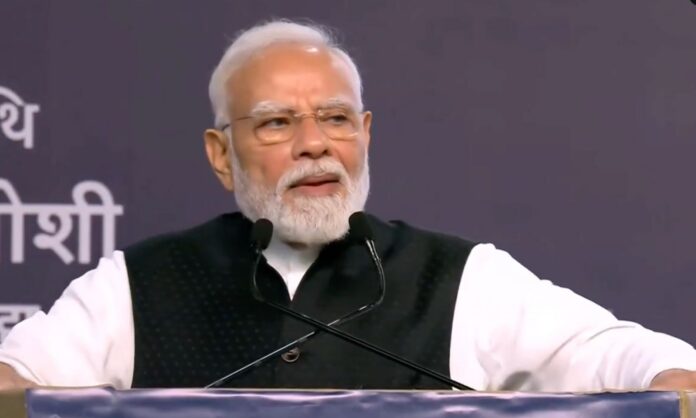
PM Modi returned to Delhi University’s Shri Ram College of Commerce (SRCC) on Saturday, 13 years after his last address at the prestigious institution, but this time with a distinctly contemporary vocabulary.
Addressing students at SRCC’s centenary celebrations, Modi mixed his political message with phrases more commonly heard on social media, describing the college’s distinguished alumni as the “OGs” and invoking the recently popular film Dhurandhar while speaking to the students.
"Dhurandhar na ho, lekin dhoom toh machayi hai": PM Modi at centenary celebration of SRCC pic.twitter.com/iKy8WmvW8a
— NDTV (@ndtv) September 5, 2026
The choice of language added a lighter touch to an address that otherwise focused heavily on how India had changed between 2013 and 2026.
‘What I said in 2013 was my conviction’
Modi opened by drawing attention to his previous visit to SRCC in 2013, when he was the chief minister of Gujarat.
He noted that portions of that speech had resurfaced and were being watched and discussed again in recent days.
“What I said in 2013 was my conviction,” Modi told the students, before asking them to revisit the circumstances in which he had delivered that address.
He encouraged the audience to look up newspaper reports from 2013 and examine what India was going through at the time, when the Congress-led UPA government was in power.
The Prime Minister contrasted the political and economic environment of that period with the situation under his government, pointing to inflation, corruption, terror attacks and concerns over economic growth.
According to Modi, India at the time was experiencing a sense of “disappointment and despair”, with growth struggling and inflation remaining high.
He also recalled the description of India as part of the international “Fragile Five” grouping, using it to underscore his argument that the country’s economic standing has changed considerably over the past decade.
PM Modi calls SRCC Alumni the ‘OGs’
Modi also turned his attention to SRCC’s alumni, many of whom have gone on to prominent positions in economics, business, public life and politics.
Using terminology familiar to younger internet users, he said the college’s distinguished former students were the “OGs” — an abbreviation commonly used to mean “original” or someone who commands longstanding respect.
He highlighted SRCC’s contribution to producing generations of students who have made their mark not just in India but internationally.
The Prime Minister also praised the institution for its academic legacy and its role in shaping leaders across different fields as it completed 100 years.
The ‘Dhurandhar’ reference
The most unexpected moment of the speech came when Modi brought popular culture into his interaction with the students.
Encouraging them to make an impact, he used the word “Dhurandhar”, a term that has gained considerable currency following the popularity of the film of the same name.
“You may not be a Dhurandhar, but make some noise,” Modi said in his interaction with the students.
The reference appeared designed to strike a conversational chord with a younger audience, allowing the Prime Minister to move between political history, contemporary internet language and popular culture during the address.
He also used the word “revisit” while asking students to look back at India’s circumstances when he had last spoken at SRCC.
From 2013 to 2026: Modi’s India comparison
A significant portion of Modi’s speech was devoted to comparing India in 2013 with the country in 2026.
On national security, he contrasted the approach towards Pakistan and cross-border attacks before 2014 with the response under his government.
“Today, when Pakistan does something, we enter their home and strike,” Modi said, referring to his government’s approach to cross-border threats.
On the economic front, he pointed to India’s latest growth figures. The economy expanded by 7.8 per cent in the April-June quarter of 2026, which Modi cited as evidence of the country’s stronger economic position.
His larger argument was that India had moved from an era he characterised by economic uncertainty, corruption and pessimism to one in which it is now among the fastest-growing major economies.
A speech tailored for Gen Z audience
The language Modi used at SRCC also comes against the backdrop of growing political attention on India’s Gen Z population.
Young Indians have increasingly shaped political conversations through Instagram reels, memes, short-form videos and online communities. Recent youth-led protests at Jantar Mantar further demonstrated the ability of digitally native groups to mobilise rapidly and drive public discourse.
The BJP and its leaders have consequently experimented with vocabulary associated with internet culture. BJP MPs have used expressions such as “MIA”, “FOMO” and “delulu” in Parliament, while Modi himself has increasingly adopted short-form, visually driven communication aimed at younger audiences.
His SRCC speech fitted into that broader trend.
But the choice of “OG” and “Dhurandhar” served another purpose as well: they allowed Modi to connect his return to SRCC with the institution’s present-day student community while simultaneously revisiting a speech delivered 13 years ago.
A different SRCC visit after 13 years
Modi’s return to SRCC came as the institution marked its centenary.
He arrived at the college after taking a Delhi Metro ride, during which he interacted with children and young commuters. Earlier in the day, he had described SRCC as an institution known for academic excellence, institution-building and producing leaders in business, public life and society.
During the centenary celebrations, the Prime Minister released a commemorative ₹100 coin marking the milestone.
His relationship with SRCC has also continued between his two visits. In April, Modi met the college’s governing body and a delegation from the institution at his residence as part of its centenary celebrations and released a commemorative postage stamp.
Thirteen years after addressing SRCC as Gujarat’s chief minister, Modi therefore returned as Prime Minister — using the occasion not merely to celebrate the college’s 100-year legacy, but to ask its students to compare two Indias separated by more than a decade.
And this time, he did it in a language that included a little “OG”, a little “Dhurandhar” and plenty of political history.
