

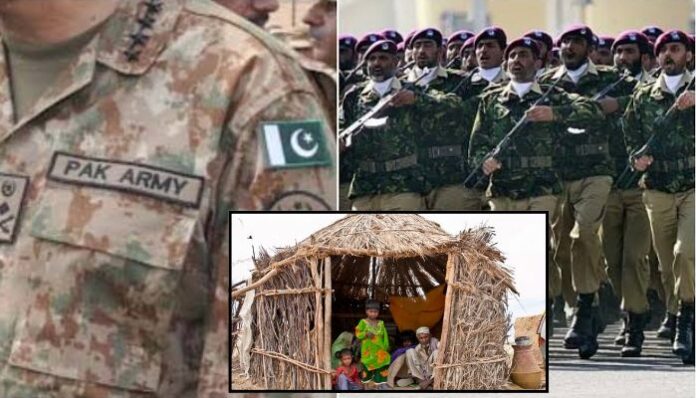
At a time when Pakistan is struggling with rising poverty, unemployment and food insecurity, its Army has sought to acquire around 435 acres of land across two villages in Khyber Pakhtunkhwa for alleged defence purposes. According to a report by The Brief, the Pakistan Army increased its land requirement from 240 acres to approximately 435 acres within seven weeks, even though the provincial administration had already stopped construction activities that it said posed a threat to the military’s new headquarters.
The development comes as nearly 70 million Pakistanis are living below the country’s national poverty line, while millions of families are struggling to afford basic food items. Household incomes have fallen, food consumption has declined, and food insecurity has increased across the country.
Pakistan Army seeks 435 acres in two villages despite construction already being stopped
According to the report, the Pakistan Army initially sought around 240 acres of land across Kenthla and Kot Jandan villages in Haripur district. However, its Military Estate Officer later requested approximately 435.2 acres, raising questions about the sudden increase in the land requirement.
The two villages are located on the Khyber Pakhtunkhwa side of the Margalla ridge, directly above the Defence Complex Islamabad. The Army had raised concerns about a private housing project being developed along the ridge, claiming that construction activities could threaten the security of its new headquarters.
The matter was taken up with the Prime Minister and Defence Minister in July and August 2023. During presentations on the headquarters project, officials from Defence Complex Islamabad raised objections to the construction. Station Headquarters Abbottabad later recorded that both the Prime Minister and Defence Minister had directed the chief secretaries of Punjab and Khyber Pakhtunkhwa to coordinate and ensure that the skyline remained unoccupied to protect sensitive military installations.
On 6th September, 2023, the Director General of Defence Complex Islamabad briefed the Khyber Pakhtunkhwa Chief Secretary in the presence of senior provincial officials. During the meeting, the Director of Buildings of the Galiyat Development Authority informed the Chief Secretary that the authority had not issued any no-objection certificate for housing societies on the ridge.
The Chief Secretary ordered an inquiry into possible negligence by local and forest officials and directed the development authority to issue legal notices to the developers. Officials were also asked to install road barriers to prevent heavy construction machinery from entering the ridge. However, the meeting minutes specifically stated that the barriers should be installed “without causing any inconvenience for the residents of Kot Jandan.”
A second meeting was held on 18th September, 2023, with officials from the revenue, finance, home and local government departments. The meeting discussed the Khyber Pakhtunkhwa Land Use and Building Control Act, 2021, and the possibility of using Section 144 to prevent construction.
The officials also discussed acquiring privately owned land under Section 4 of the Land Acquisition Act if a security checkpost was required. The Chief Secretary subsequently directed the Commissioner of Hazara to ensure that written clearance from Defence Complex Islamabad was obtained before any construction could take place along the Margalla ridge.
Army increases land requirement from 240 to 435 acres
On 22nd May, 2024, Station Headquarters Abbottabad issued a restricted directive based on instructions from the General Headquarters (GHQ) Quartering and Lands Directorate. The accompanying costing sheet identified approximately 45 acres near Kot Jandan and 195 acres near Kenthla, taking the total requirement to around 240 acres.
However, on 10th July, 2024, the Military Estate Officer for Hazara Circle sent a registered letter to the Haripur Deputy Commissioner and Land Acquisition Collector seeking 3,481 kanals and 17 marlas, equivalent to approximately 435.2 acres, across the two villages.
The letter referred to an earlier communication dated 28th June from the Haripur district administration. However, this communication was not available in the documents reviewed by The Brief. The letter was also copied to the Director General of Military Lands and Cantonments in Rawalpindi.
Following the request, the Haripur Deputy Commissioner marked the requisition “Important Top Priority” and instructed revenue officials to prepare detailed records of land ownership, village maps, market rates, property valuations and individual landowners.
On 2nd August, Station Headquarters also summoned military and civilian district officials to Abbottabad for a progress review scheduled for 5th August.
When residents travelled to the Peshawar Press Club in July 2025 to protest, they said they had not been given any clear plan for where they would go if their homes were acquired. The revenue department had already shared lists of village plots and their owners with the military.
Nearly 70 million Pakistanis living below the poverty line, food insecurity rises
The proposed land acquisition comes at a time when Pakistan is facing a serious economic and food crisis. According to the Pakistan Economic Survey, the national poverty rate increased from 21.9% in 2018-19 to 28.9% in 2024-25. This means nearly 70 million people are now living below the national poverty line.
The situation looks even worse when measured against the World Bank’s $4.20-a-day poverty line for lower-middle-income countries, under which around 120 million Pakistanis fall below the poverty threshold. Real household incomes have declined by 12% over six years, while unemployment remains a major concern. Official figures put the number of unemployed people at 5.9 million, although economist Dr Hafiz A. Pasha estimates that the actual figure could be closer to 18 million.
Poverty has increased in both rural and urban areas. Rural poverty rose from 28.2% to 36.2%, while urban poverty increased from 11% to 17.4%. Inequality has also widened, with the Gini coefficient rising from 28.4 to 32.7. Nearly four in ten children in the country are also affected by stunted growth.
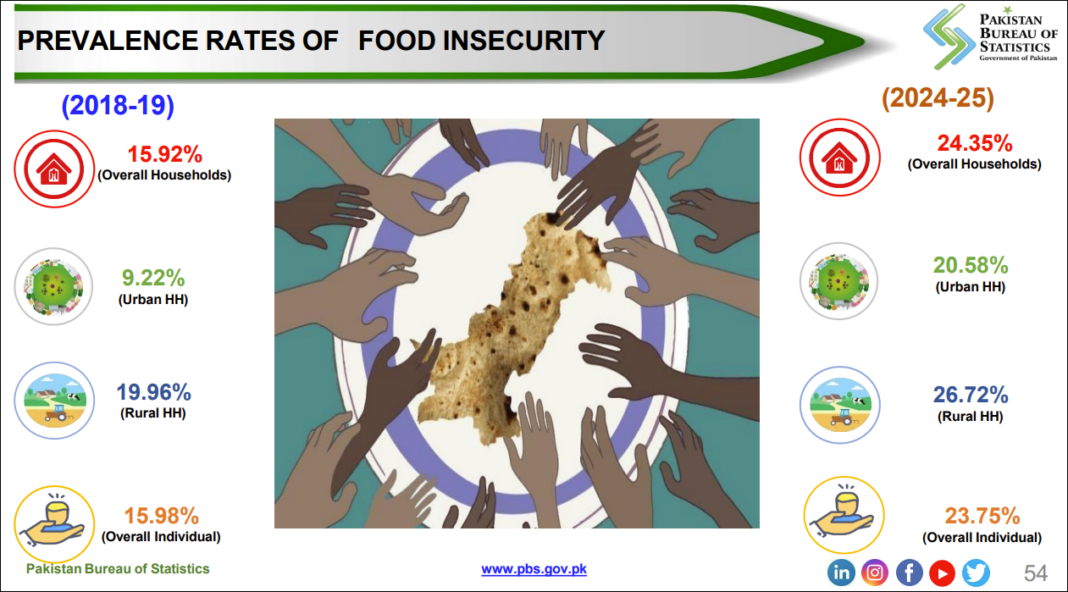
The economic crisis is also changing what ordinary Pakistani families can afford to eat. Data from the Pakistan Bureau of Statistics shows that household consumption of wheat, rice, meat, milk and even tea has declined over the last six years as families struggle with rising prices and shrinking budgets. Food insecurity has also increased sharply. The share of households facing moderate-to-severe food insecurity rose from 15.92% in 2018-19 to 24.35% in 2024-25. Severe food insecurity more than doubled during the same period, increasing from 2.37% to 5.04%.
Pakistan’s worsening economic situation has even forced many families to reduce food portions.
