

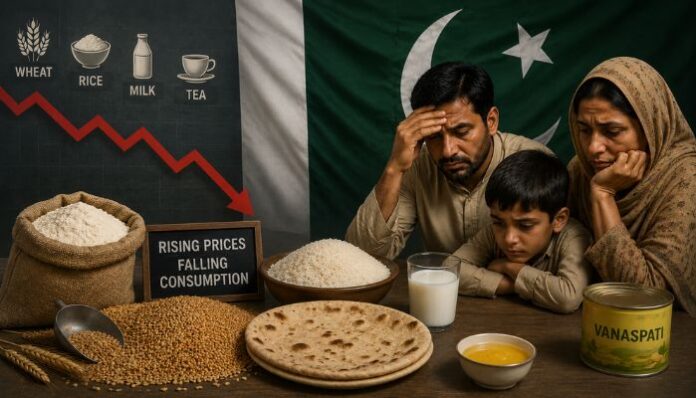
Pakistan’s food crisis has been increasingly felt in ordinary homes over the last six years, as families cut back on meat, milk, rice, wheat, and even tea because of rising prices and pressure on household budgets. Data from the Pakistan Bureau of Statistics (PBS) show that food consumption has slumped across almost all major categories in both rural and urban Pakistan.
The decline is not just about people buying less food. It also shows how the quality and composition of their diets are changing as families struggle to afford everyday necessities.
The data shows a fall in the average consumption of several commonly eaten foods. Families are eating less wheat and rice, cooking meat less often, and consuming less milk. Tea consumption has declined as well.
https://t.co/MZosGOhrVt
— The CSR Journal (@thecsrjournal) September 1, 2026
Recent data from the Pakistan Bureau of Statistics (PBS) highlights a significant decline in consumption across nearly all major food categories over the past six years. This trend is evident in both urban and rural populations, with families cutting…
This means smaller portions of staple foods, fewer meals containing meat and less milk being available for families, including children. When household incomes do not keep pace with food prices, families often have to make difficult choices about what they can afford.
There is one major exception to this trend: vanaspati ghee. Its monthly consumption increased by around 81%, rising from 690 grams to 1.25 kilograms.
Food insecurity rises sharply
The changes in food consumption are happening alongside a significant rise in food insecurity. The share of households facing moderate-to-severe food insecurity increased from 15.92% in 2018-19 to 24.35% in 2024-25.
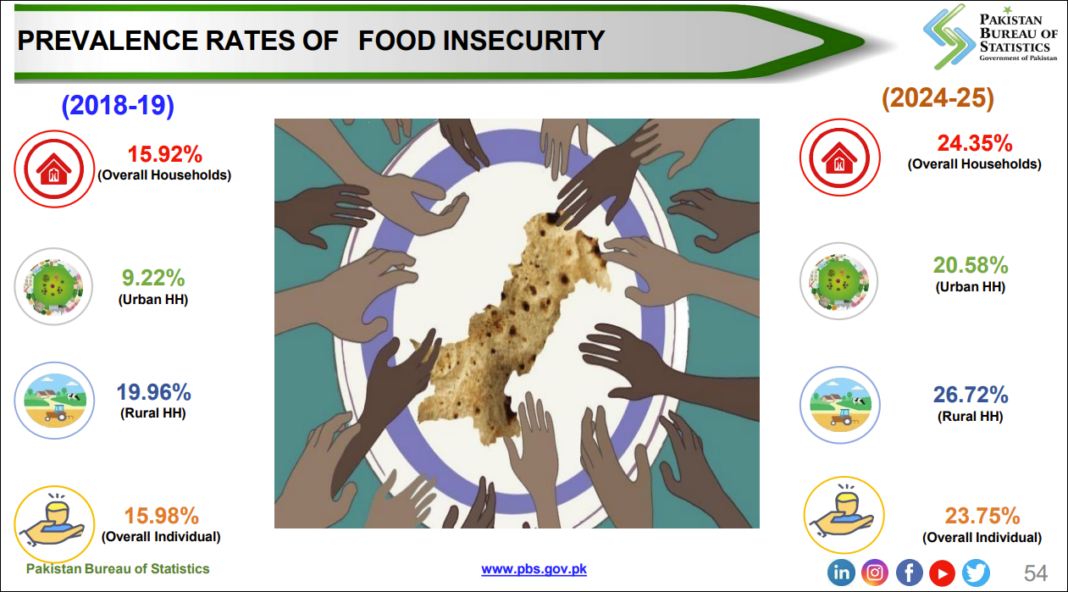
Severe food insecurity also more than doubled during the same period, rising from 2.37% to 5.04%. This means nearly one in four Pakistani households is now classified as experiencing moderate to severe food insecurity.
Food insecurity refers to inadequate or uncertain access to enough food and does not directly measure a person’s nutritional or health condition.
From ‘food available’ to ‘food affordable’
Pakistan has long presented itself as an agricultural country capable of producing enough food for its population. However, that claim of self-sufficiency has come under increasing pressure.
Pakistan has been a net food importer since at least 2021. At the same time, rising food prices have reduced what many households can afford to buy.
This is why the latest figures are not simply about food availability. Food may be available in markets, but that does not mean every family can afford enough of it.
When prices rise and purchasing power falls, families usually do not stop eating altogether. Instead, they reduce portions, buy cheaper alternatives or cut foods that are considered more expensive. Meat and milk, for example, can be costly sources of protein and other nutrients, while cheaper, calorie-heavy foods may become more attractive when budgets are tight.
The result can be a diet that provides enough calories to fill the stomach but does not necessarily provide all the nutrients needed for healthy growth and development.
Rural and urban families affected
The problem is also not limited to rural Pakistan. While food insecurity remains more common in rural areas, urban households are also reporting lower consumption of several major food categories.
This suggests that pressure on household budgets is being felt across the rural-urban divide. Families in cities and villages alike are having to reconsider what they buy and how much they consume.
The rise in severe food insecurity is particularly concerning. The proportion increased from 2.37% in 2018-19 to 5.04% in 2024-25, showing how the situation has worsened over a relatively short period.
What the changing diet means for Pakistan
The changing food habits point to a larger economic and social problem. The fall in meat and milk consumption, combined with the rise in ghee consumption, suggests that families may increasingly be choosing food based on price rather than nutritional value.
The impact could be especially serious for children. Lower consumption of nutritious foods such as milk and meat can affect diet quality and, over time, may have consequences for growth and development. For adults, poorer diets can affect energy levels and overall well-being.
The latest figures therefore present Pakistan with a difficult question. The issue is no longer simply whether the country can produce enough food. It is whether ordinary families can afford to eat enough nutritious food.
