

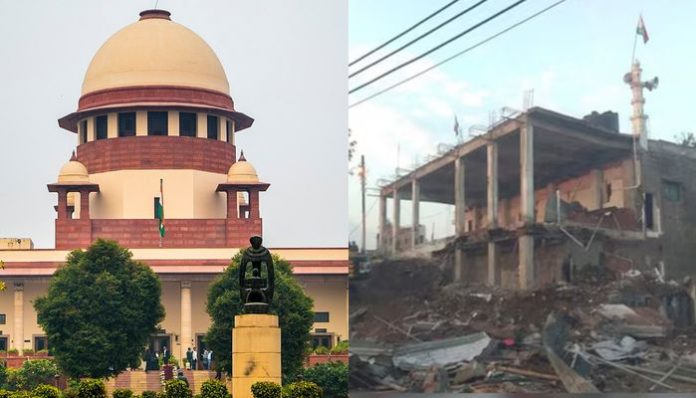
In a decisive ruling, the Supreme Court on Thursday dismissed a plea filed by Muslim devotee, Mohammed Taiyab, challenging the acquisition of land on which the Takiya Masjid stood in Ujjain, clearing the way for the expansion of the Mahakal temple complex under the ambitious Mahakal Lok Phase-II project.
A Bench of Justice Vikram Nath and Justice Sandeep Mehta ruled that the petitioner had no legal standing to question the acquisition, as he was neither the owner nor a recorded title-holder of the land. The petitioner had approached the Court as a devotee and regular worshipper at the mosque, an identity the judges held was insufficient to invoke the Court’s extraordinary jurisdiction.
“No locus, no challenge”
Senior Advocate Huzefa Ahmadi, appearing for the petitioner, argued that the entire acquisition process was vitiated by illegality. He contended that the State had bypassed mandatory safeguards under the Right to Fair Compensation and Transparency in Land Acquisition, Rehabilitation and Resettlement Act, 2013, particularly the social impact assessment required under Sections 4 to 8.
Ahmadi also submitted that the Madhya Pradesh High Court had erred in proceeding on the assumption that the acquisition stood confirmed, when in fact, according to him, the process itself was flawed from the outset.
The Bench, however, was unmoved. Repeatedly pressing the issue of locus standi, the judges pointed out that the petitioner was only an occupant and not a landowner. More crucially, the Court noted that there was no substantive challenge to the acquisition notifications themselves.
“The same question remains,” the Bench observed. “There is no challenge to the acquisition proceedings. Only to the award.”
The Court emphasised that disputes relating to compensation are squarely covered by alternative statutory remedies under the 2013 Act and cannot be dressed up as constitutional challenges.
A familiar dispute, already settled
The Takiya Masjid dispute has reached the Supreme Court more than once. Earlier, the apex court had dismissed a separate plea challenging the demolition of the mosque, filed by residents claiming to offer namaz there. That petition was rejected after the State informed the Court that the land had been lawfully acquired, compensation had been paid, and any grievance lay within the statutory framework of the land acquisition law.
The present petitioner had also approached the Madhya Pradesh High Court, which dismissed his writ petition on January 11. In a detailed judgment, the High Court upheld the acquisition for the Mahakal Lok Phase-II project and rejected multiple challenges to the land award. It held that the petitioners, who were neither recorded landowners nor title-holders, could only seek a reference on compensation under Section 64 of the 2013 Act, not question the acquisition itself.
That ruling led to the present appeal before the Supreme Court.
Claims of religious discrimination rejected
In his plea, the petitioner claimed that the acquired land was part of a Waqf property recorded with the Madhya Pradesh Waqf Board since 1985 and alleged that the mosque was demolished on January 11, 2025, the same day the High Court dismissed the earlier petitions.
He further argued that the acquisition, aimed at expanding parking and public facilities for the Mahakal temple complex, did not qualify as a valid “public purpose” under the 2013 Act. The plea alleged that the State had effectively taken land from one religious institution to benefit another, violating Articles 14, 25, 26 and 300-A of the Constitution.
Additional allegations included non-compliance with Section 91 of the Waqf Act, which mandates notice to and hearing of the Waqf Board before acquisition of Waqf land, and the misuse of urgency powers under Section 40 of the 2013 Act to bypass social impact assessment and rehabilitation safeguards.
The Supreme Court declined to entertain these claims, holding that they were raised by a petitioner who lacked the legal standing to press them before the Court.
Earlier last month, the Supreme Court had dismissed another plea challenging the Madhya Pradesh High Court order, which upheld the demolition of the Takiya mosque in Ujjain. Agreeing with the High Court’s ruling, the top court observed that the land on which the mosque stood was lawfully acquired for the expansion of the Mahakal Lok complex, a major redevelopment project linked to the Mahakaleshwar Temple, one of the 12 Jyotirlingas.
Finality for Mahakal Lok Phase-II
With Thursday’s dismissal, the Supreme Court has effectively drawn the curtain on litigation surrounding the acquisition of the Takiya Masjid land. The ruling brings finality to a long-running legal battle and clears the path for the continuation of the Mahakal Lok Phase-II project, one of Madhya Pradesh’s flagship redevelopment initiatives aimed at expanding the Mahakal temple complex and upgrading public spaces in Ujjain.
