

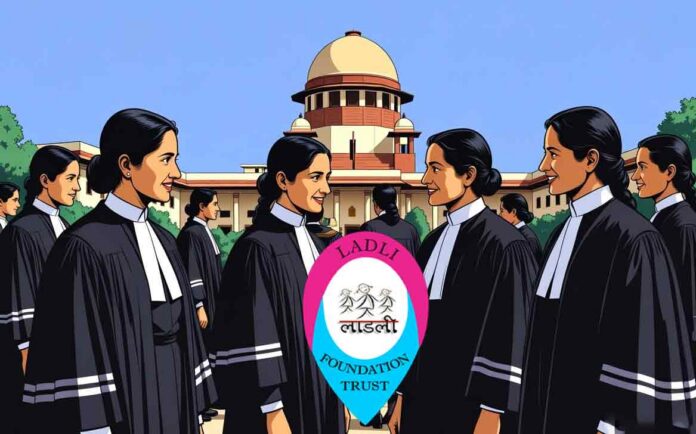
On Wednesday, 20th May, the Supreme Court sought responses from the Centre, all states and union territories on a PIL seeking 30% quota for women lawyers in government panels and law officer positions. A petition has been filed before the Supreme Court seeking 30% reservation for women lawyers in government law officer positions as well as in central and state government legal panels and those of Public Sector Undertakings (PSUs).
The plea filed by Ladli Foundation Trust has brought renewed focus on the low representation of women in India’s legal system.
SC seeks response of Centre, all states on PIL seeking 30 per cent quota for women lawyers in government panels, law officer positions. pic.twitter.com/QqX6PzyRKU
— Press Trust of India (@PTI_News) May 20, 2026
The plea highlights that women continue to remain underrepresented in key legal posts. It points out that no woman has ever been appointed as the Attorney General of India or the Solicitor General of India. It also notes that there are currently no women among the Additional Solicitors General posted across various High Courts.
The Supreme Court on Wednesday (May 20, 2026) sought responses from the Centre, all states and union territories on a PIL seeking 30 percent quota for women lawyers in government panels and law officer positions.https://t.co/IiBGLRrivT
— The Hindu (@the_hindu) May 20, 2026
According to the petitioner, this gap at senior levels has a direct impact on women’s representation in the judiciary as well. The petition argues that government law officer panels often act as “feeder pools” for judicial appointments, meaning exclusion at this stage affects future elevation to the bench.
Supreme Court observations during hearing
The matter came up briefly before a Bench headed by Chief Justice of India (CJI) Surya Kant, along with Justices Joymalya Bagchi and Vipul M Pancholi.
During the hearing on Tuesday, 19th May, CJI Surya Kant referred to a recent interaction with a woman lawyer who had expressed gratitude to the Supreme Court for earlier directions related to reservation of Bar body seats for women advocates.
He observed, “Yesterday, in the Telangana Bar Association, the Secretary was a woman appointed. She was thanking me. I enquired about the total strength of the Bar .. it is 19,000. Around 8,000 come regularly, out of which 2,000 are women. Now only one woman member appointed,” the CJI said, highlighting the gap between participation and leadership roles.
Senior Advocate and Supreme Court Bar Association (SCBA) President Vikas Singh also referred to a recent SCBA survey dealing with challenges faced by women lawyers. He urged the court to issue directions for better inclusion of women in government law officer panels.
“This is pursuant to the SCBA survey on women in the legal profession. They need to be included in government panels,” he submitted before the Bench.
Responding to concerns raised during the hearing, CJI Surya Kant also remarked on the limited work opportunities sometimes faced by women lawyers. He said, “You know there is dedicated stipends also for women members, but at times, not a single case is marked for the whole month,” pointing to practical difficulties in professional engagement.
Senior Advocate Dr Monika Gusain, also a senior executive member of the SCBA, further added that women advocates continue to face multiple structural challenges in the profession.
Petition flags deep gender imbalance in legal profession
The petition, filed by the Ladli Foundation Trust through advocate Mudit Gupta, argues that despite constitutional guarantees of equality, the legal profession continues to show a strong gender imbalance in senior positions.
It states that while women are increasingly entering law schools and joining the profession, their presence reduces significantly when it comes to positions of authority. The plea cites data suggesting that out of approximately 1.54 million enrolled advocates in India, only about 284,507 are women, making up roughly 15.31% of the legal workforce.
The petition further points to similar disparities within the judiciary. It notes that since Justice M. Fathima Beevi became the first woman judge of the Supreme Court in 1989, only 11 women have been elevated to the apex court. At present, women constitute about 5.88% of Supreme Court judges and around 13.76% of High Court judges.
It also highlights findings from the India Justice Report 2022, which states that 13 out of 17 large states have less than 30% women panel lawyers, with some states showing extremely low representation.
According to the petitioner, this under representation at the level of government law officer panels directly affects women’s career growth and their chances of reaching higher judicial and leadership roles. The matter is scheduled for further hearing next week.
