

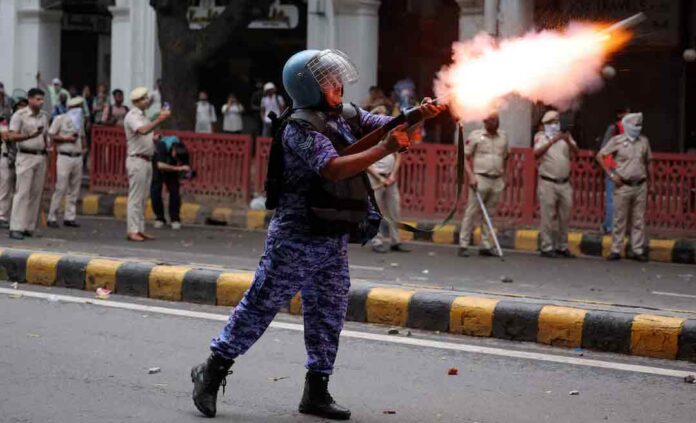
The Supreme Court on Thursday declined to impose a blanket ban on the use of pellet guns by police and paramilitary forces for crowd control, observing that law enforcement agencies are empowered to deploy them in exceptional situations as part of a graded response.
A bench comprising Chief Justice of India Surya Kant and Justices Joymalya Bagchi and V. Mohana was hearing a petition filed by former Intelligence Bureau Special Director and Central Information Commissioner Yashovardhan Azad, along with two individuals, Prashant Kumar Singh and Sheikh Irshad Mansoori, who claimed they sustained pellet injuries during the July 20 “Sansad Chalo” march led by Cockroach Janta Party against the alleged NEET paper leak.
The petitioners, represented by advocate Vrinda Grover, sought a nationwide ban or decommissioning of wholly or partly metallic kinetic projectiles/pellets fired from pump-action or projectile-action guns for dispersing civilian assemblies. They also prayed for exemplary compensation, full medical treatment, care and rehabilitation for all those injured in the July 20 incident, arguing that the unpredictable trajectory of pellets makes them inherently disproportionate, arbitrary and dangerous for crowd control, with a high risk of permanent injury to eyes and vital organs. They cited UN guidelines on less-lethal weapons and principles of necessity and proportionality under Indian law.
However, the court declined to issue any ban on pellets, saying that the petition must challenge the regulations that allow the use of its use. Justice Bagchi observed that existing police rules and the Bureau of Police Research and Development (BPRD) advisory already permit the use of pellet guns only in exceptional circumstances as one step in a graded approach to force. The bench said that without challenging the validity of those regulations themselves, a prayer for a complete ban was “vague.”
Justice Bagchi said, “Police rules allows the use in exceptional circumstances unless you challenge the rules itself. One of the steps of graded approach is use of pellet guns. In light of alleged excessive use, your prayer should be that court lays down a protocol regarding the use.”
The court further said, “In Calcutta, there was a rule that bullets should be fired at the chest to preserve ammunition and not any other body area. that rule was struck down. So you have to show us rules where use of pellets is arbitrary, etc.”
The bench noted that in extreme violent situations, police are permitted to use live bullets if milder measures fail, and questioned how pellet guns could be barred when a protest turns violent after being hijacked by miscreants. The court indicated it was open to examining the specific use of pellets in the July 20 incident and possibly framing protocols against excessive or arbitrary deployment, but asked the petitioners to amend their plea accordingly.
On the plea for compensation to those injured during the 20 July violent protests, the court directed the Delhi government to ensure adequate medical treatment for the injured petitioners and other similarly placed persons who suffered pellet-gun injuries. It also asked the Centre to preserve the ammunition log of the Rapid Action Force (RAF) deployed at the site and sought details of the relevant standard operating procedures (SOPs) governing the use of such weapons. Solicitor General Tushar Mehta assured the court that necessary records would be preserved and that assistance would be provided.
CRPF sources have maintained that standard operating procedures and anti-riot drills were followed on July 20, with non-lethal pellet guns used only after public announcements, tear gas and lathi charge proved insufficient, and that force gradient principles were observed. A small number of protesters were reported injured by metal pellets, while dozens of RAF personnel also sustained injuries.
The matter has been adjourned for further hearing after the petitioners amend their pleadings and the Centre places the relevant rules and SOPs on record. The court’s interim directions focus on medical care for the injured and preservation of evidence rather than any immediate prohibition on the weapons.
