

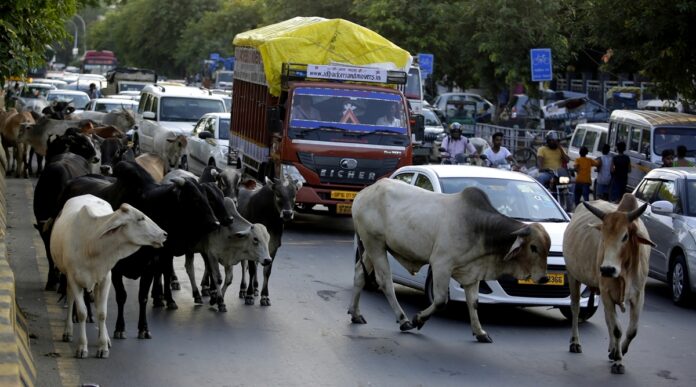
Expressing deep concern over the growing menace of stray cattle and bovines on roads and highways across the country, the Supreme Court of India has observed that such animals “are not meant to be natural speed breakers, placed willy-nilly on the National Highways, roads and streets.” In a judgment delivered on 31 July 2026, a Bench of Justice Sanjay Karol and Justice Nongmeikapam Kotiswar Singh noted that bovine-related incidents leading to injury or death of humans have become commonplace and demand urgent attention from both the Centre and the States.
The Court referred to official statistics showing that 1,130 persons were killed by accidents related to animals in 2018, 1,425 in 2019 and 1,305 in 2020. It recalled that India remains primarily an agrarian economy in which cows, bulls and other bovines form an indispensable part of rural life, a reality recognised in Article 48 of the Constitution and the fundamental duty under Article 51-A(g) to have compassion for living creatures. The Bench examined the Prevention of Cruelty to Animals Act, 1960, the Cattle Trespass Act, 1871, and the web of State legislations that provide for gaushalas, pinjrapoles and institutions for uneconomic cattle. It emphasised that the problem is not merely one of animal welfare but also of public safety, as abandoned or free-grazing animals frequently cause collisions with vehicles or attack pedestrians.
Against this backdrop, the Court issued a set of suggestions for consideration and implementation by the Central and State Governments. All States that have enacted laws relating to cattle must ensure their complete and immediate implementation in letter and spirit. Necessary amendments or rules should be framed to create a clear mechanism for payment of compensation in accidents caused by bovine or cattle, whether the victim is a pedestrian or a person travelling in a vehicle. Tagging of all animals should be made mandatory so that they can be tracked, linked to veterinary check-ups and vaccinations.
Owners who choose to abandon animals after they cease to serve an economic purpose must ensure their safe transfer to authorised shelters; the shelters must issue receipts and update the tagging database. Every municipal corporation or department should appoint a nodal officer responsible for tagging, digitisation of records and the smooth running of shelters. A copy of the judgment has been directed to be sent to the Chief Secretaries of all States, Administrators of all Union Territories and the Member Secretaries of the State Legal Services Authorities for appropriate action.
These observations and directions came in the case of an appeal filed by a widow seeking compensation for the death of her husband in an animal related incident. The appellant Nisha is the widow of Vijay Kumar, who was attacked by a stray bull while walking on a road in Sangrur on 21 September 2007. He suffered a severe head injury, remained unconscious for a prolonged period and later died. A DDR entry and FIR were registered, and before his death he had approached the authorities for compensation without success.
After his death, his widow filed a writ petition in 2010. A Single Judge of the Punjab and Haryana High Court awarded ₹29.32 lakh with interest in 2019 by applying the principles of the Motor Vehicles Act. The Division Bench, however, set aside that order in November 2025 on the ground that disputed questions of fact could not be decided under Article 226 and relegated the family to a civil suit.
The Supreme Court reversed the Division Bench order, holding that after nearly two decades of litigation the claimants could not be left remediless, especially when the occurrence of the incident itself had never been disputed by the authorities. Taking into account the long pendency of the matter and the severe injury suffered by the deceased, the Court awarded a lump-sum compensation of ₹15 lakh, payable within four weeks. It clarified that the award was made in the peculiar facts of the case and shall not be treated as a precedent.
